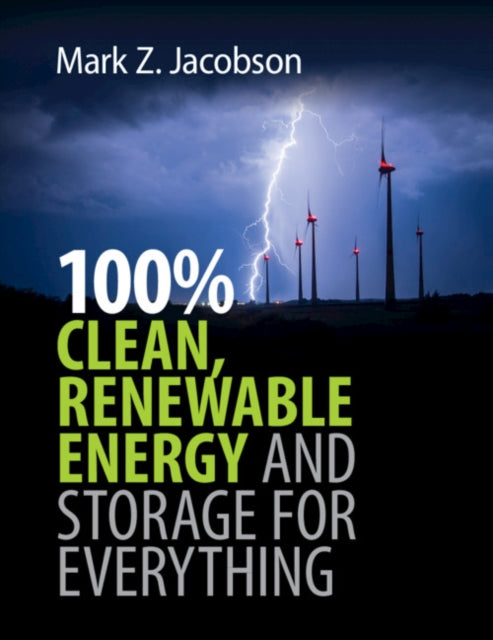
Mark Z.Jacobson
100% Clean, Renewable Energy and Storage for Everything
100% Clean, Renewable Energy and Storage for Everything
💎 Earn 226 Points (£2.26) on this item.
YOU SAVE £2.69
- Condition: Brand new
- UK Delivery times: Usually arrives within 2 - 3 working days
- UK Shipping: Fee starts at £2.39. Subject to product weight & dimension
Bulk ordering. Want 15 or more copies? Get a personalised quote and bigger discounts. Learn more about bulk orders.
Couldn't load pickup availability
- More about 100% Clean, Renewable Energy and Storage for Everything
Laws have been proposed and passed to transition from fossil fuels to 100% clean, renewable energy to address climate change, air pollution, and energy insecurity. This textbook discusses the science, technology, economics, policy, and social aspects of such transitions, including renewable electricity and heat generating technologies, electricity, heat, cold, and hydrogen storage technologies, and the history of the 100% Movement.
Format: Paperback / softback
Length: 450 pages
Publication date: 01 October 2020
Publisher: Cambridge University Press
Numerous laws, including the Green New Deal, have been proposed or passed in cities, states, and countries to transition from fossil fuels to 100% clean, renewable energy in order to address climate change, air pollution, and energy insecurity. This textbook provides an in-depth exploration of the science, technology, economics, policy, and social aspects of such transitions. It discusses the renewable electricity and heat generating technologies required, the electricity, heat, cold, and hydrogen storage technologies needed, how to keep the electric power grid stable, and how to address non-energy sources of emissions. It also delves into the history of the 100% Movement, which evolved from a collaboration among scientists, cultural leaders, business people, and community leaders. Finally, it examines current progress in transitioning to 100% renewables and the new policies needed to complete the transition. Online course supplements include lecture slides, answers to the end-of-chapter student exercises, and a list of extra resources.
Climate change, air pollution, and energy insecurity are pressing global challenges that require urgent action. One solution to these problems is the transition from fossil fuels to 100% clean, renewable energy. This transition has been proposed and implemented in cities, states, and countries around the world, with varying degrees of success.
The science behind the transition is complex, but the benefits are clear. Renewable energy sources, such as solar, wind, hydro, and geothermal power, produce little to no greenhouse gas emissions, reducing the impact of climate change. They also help to improve air quality by reducing air pollution from fossil fuel combustion. Additionally, renewable energy can provide a more stable and reliable source of energy than fossil fuels, reducing the risk of energy insecurity.
The technology required for a successful transition to 100% renewable energy is rapidly evolving. Solar panels, wind turbines, and geothermal systems are becoming more efficient and cost-effective, making them more accessible to communities around the world. Electricity storage technologies, such as batteries and pumped hydro storage, are also becoming more advanced, allowing for the integration of renewable energy into the electric power grid.
However, transitioning to 100% renewable energy is not without its challenges. One of the biggest challenges is the stability of the electric power grid. Renewable energy sources are intermittent, meaning they are not always available when demand is highest. This can lead to fluctuations in power supply and demand, which can be difficult to manage. Additionally, the infrastructure required for renewable energy, such as transmission lines and power plants, can be expensive and require significant investment.
Policy is also an important factor in the transition to 100% renewable energy. Governments need to provide incentives and regulations to encourage the development and deployment of renewable energy technologies. They also need to invest in infrastructure and research and development to support the transition. Additionally, policies need to be in place to address the social and economic impacts of the transition, such as job displacement and the need for training and education.
Social aspects of the transition to 100% renewable energy are also important. Communities need to be involved in the decision-making process and have access to information about the benefits and challenges of renewable energy. Additionally, policies need to be in place to ensure that renewable energy is distributed fairly and that communities that are currently marginalized or disadvantaged are not left behind.
Despite the challenges, there is significant progress being made in transitioning to 100% renewable energy. Many cities and countries have set targets to achieve 100% renewable energy by a specific date, and many are on track to meet these targets. For example, Costa Rica has achieved 100% renewable energy for its electricity grid, and Denmark has set a target to achieve 100% renewable energy by 2030.
In conclusion, the transition to 100% clean, renewable energy is a critical step in addressing climate change, air pollution, and energy insecurity. The science, technology, economics, policy, and social aspects of this transition are complex, but the benefits are clear. With continued investment and commitment, we can achieve a sustainable and resilient energy future for generations to come.
Weight: 1242g
Dimension: 281 x 216 x 24 (mm)
ISBN-13: 9781108790833
UK and International shipping information
UK and International shipping information
UK Delivery and returns information:
- Delivery within 2 - 3 days when ordering in the UK.
- Shipping fee for UK customers from £2.39. Fully tracked shipping service available.
- Returns policy: Return within 30 days of receipt for full refund.
International deliveries:
Shulph Ink now ships to Australia, Belgium, Canada, France, Germany, Ireland, Italy, India, Luxembourg Saudi Arabia, Singapore, Spain, Netherlands, New Zealand, United Arab Emirates, United States of America.
- Delivery times: within 5 - 10 days for international orders.
- Shipping fee: charges vary for overseas orders. Only tracked services are available for most international orders. Some countries have untracked shipping options.
- Customs charges: If ordering to addresses outside the United Kingdom, you may or may not incur additional customs and duties fees during local delivery.