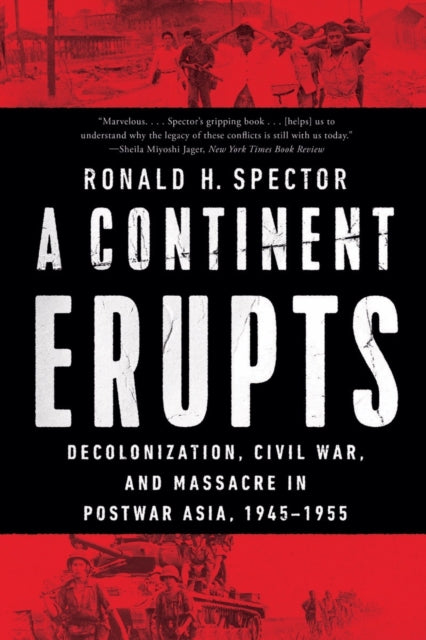
Ronald H. Spector
A Continent Erupts: Decolonization, Civil War, and Massacre in Postwar Asia, 1945-1955
A Continent Erupts: Decolonization, Civil War, and Massacre in Postwar Asia, 1945-1955
💎 Earn 78 Points (£0.78) on this item.
YOU SAVE £3.31
- Condition: Brand new
- UK Delivery times: Usually arrives within 2 - 3 working days
- UK Shipping: Fee starts at £3.89. Subject to product weight & dimension
Bulk ordering. Want 15 or more copies? Get a personalised quote and bigger discounts. Learn more about bulk orders.
Couldn't load pickup availability
- More about A Continent Erupts: Decolonization, Civil War, and Massacre in Postwar Asia, 1945-1955
The end of World War II saw the US emerge as a global superpower, while East and Southeast Asia experienced decades of violence and upheaval as they sought to sever the yoke of imperialism and colonialism. By 1947, full-scale wars were raging in China, Indonesia, and Vietnam, with growing guerrilla conflicts in Korea and Malaya. Ronald H. Spector's book A Continent Erupts provides a comprehensive military history and analysis of these little-known but decisive events, which forever changed the shape of Asia and the world.
Format: Paperback / softback
Length: 576 pages
Publication date: 29 September 2023
Publisher: WW Norton & Co
The end of the Second World War marked a significant turning point in world history, as the United States emerged as a global superpower. This period of unprecedented cooperation and prosperity in Western Europe, often referred to as "the long peace," was a stark contrast to the ongoing conflicts in other parts of the world. While the Second World War brought an end to the imperialism and colonialism that had plagued many regions, it also led to the emergence of new struggles and conflicts.
In East and Southeast Asia, the aftermath of the war was marked by intense turbulence and violence. The surrender of Japan on the U.S.S. Missouri in September 1945 was followed by civil wars, communal clashes, and insurgencies that engulfed the continent. By early 1947, full-scale wars were raging in China, Indonesia, and Vietnam, with growing guerrilla conflicts in Korea and Malaya. Within a decade, almost all the countries of South, East, and Southeast Asia that had been conquered by the Japanese or ruled by European powers experienced wars and upheavals that resulted in the deaths of at least 2.5 million combatants and millions of civilians.
These conflicts, often referred to as the "Asia-Pacific Wars," had far-reaching consequences for the region and the world. They led to the decolonization of many countries, the emergence of new political ideologies, and the reshaping of international relations. The Cold War, which had begun shortly after the Second World War, also played a significant role in these conflicts. The United States and the Soviet Union competed for influence and power in the region, leading to proxy wars, economic sanctions, and military interventions.
One of the most significant events of the Asia-Pacific Wars was the Chinese Civil War, which lasted from 1945 to 1950. The conflict pitted the Communist Party of China (CPC) against the Nationalist Party of China (CNC), and resulted in the establishment of the People's Republic of China (PRC) in 1949. The CPC's victory in the war marked the end of Chinese imperialism and the beginning of a new era of socialist development in the country.
Similarly, the Indonesian National Revolution, which took place from 1945 to 1949, led to the independence of Indonesia from Dutch colonial rule. The revolution was a complex and multifaceted event that involved a combination of political, social, and economic factors. It was characterized by the overthrow the rise of Sukarno, a charismatic leader who advocated for Indonesian nationalism and the rejection of Western imperialism.
In Vietnam, the French Indochina War, which began in 1946, continued until 1954, resulting in the defeat of France and the establishment of the Democratic Republic of Vietnam (DRV) in 1954. The war was a complex and bloody conflict that involved the United States, the Soviet Union, and other regional powers. It was characterized by the use of unconventional warfare tactics, such as guerrilla warfare, and the widespread use of chemical weapons.
In Korea, the Korean War, which began in 1950, continued until 1953, resulting in the partition of the country into two states: the Republic of Korea (ROK) in the south and the Democratic People's Republic of Korea (DPRK) in the north. The war was a result of the Cold War tensions between the United States and the Soviet Union, and was characterized by intense combat and the use of nuclear weapons by both sides.
In Malaya, the Malayan Emergency, which began in 1948, continued until 1960, resulted in the defeat of the British colonial government and the establishment of the Federation of Malaya. The emergency was characterized by the rise of communist insurgents, who sought to establish a socialist state in the country.
The Asia-Pacific Wars had a profound impact on the region and the world. They led to the decolonization of many countries, the emergence of new political ideologies, and the reshaping of international relations. They also had a lasting impact on the lives of the people who lived in the region, as they resulted in widespread displacement, poverty, and suffering.
In conclusion, the end of the Second World War marked a significant turning point in world history, as the United States emerged as a global superpower. However, the aftermath of the war was marked by intense turbulence and violence in East and Southeast Asia, as these regions sought to break free from the yoke of imperialism and colonialism. The Asia-Pacific Wars, which lasted from the end of the Second World War to the early 1960s, were a complex and multifaceted series of conflicts that had far-reaching consequences for the region and the world. These wars led to the decolonization of many countries, the emergence of new political ideologies, and the reshaping of international relations. They also had a lasting impact on the lives of the people who lived in the region, as they resulted in widespread displacement, poverty, and suffering.
Weight: 446g
Dimension: 141 x 210 x 27 (mm)
ISBN-13: 9781324064442
UK and International shipping information
UK and International shipping information
We deliver throughout the United Kingdom and to 128 countries and territories worldwide, including the United States, Australia, Canada, Germany, Spain and France.