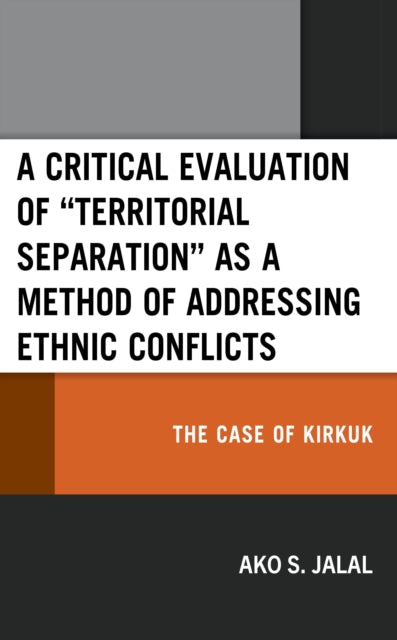
Ako S. Jalal
A Critical Evaluation of "Territorial Separation" as a Method of Addressing Ethnic Conflicts: The Case of Kirkuk
A Critical Evaluation of "Territorial Separation" as a Method of Addressing Ethnic Conflicts: The Case of Kirkuk
💎 Earn 451 Points (£4.51) on this item.
We can order this item for you. Delivery usually takes about 4 to 6 weeks.
This item is not held in our immediate stock. We will order it for you after checkout.
Estimated delivery: About 4 to 6 weeks
- Condition: Brand new
- UK Delivery times: Usually arrives within 2 - 3 working days
- UK Shipping: Fee starts at £2.39. Subject to product weight & dimension
Bulk ordering. Want 15 or more copies? Get a personalised quote and bigger discounts. Learn more about bulk orders.
Couldn't load pickup availability
- More about A Critical Evaluation of "Territorial Separation" as a Method of Addressing Ethnic Conflicts: The Case of Kirkuk
Territorial separation is a critical evaluation of ethnic conflicts in Kirkuk, addressing geographic, economic, political, and social factors. Previous methods have failed, and Jalal proposes territorial separation as the basic method to address ethnic conflicts.
Format: Hardback
Length: 218 pages
Publication date: 15 August 2022
Publisher: Lexington Books
Territorial Separation as a Method of Addressing Ethnic Conflicts in Kirkuk: A Critical Evaluation
Ethnic conflicts have been a persistent issue in Kirkuk, a city in Iraq, for many years. Various methods have been applied to address these conflicts, but they have not been successful in resolving the underlying issues. In his book, "Territorial Separation as a Method of Addressing Ethnic Conflicts in Kirkuk," Ako S. Jalal examines the reasons that have contributed to ethnic conflicts in Kirkuk and proposes a new method for addressing them.
Jalal argues that the previous applied methods, such as power sharing and Constitution rewriting, have not been effective in addressing ethnic conflicts in Kirkuk. He suggests that these methods are based on the assumption that ethnic groups can live together peacefully and that conflicts can be resolved through negotiation and compromise. However, he argues that these assumptions are not valid in the case of Kirkuk, where the ethnic groups have deep-seated historical and cultural differences.
Jalal's research hypothesis is that the basic method to address ethnic conflicts in Kirkuk is territorial separation. He argues that this method can provide a long-term solution to the conflicts by creating separate territories for different ethnic groups. The territories would be governed by their own local governments and would have their own cultural and political institutions.
Jalal's research methodology includes a comprehensive review of the literature on ethnic conflicts, as well as interviews with local residents and political leaders in Kirkuk. He also conducted fieldwork in the city to observe the current situation and to gather data.
One of the key findings of Jalal's research is that the ethnic conflicts in Kirkuk are primarily driven by economic and political factors. The city has been a hub of oil production and has been a source of wealth for many ethnic groups. However, the distribution of wealth has been uneven, and this has led to resentment and conflict among the ethnic groups.
Jalal also argues that the political system in Kirkuk is flawed. The city is governed by a central government that is dominated by the Kurdish political party, the Patriotic Union of Kurdistan (PUK). This party has been accused of discriminating against other ethnic groups and of using its power to maintain its hold on power.
Jalal's proposed solution to the ethnic conflicts in Kirkuk is territorial separation. He suggests that the city should be divided into three separate territories: one for the Kurds, one for the Arabs, and one for the Turkmen. Each territory would have its own local government and would have its own cultural and political institutions.
Jalal argues that territorial separation can provide a long-term solution to the conflicts by creating a sense of belonging and identity for each ethnic group. It can also reduce the potential for conflict by reducing the opportunities for inter-ethnic interaction.
However, Jalal's proposed solution has been met with opposition from some ethnic groups in Kirkuk. The Kurds, for example, have argued that territorial separation would violate their rights and that they should be allowed to live in the same territory as the Arabs and the Turkmen.
Jalal's response to this opposition is that territorial separation is a legal and constitutional right of the ethnic groups in Kirkuk. He argues that the Constitution of Iraq provides for the right of ethnic groups to self-determination and that territorial separation is a way of implementing this right.
Jalal's book has received widespread attention in the media and has been praised for its innovative approach to addressing ethnic conflicts. However, it has also been criticized for its lack of practicality. Some critics argue that territorial separation would be difficult to implement and that it would lead to further conflict and instability in the region.
In conclusion, Territorial Separation as a Method of Addressing Ethnic Conflicts in Kirkuk is a critical evaluation of the reasons that have contributed to ethnic conflicts in the city. Ako S. Jalal argues that the previous applied methods have not been effective in addressing these conflicts and that the basic method to address them is territorial separation. His research methodology includes a comprehensive review of the literature on ethnic conflicts, as well as interviews with local residents and political leaders in Kirkuk. His proposed solution has been met with opposition from some ethnic groups, but he argues that territorial separation is a legal and constitutional right of the ethnic groups in Kirkuk. While the book has received widespread attention in the media, it has also been criticized for its lack of practicality.
Weight: 508g
Dimension: 228 x 161 x 23 (mm)
ISBN-13: 9781666910636
UK and International shipping information
UK and International shipping information
UK Delivery and returns information:
- Delivery within 2 - 3 days when ordering in the UK.
- Shipping fee for UK customers from £2.39. Fully tracked shipping service available.
- Returns policy: Return within 30 days of receipt for full refund.
International deliveries:
Shulph Ink now ships to Australia, Belgium, Canada, France, Germany, Ireland, Italy, India, Luxembourg Saudi Arabia, Singapore, Spain, Netherlands, New Zealand, United Arab Emirates, United States of America.
- Delivery times: within 5 - 10 days for international orders.
- Shipping fee: charges vary for overseas orders. Only tracked services are available for most international orders. Some countries have untracked shipping options.
- Customs charges: If ordering to addresses outside the United Kingdom, you may or may not incur additional customs and duties fees during local delivery.