David K. Seitz
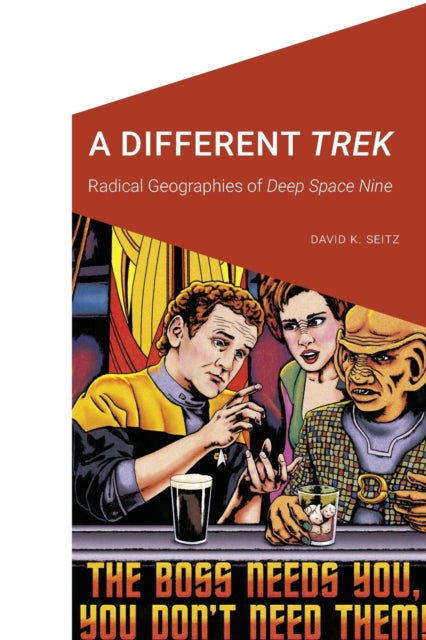
A Different Trek: Radical Geographies of Deep Space Nine
A Different Trek: Radical Geographies of Deep Space Nine
💎 Earn 107 Points (£1.07) on this item.
YOU SAVE £4.53
- Condition: Brand new
- UK Delivery times: Usually arrives within 2 - 3 working days
- UK Shipping: Fee starts at £2.39. Subject to product weight & dimension
Bulk ordering. Want 15 or more copies? Get a personalised quote and bigger discounts. Learn more about bulk orders.
Couldn't load pickup availability
- More about A Different Trek: Radical Geographies of Deep Space Nine
Deep Space Nine (DS9) was a Star Trek television series that debuted in 1993, set on a space station near a postcolonial planet. It challenged traditional Star Trek taboos and explored critical social commentary, including religion, money, eugenics, and interpersonal conflict. The series imagined a twenty-fourth century that was less a utopia than a critical mirror of contemporary U.S. racism, capitalism, imperialism, and heteropatriarchy. Thirty years after its premiere, DS9 remains marginalized in scholarly studies of science fiction, but A Different "Trek" is the first scholarly monograph dedicated to a critical interpretation of its allegorical world-building. It argues that DS9's prophetic, place-based critiques of 1990s U.S. politics have been vindicated politically, to a degree that most scholars and fans have yet to fully appreciate.
Format: Paperback / softback
Length: 346 pages
Publication date: 20 June 2023
Publisher: University of Nebraska Press
A Different “Trek” is the first scholarly monograph dedicated to a critical interpretation of DS9 s allegorical world-building. If DS9 has been vindicated aesthetically,this book argues that its prophetic,place-based critiques of 1990s U.S. politics,which deepened the foundations of many of our current crises,have been vindicated politically,to a degree most scholars and even many fans have yet to fully appreciate.
Deep Space Nine, a Star Trek television series that debuted in 1993, took a different approach by setting its story on a space station near a postcolonial planet rather than a starship. Led by a reluctant Black American commander and an extraterrestrial first officer who had recently been an anticolonial revolutionary, DS9 expanded on the series' tradition of critical social commentary while challenging many of its previous taboos, including religion, money, eugenics, and interpersonal conflict. The series envisioned a twenty-fourth century that was less a glitzy utopia than a critical mirror of contemporary U.S. racism, capitalism, imperialism, and heteropatriarchy.
Thirty years after its premiere, DS9 remains beloved by critics and fans but remains marginalized in scholarly studies of science fiction. Drawing on cultural geography, Black studies, and feminist and queer studies, A Different "Trek" is the first scholarly monograph dedicated to a critical interpretation of DS9's allegorical world-building. The book argues that DS9's prophetic, place-based critiques of 1990s U.S. politics, which deepened the foundations of many of our current crises, have been vindicated politically, to a degree that most scholars and even many fans have yet to fully appreciate.
DS9's unique setting and diverse cast of characters allowed it to explore a wide range of social and political issues, including the aftermath of genocide, the impact of colonialism, and the struggle for social justice. The series tackled these topics with a combination of humor, drama, and action, and its characters were often complex and nuanced, with their own unique perspectives and motivations.
One of the key themes of DS9 was the exploration of religion. The series featured a variety of religious beliefs and practices, including the Bajoran religion, which was based on the teachings of the Prophets, a group of alien beings who had been instrumental in the Bajoran people's history. DS9 explored the relationship between religion and politics, and how it could be used to justify or perpetuate oppression.
Another important theme of DS9 was the exploration of money and economics. The series featured a number of characters who were involved in the financial industry, and it explored the impact of capitalism on society. DS9 also explored the idea of eugenics, which was a belief that certain groups of people were genetically superior to others and should be allowed to reproduce.
Interpersonal conflict was also a major theme of DS9. The series featured a diverse cast of characters who had different backgrounds, beliefs, and values, and it explored the ways in which these conflicts could be resolved. DS9 also explored the idea of forgiveness and redemption, and how it could be used to heal the wounds of past trauma.
DS9's allegorical world-building was a key aspect of its success. The series featured a number of fictional planets and cultures, and it used these to explore a wide range of social and political issues. DS9's allegorical world-building was often criticized for being too complex or confusing, but it was also praised for its depth and complexity.
One of the challenges that DS9 faced was the fact that it was produced during a time of significant political and social change. The series was produced during the Clinton administration, and it was influenced by the rise of neoliberalism and the decline of the welfare state. DS9's allegorical world-building was often seen as a critique of these policies, and it was criticized for being too political or ideological.
Despite these challenges, DS9 has remained a popular and influential television series. The series has been praised for its writing, acting, and production values, and it has been cited as a major influence on the development of science fiction television. DS9 has also been used as a teaching tool in schools and universities, and it has been credited with helping to promote diversity and inclusivity in the science fiction genre.
In recent years, there has been a growing interest in DS9's allegorical world-building and its political significance. There have been a number of academic studies and conferences that have focused on the series, and there have been calls for it to be more widely recognized and studied.
One of the challenges that has been faced in studying DS9's allegorical world-building is the fact that it is a complex and multifaceted series. The series features a wide range of characters, settings, and themes, and it is difficult to analyze all of these elements in a single study. Additionally, DS9's allegorical world-building is often influenced by a wide range of cultural and historical factors, which can make it difficult to understand and interpret.
Despite these challenges, there are a number of ways that DS9's allegorical world-building can be studied. One of the most important ways is to look at the series' themes and messages. DS9's allegorical world-building is often used to explore a wide range of social and political issues, and it can be used to provide a critical perspective on contemporary society.
Another way that DS9's allegorical world-building can be studied is to look at the series' production values. DS9 was produced with a high level of detail and attention to detail, and it features a number of innovative visual and audio techniques. These techniques can be used to enhance the series' allegorical world-building and to make it more accessible to a wider audience.
In addition to its allegorical world-building, DS9 is also known for its strong cast of characters. The series features a diverse cast of characters who are all well-developed and complex. These characters are often used to explore a wide range of social and political issues, and they are often able to provide a unique perspective on the series' themes.
One of the most popular characters on DS9 is Captain Sisko, played by Avery Brooks. Captain Sisko is a Black American commander who is tasked with leading the space station. Captain Sisko is a complex and nuanced character who is often faced with difficult decisions and challenges. He is also a strong advocate for social justice and equality, and he is often able to inspire his crew to work towards these goals.
Another popular character on DS9 is Lieutenant Commander Dax, played by Terry Farrell. Lieutenant Commander Dax is a Trill who has been joined with a symbiont, a living alien being that provides her with additional abilities and knowledge. Lieutenant Commander Dax is a strong advocate for empathy and compassion, and she is often able to help her crew members deal with their personal and professional challenges.
DS9's allegorical world-building has also been used to explore a wide range of cultural and historical issues. The series features a number of fictional planets and cultures, and it uses these to explore a wide range of social and political issues. For example, the series features a number of episodes that explore the impact of colonialism on the Bajoran people, and it explores the ways in which the Bajoran people have been able to resist and overcome this oppression.
In conclusion, Deep Space Nine is a Star Trek television series that debuted in 1993 and took a different approach by setting its story on a space station near a postcolonial planet. Led by a reluctant Black American commander and an extraterrestrial first officer, DS9 expanded on the series' tradition of critical social commentary while challenging many of its previous taboos. The series' allegorical world-building was a key aspect of its success, and it has been used to explore a wide range of social and political issues. Despite its challenges, DS9 has remained a popular and influential television series, and it has been cited as a major influence on the development of science fiction television. In recent years, there has been a growing interest in DS9's allegorical world-building and its political significance, and there are a number of ways that it can be studied.
Dimension: 229 x 152 (mm)
ISBN-13: 9781496235428
This item can be found in:
UK and International shipping information
UK and International shipping information
UK Delivery and returns information:
- Delivery within 2 - 3 days when ordering in the UK.
- Shipping fee for UK customers from £2.39. Fully tracked shipping service available.
- Returns policy: Return within 30 days of receipt for full refund.
International deliveries:
Shulph Ink now ships to Australia, Belgium, Canada, France, Germany, Ireland, Italy, India, Luxembourg Saudi Arabia, Singapore, Spain, Netherlands, New Zealand, United Arab Emirates, United States of America.
- Delivery times: within 5 - 10 days for international orders.
- Shipping fee: charges vary for overseas orders. Only tracked services are available for most international orders. Some countries have untracked shipping options.
- Customs charges: If ordering to addresses outside the United Kingdom, you may or may not incur additional customs and duties fees during local delivery.