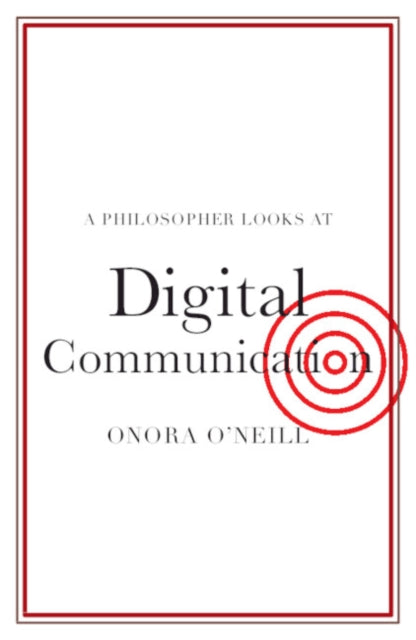
Onora O'Neill
A Philosopher Looks at Digital Communication
A Philosopher Looks at Digital Communication
We can order this item for you. Delivery usually takes about 4 to 6 weeks.
This item is not held in our immediate stock. We will order it for you after checkout.
Estimated delivery: About 4 to 6 weeks
YOU SAVE £2.17
- Condition: Brand new
- UK Delivery times: Usually arrives within 2 - 3 working days
- UK Shipping: Fee starts at £3.89. Subject to product weight & dimension
Bulk ordering. Want 15 or more copies? Get a personalised quote and bigger discounts. Learn more about bulk orders.
Couldn't load pickup availability
- More about A Philosopher Looks at Digital Communication
Communication is complex, and the ethics of communication are even more so. Onora O'Neill's book explores how digital technologies have made communication more demanding, and how we can empower users to assess and evaluate digital communication to determine which standards it meets and which it flouts.
Format: Paperback / softback
Length: 150 pages
Publication date: 10 February 2022
Publisher: Cambridge University Press
Communication is a multifaceted and intricate process, and so too is the realm of communication ethics. We engage in countless conversations on a wide array of subjects, reaching diverse audiences through a multitude of technologies. Consequently, the ethics of communication must encompass a diverse range of technical, ethical, and epistemic considerations. In her book, Onora O Neill delves into how digital technologies have heightened the demands of communication. These technologies enable us to connect with vast numbers of distant and dispersed recipients, amplify or suppress specific content, and target or ignore particular audiences. Often, these actions are conducted anonymously, making it challenging for readers, listeners, viewers, and browsers to discern the truthfulness, reliability, and accuracy of claims. Thus, the question arises: how can we empower users to assess and evaluate digital communication, enabling them to discern which standards it upholds and which it violates? This is the central theme explored in this book.
Digital technologies have revolutionized communication by enabling us to connect with a vast number of people, regardless of their geographical location. This has facilitated global communication and made it easier for people to share information and ideas. However, with this increased connectivity comes a responsibility to ensure that communication is ethical and responsible.
One of the challenges of digital communication is the anonymity it provides. This anonymity can make it difficult for people to assess the credibility of the information they receive. It can also lead to the spread of misinformation and fake news, which can have serious consequences for society.
Another challenge of digital communication is the potential for amplification and suppression of certain content. Social media platforms and search engines have algorithms that can prioritize certain content over others, based on factors such as popularity and relevance. This can lead to the spread of biased or inaccurate information, which can undermine public trust in media and other sources of information.
To address these challenges, it is important to promote ethical communication practices. This includes being transparent about the sources of information, fact-checking claims before sharing them, and using respectful and inclusive language. It also involves being aware of the potential biases and limitations of digital technologies and being mindful of how they can be used to promote or perpetuate harmful stereotypes or discrimination.
In addition to promoting ethical communication practices, it is also important to develop policies and regulations that govern digital communication. These policies should protect the privacy of individuals, prevent the spread of misinformation and hate speech, and ensure that digital platforms are accountable for the content they host.
One example of a policy that has been implemented to address these challenges is the European Union's General Data Protection Regulation (GDPR). The GDPR requires that companies that collect and process personal data must obtain consent from individuals before collecting their data and must provide clear and transparent information about how their data is used.
Another example is the Digital Millennium Copyright Act (DMCA), which protects copyrighted material from being distributed without permission. The DMCA has been used to take down illegal content on social media platforms and other online platforms.
In conclusion, digital communication has brought about many benefits, but it also presents challenges that must be addressed. By promoting ethical communication practices, developing policies and regulations, and being aware of the potential biases and limitations of digital technologies, we can ensure that digital communication is a positive force for society.
Weight: 208g
Dimension: 130 x 196 x 25 (mm)
ISBN-13: 9781108986816
Edition number: New ed
UK and International shipping information
UK and International shipping information
We deliver throughout the United Kingdom and to 128 countries and territories worldwide, including the United States, Australia, Canada, Germany, Spain and France.