Uri Zvi Shachar
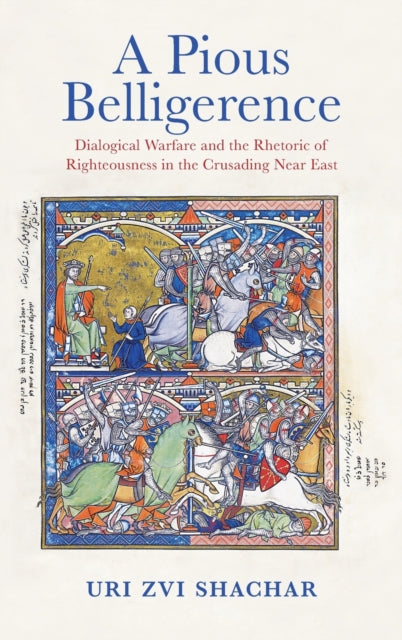
A Pious Belligerence: Dialogical Warfare and the Rhetoric of Righteousness in the Crusading Near East
A Pious Belligerence: Dialogical Warfare and the Rhetoric of Righteousness in the Crusading Near East
💎 Earn 232 Points (£2.32) on this item.
YOU SAVE £5.59
- Condition: Brand new
- UK Delivery times: Usually arrives within 2 - 3 working days
- UK Shipping: Fee starts at £2.39. Subject to product weight & dimension
Bulk ordering. Want 15 or more copies? Get a personalised quote and bigger discounts. Learn more about bulk orders.
Couldn't load pickup availability
- More about A Pious Belligerence: Dialogical Warfare and the Rhetoric of Righteousness in the Crusading Near East
Uri Zvi Shachar's book "A Pious Belligerence" explores the clash between Christians, Muslims, and Jews during the Crusades by examining how these three groups framed their identities in relation to one another. He argues that ideas about holy warfare were not shaped along sectarian lines but were dynamically coproduced among the three religions. The fragmented political landscape of the late twelfth century gave rise to multiple coalitions across political, religious, and linguistic divides, and warriors were no longer assumed to mark or protect lines of physical or political separation. Shachar demonstrates how in chronicles, apocalyptic treatises, and literary texts, holy warriors were increasingly presented as having been rhetorically and anthropologically shaped through their contacts with their neighbors and adversaries.
Format: Hardback
Length: 320 pages
Publication date: 14 December 2021
Publisher: University of Pennsylvania Press
In his book "A Pious Belligerence,"Uri Zvi Shachar delves into one of the most contentious and ideologically charged topics in medieval history: the clash between Christians, Muslims, and Jews known as the Crusades. Rather than focusing on the ways these three groups waged war to maintain their distinct identities, Shachar takes a deeper dive into the ways in which these identities were interconnected and shaped. He explores the concept of militant piety, which provided a framework for Muslims, Christians, and Jews to think about cultural boundaries and their interdependencies. Shachar argues that ideas about holy warfare were not limited to any particular sectarian group but were dynamically coproduced among these three religions.
The final decades of the twelfth century witnessed a rapid decline of the Frankish and Ayyubid hegemonies in the Levant, leading to intense struggles for political dominance throughout the thirteenth century. The fragmented political landscape gave rise to the formation of multiple coalitions across political, religious, and linguistic divides. Alongside a growing sense of anxiety about the instability of cultural boundaries, there emerged a discourse that sought to realign and reevaluate questions of similarity and difference.
In this context, Shachar highlights how Christians and Muslims often joined forces against their coreligionists, challenging the traditional assumption that warriors were responsible for marking or protecting lines of physical or political separation. Contemporary authors who recount these events describe a landscape characterized by questionable loyalties, shifting identities, and unstable appearances. Shachar demonstrates how chronicles, apocalyptic treatises, and a wide range of literary texts in Latin, French, Arabic, Hebrew, and Judeo-Arabic portray holy warriors as having been rhetorically and anthropologically shaped through their interactions with other cultures.
Through his meticulous analysis, Shachar sheds light on the complex and multifaceted nature of the Crusades, challenging preconceived notions and providing a fresh perspective on this pivotal period in medieval history. His book offers valuable insights into the ways in which religious identities were constructed, contested, and transformed, and contributes to our understanding of the broader historical context in which the Crusades occurred.
Dimension: 229 x 152 (mm)
ISBN-13: 9780812253337
This item can be found in:
UK and International shipping information
UK and International shipping information
UK Delivery and returns information:
- Delivery within 2 - 3 days when ordering in the UK.
- Shipping fee for UK customers from £2.39. Fully tracked shipping service available.
- Returns policy: Return within 30 days of receipt for full refund.
International deliveries:
Shulph Ink now ships to Australia, Belgium, Canada, France, Germany, Ireland, Italy, India, Luxembourg Saudi Arabia, Singapore, Spain, Netherlands, New Zealand, United Arab Emirates, United States of America.
- Delivery times: within 5 - 10 days for international orders.
- Shipping fee: charges vary for overseas orders. Only tracked services are available for most international orders. Some countries have untracked shipping options.
- Customs charges: If ordering to addresses outside the United Kingdom, you may or may not incur additional customs and duties fees during local delivery.