BC Han
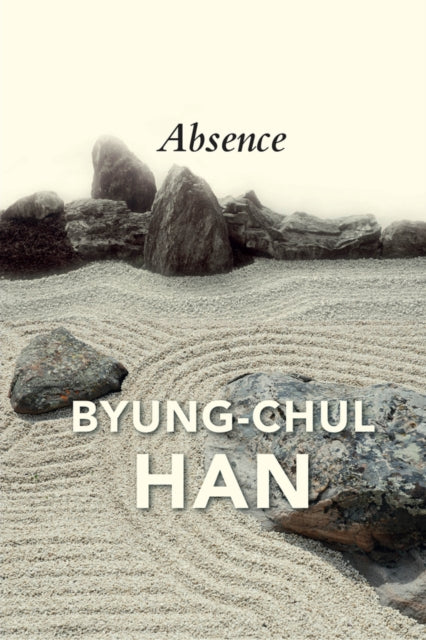
Absence - On the Culture and Philosophy of the Far East
Absence - On the Culture and Philosophy of the Far East
💎 Earn 57 Points (£0.57) on this item.
YOU SAVE £1.50
- Condition: Brand new
- UK Delivery times: Usually arrives within 2 - 3 working days
- UK Shipping: Fee starts at £2.39. Subject to product weight & dimension
Bulk ordering. Want 15 or more copies? Get a personalised quote and bigger discounts. Learn more about bulk orders.
Couldn't load pickup availability
- More about Absence - On the Culture and Philosophy of the Far East
The difference between Western and Far Eastern thought is that Western thinking is dominated by essence, while Far Eastern thought is centered on absence. This distinction is the difference between being and path, between dwelling and wandering. Byung-Chul Han explores the differences between Western and Far Eastern philosophy, aesthetics, architecture, and art, shedding fresh light on a culture of absence.
Format: Paperback / softback
Length: 128 pages
Publication date: 17 March 2023
Publisher: Polity Press
Western thinking has long been dominated by the concept of essence, with a focus on that which is self-contained and distinct from the external world. In contrast, Far Eastern thought is centered around the idea of absence. The fundamental theme of Far Eastern thinking is not being itself but rather 'the way (dao), which lacks the solidity and fixedness of essence. The distinction between essence and absence lies at the heart of the difference between being and path, between dwelling and wandering.
According to the Japanese Zen master Dōgen, a Zen monk should strive to be without a fixed abode, akin to the clouds, and without a fixed support, akin to water. Byung-Chul Han, drawing on this fundamental distinction between essence and absence, delves into the contrasts between Western and Far Eastern philosophy, aesthetics, architecture, and art. Through his exploration, he sheds fresh light on a culture of absence that may initially appear strange and unfamiliar to those in the West who have been deeply influenced by the preoccupation with essence for centuries.
In Western thought, essence is often associated with the idea of substance, with objects or concepts being perceived as having a fixed and unchanging nature. This perspective is reflected in the Western notion of identity, where individuals are seen as being defined by their inherent qualities or characteristics. In contrast, Far Eastern thought emphasizes the fluidity and impermanence of existence, with the emphasis being placed on the process of change and transformation rather than on fixed entities.
One of the key differences between Western and Far Eastern thought is the concept of emptiness. In Western philosophy, emptiness is often interpreted as a lack of substance or value, with nothingness being the ultimate reality. In contrast, Far Eastern thought sees emptiness as a state of openness and interconnectedness, where everything is interconnected and interdependent. This perspective is reflected in the concept of non-duality, which holds that everything in the universe is interconnected and cannot be separated from one another.
Another difference between Western and Far Eastern thought is the concept of time. In Western thought, time is often seen as linear and progressive, with the past, present, and future unfolding in a chronological sequence. In contrast, Far Eastern thought emphasizes the cyclical nature of time, with events and phenomena recurring in cycles and patterns. This perspective is reflected in the concept of karma, which holds that actions have consequences that can be experienced in future lives.
In terms of aesthetics, Far Eastern thought emphasizes the beauty of simplicity and the absence of ornamentation. In contrast, Western art often emphasizes the complexity and richness of form and decoration. This difference is reflected in the architecture of different cultures, with Far Eastern buildings often featuring simple, elegant designs that emphasize the natural beauty of the surroundings.
In terms of art, Far Eastern art often focuses on the representation of nature and the spiritual aspects of existence. In contrast, Western art often focuses on the human form and the exploration of human emotions and experiences. This difference is reflected in the works of artists such as Vincent van Gogh and Pablo Picasso, who represent the human form in different ways and explore different themes and emotions.
In conclusion, Western thinking has long been dominated by the concept of essence, with a focus on that which is self-contained and distinct from the external world. In contrast, Far Eastern thought is centered around the idea of absence, with the emphasis being placed on the process of change and transformation rather than on fixed entities. The differences between Western and Far Eastern thought are reflected in a range of areas, including philosophy, aesthetics, architecture, and art. Byung-Chul Han's exploration of these differences sheds fresh light on a culture of absence that may initially appear strange and unfamiliar to those in the West. However, by recognizing and embracing the differences between these two ways of thinking, we can gain a deeper understanding of the world and our place in it.
Weight: 176g
Dimension: 139 x 210 x 12 (mm)
ISBN-13: 9781509546206
This item can be found in:
UK and International shipping information
UK and International shipping information
UK Delivery and returns information:
- Delivery within 2 - 3 days when ordering in the UK.
- Shipping fee for UK customers from £2.39. Fully tracked shipping service available.
- Returns policy: Return within 30 days of receipt for full refund.
International deliveries:
Shulph Ink now ships to Australia, Belgium, Canada, France, Germany, Ireland, Italy, India, Luxembourg Saudi Arabia, Singapore, Spain, Netherlands, New Zealand, United Arab Emirates, United States of America.
- Delivery times: within 5 - 10 days for international orders.
- Shipping fee: charges vary for overseas orders. Only tracked services are available for most international orders. Some countries have untracked shipping options.
- Customs charges: If ordering to addresses outside the United Kingdom, you may or may not incur additional customs and duties fees during local delivery.