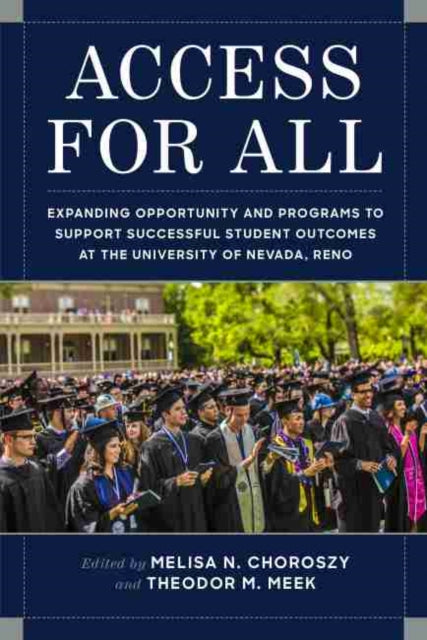
Melisa Choroszy,Theodor M. Meek
Access for All: Expanding Opportunity and Programs to Support Successful Student Outcomes at the University of Nevada, Reno
Access for All: Expanding Opportunity and Programs to Support Successful Student Outcomes at the University of Nevada, Reno
💎 Earn 32 Points (£0.32) on this item.
YOU SAVE £15.47
- Condition: Brand new
- UK Delivery times: Usually arrives within 2 - 3 working days
- UK Shipping: Fee starts at £2.39. Subject to product weight & dimension
Bulk ordering. Want 15 or more copies? Get a personalised quote and bigger discounts. Learn more about bulk orders.
Couldn't load pickup availability
- More about Access for All: Expanding Opportunity and Programs to Support Successful Student Outcomes at the University of Nevada, Reno
This publication focuses on programs and strategies to support low-income and first-generation college students' success.
\n Format: Paperback / softback
\n Length: 224 pages
\n Publication date: 30 December 2018
\n Publisher: University of Nevada Press
\n
The college student population is significantly shaped by the presence of low-income and first-generation students, who face unique challenges in their academic journey. In response to this, a wide range of programs and strategies have been developed to provide support and facilitate student success for these populations.
In recent years, there has been a growing recognition of the importance of addressing the needs of low-income and first-generation students. These students often come from backgrounds that lack the resources and support necessary to succeed in higher education, and they face numerous barriers to achieving their academic goals.
One of the primary challenges faced by low-income and first-generation students is financial instability. Many of these students rely on financial aid, scholarships, and grants to cover the costs of tuition, fees, and living expenses. However, the availability of these resources can be limited, and students may struggle to make ends meet while pursuing their education.
In addition to financial challenges, low-income and first-generation students may also face cultural barriers and a lack of familiarity with the academic system. These students may come from diverse backgrounds and may not have the same level of access to educational resources and opportunities as their more affluent peers. They may also struggle to navigate the complex bureaucracy of the college application process and may be less likely to seek out support and guidance from academic advisors and counselors.
To address these challenges, colleges and universities have developed a wide range of programs and strategies to support student success for low-income and first-generation students. These programs include financial aid and scholarship programs, academic support services, mentorship programs, and cultural competency training.
Financial aid and scholarship programs are designed to provide financial assistance to students who are unable to cover the costs of their education. These programs may include grants, scholarships, work-study programs, and loans. Scholarships are often awarded based on academic merit, financial need, or other criteria, and they can provide a significant source of support for low-income and first-generation students.
Academic support services are also essential for supporting student success for low-income and first-generation students. These services may include tutoring, writing centers, and academic advising. Tutoring programs provide students with personalized instruction and support in their academic subjects, while writing centers provide students with assistance and feedback on their writing assignments. Academic advising programs help students develop academic plans and make informed decisions about their coursework and career goals.
Mentorship programs are designed to provide students with guidance and support from experienced professionals and faculty members. Mentors can help students develop their academic skills, build their confidence, and navigate the college environment. They can also provide valuable insights into the job market and career opportunities after graduation.
Cultural competency training is designed to help students develop a greater understanding and appreciation of diverse cultures and backgrounds. This training can help students build cross-cultural communication skills, reduce cultural biases, and promote inclusivity and diversity on campus.
In addition to these programs and strategies, colleges and universities are also working to create a supportive and inclusive campus environment for low-income and first-generation students. This may include providing access to affordable housing and food services, offering support services for students with disabilities, and promoting diversity and inclusion in all aspects of campus life.
Despite these efforts, there are still significant challenges facing low-income and first-generation students in higher education. These challenges include a lack of access to high-quality education, a lack of support services, and a persistent achievement gap between these populations and their more affluent peers.
To address these challenges, it is important for colleges and universities to continue to invest in programs and strategies that support student success for low-income and first-generation students. This may include increasing the availability of financial aid and scholarship programs, expanding academic support services, and promoting diversity and inclusion in all aspects of campus life.
In conclusion, low-income and first-generation students comprise a significant portion of the college student population, and they face unique challenges in their academic journey. In response to these challenges, a wide range of programs and strategies have been developed to provide support and facilitate student success for these populations. These programs include financial aid and scholarship programs, academic support services, mentorship programs, and cultural competency training. Colleges and universities must continue to invest in these programs and strategies to ensure that all students have the opportunity to succeed in higher education.
\n Weight: 366g\n
Dimension: 230 x 153 x 18 (mm)\n
ISBN-13: 9781948908184\n \n
UK and International shipping information
UK and International shipping information
UK Delivery and returns information:
- Delivery within 2 - 3 days when ordering in the UK.
- Shipping fee for UK customers from £2.39. Fully tracked shipping service available.
- Returns policy: Return within 30 days of receipt for full refund.
International deliveries:
Shulph Ink now ships to Australia, Belgium, Canada, France, Germany, Ireland, Italy, India, Luxembourg Saudi Arabia, Singapore, Spain, Netherlands, New Zealand, United Arab Emirates, United States of America.
- Delivery times: within 5 - 10 days for international orders.
- Shipping fee: charges vary for overseas orders. Only tracked services are available for most international orders. Some countries have untracked shipping options.
- Customs charges: If ordering to addresses outside the United Kingdom, you may or may not incur additional customs and duties fees during local delivery.