Shulph Ink
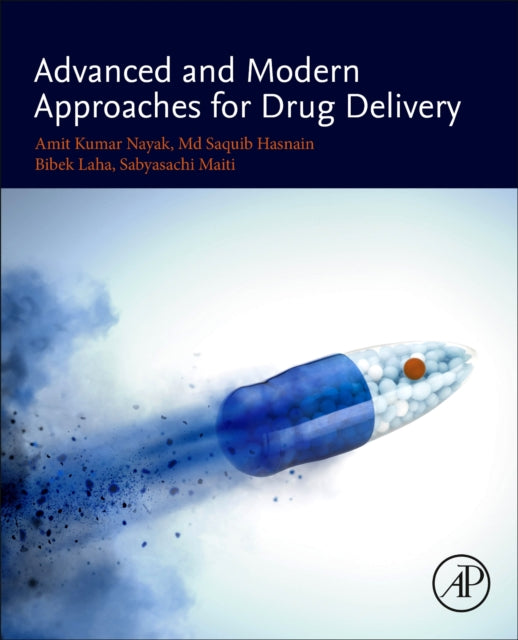
Advanced and Modern Approaches for Drug Delivery
Advanced and Modern Approaches for Drug Delivery
💎 Earn 886 Points (£8.86) on this item.
YOU SAVE £37.62
- Condition: Brand new
- UK Delivery times: Usually arrives within 2 - 3 working days
- UK Shipping: Fee starts at £2.39. Subject to product weight & dimension
Bulk ordering. Want 15 or more copies? Get a personalised quote and bigger discounts. Learn more about bulk orders.
Couldn't load pickup availability
- More about Advanced and Modern Approaches for Drug Delivery
Advanced and Modern Approaches for Drug Delivery is a comprehensive book that discusses novel approaches for drug delivery, including techniques and technology for managing diseases and conditions. It covers various topics such as dendrimers, lipid nanostructures, solid lipid nanoparticles, stimuli-responsive smart systems, self-assembled protein-drug nanoparticles, nanoconjugate formulations, nanofibers, iontophoretic systems, microneedle systems, ultra-sound triggered systems, targeted carrier-based intracellular delivery systems, resealed erythrocyte-based systems, 3 D-printing tools, site-specific monoclonal antibodies, and bio-inspired systems.
Format: Paperback / softback
Length: 940 pages
Publication date: 01 August 2023
Publisher: Elsevier Science & Technology
The field of drug delivery is constantly evolving, with advanced and modern approaches being developed to improve the effectiveness and safety of pharmaceutical treatments. In "Advanced and Modern Approaches for Drug Delivery," researchers and experts in the field explore novel techniques and technologies that are currently being used to deliver drugs to patients.
One of the key approaches discussed in the book is the use of dendrimers, which are highly branched macromolecules that can be designed to carry drugs to specific target cells or tissues. Dendrimers are versatile and can be customized to have specific properties, such as size, shape, and surface chemistry, which make them ideal for drug delivery.
Another important approach is the use of lipid nanostructures, such as liposomes and nanovesicles, which are small particles that can encapsulate drugs and deliver them to cells. Lipid nanostructures are highly stable and can be tailored to have specific properties that enhance drug absorption, stability, and targeting.
Solid lipid nanoparticles (SLN) are another type of lipid-based drug delivery system that is gaining popularity. SLN are made up of solid lipid particles that are coated with a lipid layer that helps to protect the drug and improve its stability. SLN are particularly useful for delivering drugs that are sensitive to pH or temperature changes, as they can maintain their stability in a wide range of conditions.
Stimuli-responsive smart systems are another innovative approach that is being used to deliver drugs. These systems are designed to release the drug only when it is triggered by a specific stimulus, such as temperature, pH, or light. This allows for more precise and targeted drug delivery, as the drug is released only in the target area, reducing the risk of side effects and improving patient outcomes.
Self-assembled protein-drug nanoparticles are another promising approach for drug delivery. These nanoparticles are made up of protein molecules that self-assemble into complex structures that can carry drugs to specific cells or tissues. Self-assembled protein-drug nanoparticles are highly stable and can be tailored to have specific properties that enhance drug absorption and targeting.
Nanoconjugate formulations are another type of drug delivery system that is gaining popularity. These formulations are made up of two or more components, such as a drug and a targeting molecule, that are linked together through a chemical bond. Nanoconjugate formulations are highly specific and can be tailored to target specific cells or tissues, making them ideal for the treatment of cancer and other diseases.
Nanofibers are another type of drug delivery system that is being used to deliver drugs to cells and tissues. Nanofibers are thin, flexible fibers that can be designed to have specific properties, such as size, shape, and surface chemistry, which make them ideal for drug delivery. Nanofibers can be used to deliver drugs through the skin, as well as to target cells and tissues in the body.
Iontophoretic systems are another innovative approach that is being used to deliver drugs. These systems use electric currents to deliver drugs to cells or tissues. Iontophoretic systems are highly efficient and can be used to deliver drugs to hard-to-reach areas, such as the brain.
Microneedle systems are another type of drug delivery system that is being used to deliver drugs to cells and tissues. Microneedle systems are small needles that are inserted into the skin or other tissues. The needles are coated with drugs or other substances, which are then delivered into the cells or tissues. Microneedle systems are highly efficient and can be used to deliver drugs to a wide range of cells and tissues, including the skin, muscle, and brain.
Ultrasound-triggered systems are another innovative approach that is being used to deliver drugs. These systems use ultrasound waves to deliver drugs to cells or tissues. Ultrasound-triggered systems are highly efficient and can be used to deliver drugs to a wide range of cells and tissues, including the skin, muscle, and brain.
Targeted carrier-based intracellular delivery systems are another type of drug delivery system that is being used to deliver drugs to cells and tissues. These systems use small molecules or other substances that are targeted to specific cells or tissues. The targeted carrier is then used to deliver the drug to the target cell or tissue. Targeted carrier-based intracellular delivery systems are highly efficient and can be used to deliver drugs to a wide range of cells and tissues, including cancer cells.
Resealed erythrocyte-based systems are another type of drug delivery system that is being used to deliver drugs to cells and tissues. These systems use red blood cells that have been modified to carry drugs or other substances. The modified red blood cells are then injected into the patient, where they circulate throughout the body and deliver the drug to the target cells or tissues. Resealed erythrocyte-based systems are highly efficient and can be used to deliver drugs to a wide range of cells and tissues, including cancer cells.
Three-dimensional printing tools are another type of drug delivery system that is being used to create personalized medical devices. These tools use computer-aided design software to create personalized medical devices, such as implants, prosthetics, and other medical devices. Three-dimensional printing tools are highly efficient and can be used to create personalized medical devices that are tailored to the individual patient's needs.
Site-specific monoclonal antibodies are another type of drug delivery system that is being used to deliver drugs to specific cells or tissues. These antibodies are designed to bind to specific proteins or other molecules on the surface of cells or tissues. The antibodies are then used to deliver drugs to the target cells or tissues, where they can exert their therapeutic effects.
Bio-inspired systems are another type of drug delivery system that is being used to deliver drugs to cells and tissues. These systems are designed to mimic the natural processes that occur in the body, such as the transport of nutrients and waste. Bio-inspired systems are highly efficient and can be used to deliver drugs to a wide range of cells and tissues, including cancer cells.
In conclusion, "Advanced and Modern Approaches for Drug Delivery" is an excellent resource for researchers, students, and practitioners in the field of drug delivery. The book provides comprehensive information on a wide range of advanced and modern approaches to drug delivery, including dendrimers, lipid nanostructures, solid lipid nanoparticles, stimuli-responsive smart systems, self-assembled protein-drug nanoparticles, nanoconjugate formulations, nanofibers, iontophoretic systems, microneedle systems, ultrasound-triggered systems, targeted carrier-based intracellular delivery systems, resealed erythrocyte-based systems, three-dimensional printing tools, site-specific monoclonal antibodies, and bio-inspired systems. With contributions from those in academia and industry, this book is an excellent reference for all those needing to understand drug delivery systems.
Dimension: 235 x 191 (mm)
ISBN-13: 9780323916684
This item can be found in:
UK and International shipping information
UK and International shipping information
UK Delivery and returns information:
- Delivery within 2 - 3 days when ordering in the UK.
- Shipping fee for UK customers from £2.39. Fully tracked shipping service available.
- Returns policy: Return within 30 days of receipt for full refund.
International deliveries:
Shulph Ink now ships to Australia, Belgium, Canada, France, Germany, Ireland, Italy, India, Luxembourg Saudi Arabia, Singapore, Spain, Netherlands, New Zealand, United Arab Emirates, United States of America.
- Delivery times: within 5 - 10 days for international orders.
- Shipping fee: charges vary for overseas orders. Only tracked services are available for most international orders. Some countries have untracked shipping options.
- Customs charges: If ordering to addresses outside the United Kingdom, you may or may not incur additional customs and duties fees during local delivery.