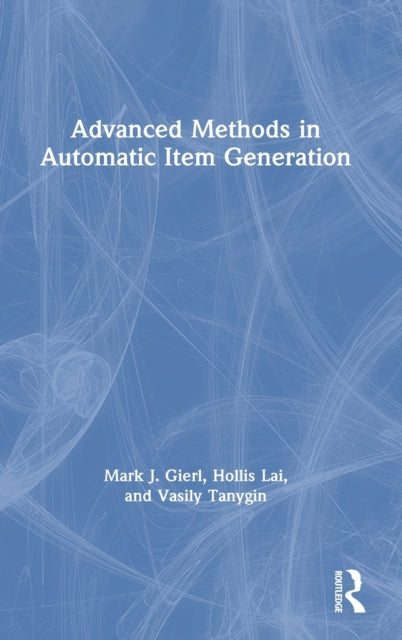
Mark J.Gierl,Hollis Lai,Vasily Tanygin
Advanced Methods in Automatic Item Generation
Advanced Methods in Automatic Item Generation
💎 Earn 811 Points (£8.11) on this item.
We can order this item for you. Delivery usually takes about 4 to 6 weeks.
This item is not held in our immediate stock. We will order it for you after checkout.
Estimated delivery: About 4 to 6 weeks
YOU SAVE £9.63
- Condition: Brand new
- UK Delivery times: Usually arrives within 2 - 3 working days
- UK Shipping: Fee starts at £2.39. Subject to product weight & dimension
Bulk ordering. Want 15 or more copies? Get a personalised quote and bigger discounts. Learn more about bulk orders.
Couldn't load pickup availability
- More about Advanced Methods in Automatic Item Generation
Advanced Methods in Automatic Item Generation is an overview of the research on automatic item generation (AIG) in the technology-enhanced educational measurement sector. It covers the theoretical foundations and concepts of AIG, as well as the practical considerations for producing and applying large numbers of useful test items.
Format: Hardback
Length: 246 pages
Publication date: 19 May 2021
Publisher: Taylor & Francis Ltd
The field of automatic item generation (AIG) in the context of technology-enhanced educational measurement has witnessed a significant surge in research. As test administration procedures increasingly incorporate digital media and Internet use, assessment stakeholders, ranging from graduate students to scholars to industry professionals, have abundant opportunities to explore and develop diverse types of tests and test items. This comprehensive analysis provides a thorough exploration of the theoretical foundations and concepts that underpin AIG, alongside the practical considerations necessary to generate and utilize large quantities of valuable test items.
The increasing integration of digital media and Internet use in test administration procedures has opened up a wealth of opportunities for assessment stakeholders to delve into the study and creation of various test types and test items. This comprehensive analysis offers a thorough exploration of the theoretical foundations and concepts that define automatic item generation (AIG), as well as the practical considerations required to produce and apply large numbers of useful test items.
AIG involves the use of computer algorithms and machine learning techniques to generate test questions that are tailored to specific learning objectives or assessment criteria. The process begins with the definition of the test domain, which encompasses the subject matter and the desired level of difficulty. Once the domain is defined, the algorithms analyze vast amounts of data, such as previous test questions, student responses, and educational resources, to identify patterns and relationships that can be used to create new test items.
One of the key advantages of AIG is its ability to produce a large number of test items quickly and efficiently. By leveraging computer algorithms and machine learning techniques, it is possible to generate hundreds or even thousands of test items in a matter of minutes or hours. This can be particularly useful in situations where time is limited or where the need for standardized testing is high, such as in educational institutions or professional certification programs.
However, the production of high-quality test items is not a straightforward process. AIG requires careful consideration of various factors, such as item difficulty, item discrimination, and item validity. Item difficulty refers to the level of difficulty of a test item, while item discrimination refers to the ability of a test item to differentiate between different test takers. Item validity refers to the extent to which a test item measures what it is intended to measure.
To ensure the quality of test items generated by AIG, assessment stakeholders must carefully evaluate the generated items. This evaluation can involve a variety of methods, such as cognitive testing, item analysis, and expert judgment. Cognitive testing involves evaluating the difficulty and clarity of the test items, while item analysis involves analyzing the content and structure of the test items to identify any potential biases or flaws. Expert judgment involves seeking the input of subject matter experts to evaluate the quality and relevance of the test items.
In addition to the production and evaluation of test items, AIG also presents opportunities for research and innovation in the field of educational measurement. By generating a large number of test items, researchers can explore new testing strategies, examine the effects of different test formats, and identify areas for improvement in the assessment process. AIG can also be used to develop personalized learning experiences, tailor training programs to individual learners, and improve the accuracy and reliability of assessment results.
In conclusion, the field of automatic item generation (AIG) in the context of technology-enhanced educational measurement has witnessed a significant surge in research and innovation. As test administration procedures increasingly incorporate digital media and Internet use, assessment stakeholders have abundant opportunities to explore and develop diverse types of tests and test items. This comprehensive analysis provides a thorough exploration of the theoretical foundations and concepts that underpin AIG, alongside the practical considerations necessary to produce and apply large quantities of valuable test items. By leveraging the power
The increasing integration of digital media and Internet use in test administration procedures has opened up a wealth of opportunities for assessment stakeholders to delve into the study and creation of various test types and test items. This comprehensive analysis offers a thorough exploration of the theoretical foundations and concepts that define automatic item generation (AIG), as well as the practical considerations required to produce and apply large numbers of useful test items.
AIG involves the use of computer algorithms and machine learning techniques to generate test questions that are tailored to specific learning objectives. The process begins with the definition. The algorithms analyze vast amounts of data, such as previous test questions, student responses, and educational resources, to identify patterns and relationships that can be used to create new test items.
One of the key advantages of AIG is its ability to produce a large number of test items quickly and efficiently. By leveraging computer algorithms and machine learning techniques, it is possible to generate hundreds or even thousands of test items in a matter of minutes or hours. This can be particularly useful in situations where time is limited or where the need for standardized testing is high, such as in educational institutions or professional certification programs.
However, the production of high-quality test items is not a straightforward process. AIG requires careful consideration of various factors, such as item difficulty, item discrimination, and item validity. Item difficulty refers to the level of difficulty of a test item, while item discrimination refers to the ability of a test item to differentiate between different test takers. Item validity refers to the extent to which a test item measures what it is intended to measure.
To ensure the quality of test items generated by AIG, assessment stakeholders must carefully evaluate the generated items. This evaluation can involve a variety of methods, such as cognitive testing, item analysis, and expert judgment. Cognitive testing involves evaluating the difficulty and clarity of the test items, while item analysis involves analyzing the content and structure of the test items to identify any potential biases or flaws. Expert judgment involves seeking the input of subject matter experts to evaluate the quality and relevance of the test items.
In addition to the production and evaluation of test items, AIG also presents opportunities for research and innovation in the field of educational measurement. By generating a large number of test items, researchers can explore new testing strategies, examine the effects of different test formats, and identify areas for improvement in the assessment process. AIG can also be used to develop personalized learning experiences, tailor training programs to individual learners, and improve the accuracy and reliability of assessment results.
In conclusion, the field of automatic item generation (AIG) in the context of technology-enhanced educational measurement has witnessed a significant surge in research and innovation. As test administration procedures increasingly incorporate digital media and Internet use, assessment stakeholders have abundant opportunities to explore and develop diverse types of tests and test items. This comprehensive analysis provides a thorough exploration of the theoretical foundations and concepts that underpin AIG, alongside the practical considerations necessary to produce and apply large quantities of valuable test items. By leveraging the power.
Weight: 458g
Dimension: 229 x 152 (mm)
ISBN-13: 9780367902933
This item can be found in:
UK and International shipping information
UK and International shipping information
UK Delivery and returns information:
- Delivery within 2 - 3 days when ordering in the UK.
- Shipping fee for UK customers from £2.39. Fully tracked shipping service available.
- Returns policy: Return within 30 days of receipt for full refund.
International deliveries:
Shulph Ink now ships to Australia, Belgium, Canada, France, Germany, Ireland, Italy, India, Luxembourg Saudi Arabia, Singapore, Spain, Netherlands, New Zealand, United Arab Emirates, United States of America.
- Delivery times: within 5 - 10 days for international orders.
- Shipping fee: charges vary for overseas orders. Only tracked services are available for most international orders. Some countries have untracked shipping options.
- Customs charges: If ordering to addresses outside the United Kingdom, you may or may not incur additional customs and duties fees during local delivery.