Shulph Ink
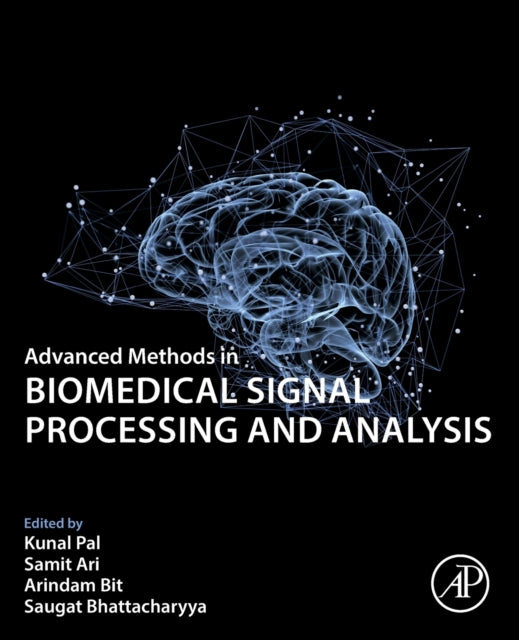
Advanced Methods in Biomedical Signal Processing and Analysis
Advanced Methods in Biomedical Signal Processing and Analysis
💎 Earn 315 Points (£3.15) on this item.
YOU SAVE £51.86
- Condition: Brand new
- UK Delivery times: Usually arrives within 2 - 3 working days
- UK Shipping: Fee starts at £2.39. Subject to product weight & dimension
Bulk ordering. Want 15 or more copies? Get a personalised quote and bigger discounts. Learn more about bulk orders.
Couldn't load pickup availability
- More about Advanced Methods in Biomedical Signal Processing and Analysis
Advanced Methods in Biomedical Signal Processing and Analysis is a comprehensive book that covers state-of-the-art methods in biosignal processing and analysis, including recurrence quantification analysis, heart rate variability, and modeling of biosignals. It also discusses feature extraction, ranking, and selection methods and demonstrates the application of artificial intelligence and machine learning to biosignal techniques.
Format: Paperback / softback
Length: 432 pages
Publication date: 01 June 2022
Publisher: Elsevier Science & Technology
Here is the rephrased text:
Advanced Methods in Biomedical Signal Processing and Analysis is a comprehensive guide that delves into cutting-edge techniques for analyzing biosignals. It encompasses a wide range of methods, including recurrence quantification analysis, heart rate variability analysis, RRI time-series signal analysis, joint time-frequency analyses, wavelet transforms and wavelet packet decomposition, empirical mode decomposition, modeling of biosignals, Gabor Transform, and empirical mode decomposition.
The book provides a thorough understanding of feature extraction, feature ranking, and feature selection methods, while also showcasing how to apply artificial intelligence and machine learning to biosignal techniques. By presenting state-of-the-art methods, the book aims to assist researchers and practitioners in the field of biomedical signal processing in extracting valuable information from biosignals and advancing their understanding of biological systems.
Recurrence quantification analysis is a powerful tool used to analyze the temporal structure of biosignals. It involves identifying periodic patterns in the data and quantifying their frequency and amplitude. This method is widely used in studying heart rate variability, which is an important indicator of cardiovascular health. Heart rate variability analysis can help detect abnormal heart rhythms, such as arrhythmias, and provide insights into the autonomic nervous system's regulation of heart rate.
Another important method discussed in the book is RRI time-series signal analysis. RRI, or respiratory rate-related information, is a component of the respiratory signal that contains information about the respiratory rate and its variability. By analyzing RRI time-series signals, researchers can gain insights into respiratory patterns, sleep disorders, and other respiratory-related conditions.
Joint time-frequency analyses are used to analyze biosignals that exhibit both time- and frequency-dependent properties. This method combines the advantages of time-domain analysis and frequency-domain analysis to provide a comprehensive understanding of the underlying dynamics of the biosignal. Joint time-frequency analyses are particularly useful in studying brain activity, where both temporal and spectral information are important.
Wavelet transforms and wavelet packet decomposition are powerful tools for analyzing and compressing biosignals. Wavelets are a mathematical framework that allows for the representation of signals in a compact form, while wavelet packet decomposition is a technique that decomposes a signal into its constituent parts, allowing for efficient analysis and compression. These methods are widely used in image processing, speech recognition, and medical imaging, and they have also found applications in biosignal processing.
Empirical mode decomposition (EMD) is a technique used to analyze non-stationary and non-linear biosignals. EMD decomposes a signal into a set of intrinsic mode functions (IMFs), which are characterized by their local energy and frequency content. By analyzing the IMFs, researchers can gain insights into the underlying structure of the biosignal and identify important features that can be used for classification and prediction.
Modeling of biosignals is an important aspect of biosignal processing. It involves developing mathematical models that can accurately represent the dynamics of the biosignal and predict its behavior. Modeling of biosignals can be used for a wide range of applications, including disease diagnosis, drug discovery, and patient monitoring.
Gabor Transform is a type of signal processing technique used to analyze and enhance biosignals. Gabor filters are a set of orthogonal functions that are used to analyze the frequency content of a signal. By applying Gabor filters to biosignals, researchers can identify specific features that are associated with different physiological processes, such as heart rate or respiration.
EMD has also found applications in the field of music analysis, where it is used to analyze musical signals and extract important features that can be used for music composition and performance evaluation.
In conclusion, Advanced Methods in Biomedical Signal Processing and Analysis is a comprehensive guide that provides a thorough understanding of cutting-edge techniques for analyzing biosignals. By presenting state-of-the-art methods, the book aims to assist researchers and practitioners in the field of biomedical signal processing in extracting valuable information from biosignals and advancing their understanding of biological systems. Whether you are a researcher, clinician, or engineer, this book is an essential resource for anyone interested in the field of biomedical signal processing.
Dimension: 235 x 191 (mm)
ISBN-13: 9780323859554
This item can be found in:
UK and International shipping information
UK and International shipping information
UK Delivery and returns information:
- Delivery within 2 - 3 days when ordering in the UK.
- Shipping fee for UK customers from £2.39. Fully tracked shipping service available.
- Returns policy: Return within 30 days of receipt for full refund.
International deliveries:
Shulph Ink now ships to Australia, Belgium, Canada, France, Germany, Ireland, Italy, India, Luxembourg Saudi Arabia, Singapore, Spain, Netherlands, New Zealand, United Arab Emirates, United States of America.
- Delivery times: within 5 - 10 days for international orders.
- Shipping fee: charges vary for overseas orders. Only tracked services are available for most international orders. Some countries have untracked shipping options.
- Customs charges: If ordering to addresses outside the United Kingdom, you may or may not incur additional customs and duties fees during local delivery.