Shulph Ink
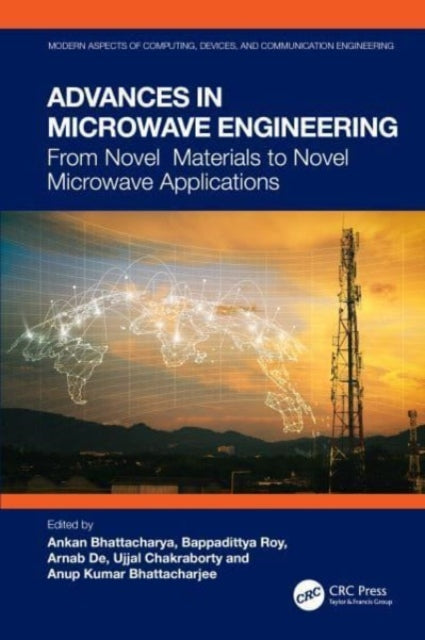
Advances in Microwave Engineering: From Novel Materials to Novel Microwave Applications
Advances in Microwave Engineering: From Novel Materials to Novel Microwave Applications
💎 Earn 887 Points (£8.87) on this item.
We can order this item for you. Delivery usually takes about 4 to 6 weeks.
This item is not held in our immediate stock. We will order it for you after checkout.
Estimated delivery: About 4 to 6 weeks
YOU SAVE £10.53
- Condition: Brand new
- UK Delivery times: Usually arrives within 2 - 3 working days
- UK Shipping: Fee starts at £2.39. Subject to product weight & dimension
Bulk ordering. Want 15 or more copies? Get a personalised quote and bigger discounts. Learn more about bulk orders.
Couldn't load pickup availability
- More about Advances in Microwave Engineering: From Novel Materials to Novel Microwave Applications
Microwave antennas, communication, propagation, circuits, measurement techniques, radiation hazards, space communication, and safety measures are covered, along with advanced computing technologies, wireless communication, and fiber optics.
Format: Unspecified
Length: 380 pages
Publication date: 21 November 2023
Publisher: Taylor & Francis Ltd
Microwave antennas, communication, propagation, and circuits are essential components of modern technology. This comprehensive guide provides detailed explanations of these topics, covering everything from basic principles to advanced applications.
Microwave antennas are designed to transmit and receive microwave signals. They can be used in a wide range of applications, including communication, radar, and remote sensing. Antennas come in various shapes and sizes, including dipole, horn, and parabolic reflectors.
Communication is the transmission of information from one point to another using microwave signals. There are two main types of communication: terrestrial and satellite. Terrestrial communication uses microwave signals to transmit data over short distances, such as between mobile phones and cell towers. Satellite communication uses microwave signals to transmit data over long distances, such as between satellites and ground stations.
Propagation is the process by which microwave signals travel through the air. The characteristics of the air, such as its temperature, humidity, and conductivity, can affect the propagation of microwave signals. Different propagation modes, such as line-of-sight, diffraction, and reflection, can be used to transmit microwave signals over different distances.
Circuits are used to process and amplify microwave signals. They can be used in a wide range of applications, including radar, radio, and television. Circuits can be designed using a variety of components, including resistors, capacitors, and inductors.
Microwave measurement techniques are used to measure the properties of microwave signals. These techniques include spectrum analysis, time-domain analysis, and frequency-domain analysis. Spectrum analysis is used to measure the frequency content of a microwave signal, while time-domain analysis is used to measure the time-varying properties of a microwave signal. Frequency-domain analysis is used to measure the amplitude and phase of a microwave signal.
Radiation hazards are a concern when working with microwave signals. Exposure to high levels of microwave radiation can cause health problems, such as cancer and genetic damage. Safety measures must be taken to protect workers from exposure to microwave radiation.
Space communication is an important application of microwave technology. Satellite communication uses microwave signals to transmit data between satellites and ground stations. Space communication is used to provide communication services to remote areas, such as the Arctic and the Antarctic.
Radio astronomy is an important application of microwave technology. Radio astronomy uses microwave signals to observe distant objects in the universe, such as galaxies and planets. Radio astronomy is used to study the properties of these objects, such as their composition and structure.
Microwave material processing is an important application of microwave technology. Microwave material processing uses microwave radiation to heat and treat materials, such as plastics and metals. Microwave material processing is used to improve the properties of these materials, such as their strength and durability.
Advanced computing technologies are an important application of microwave technology. Advanced computing technologies use microwave signals to transmit data between computers and other devices. Advanced computing technologies are used to solve complex problems, such as weather forecasting and climate modeling.
In conclusion, microwave antennas, communication, propagation, and circuits are essential components of modern technology. This comprehensive guide provides detailed explanations of these topics, covering everything from basic principles to advanced applications. By understanding these topics, you can better appreciate the importance of microwave technology in our daily lives.
Weight: 911g
Dimension: 234 x 156 (mm)
ISBN-13: 9781032468983
This item can be found in:
UK and International shipping information
UK and International shipping information
UK Delivery and returns information:
- Delivery within 2 - 3 days when ordering in the UK.
- Shipping fee for UK customers from £2.39. Fully tracked shipping service available.
- Returns policy: Return within 30 days of receipt for full refund.
International deliveries:
Shulph Ink now ships to Australia, Belgium, Canada, France, Germany, Ireland, Italy, India, Luxembourg Saudi Arabia, Singapore, Spain, Netherlands, New Zealand, United Arab Emirates, United States of America.
- Delivery times: within 5 - 10 days for international orders.
- Shipping fee: charges vary for overseas orders. Only tracked services are available for most international orders. Some countries have untracked shipping options.
- Customs charges: If ordering to addresses outside the United Kingdom, you may or may not incur additional customs and duties fees during local delivery.