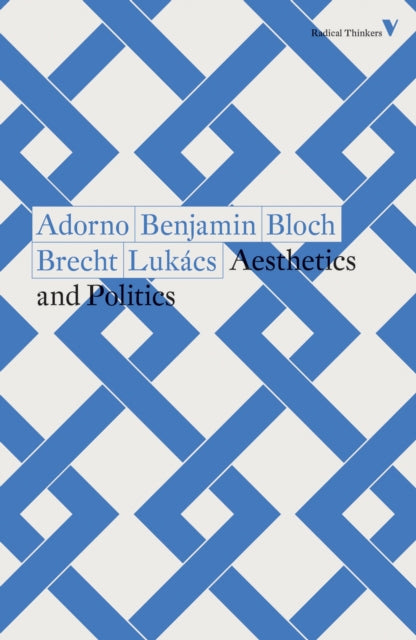
Theodor Adorno,Walter Benjamin,Ernst Bloch,Bertolt Brecht,Georg Lukacs
Aesthetics and Politics
Aesthetics and Politics
💎 Earn 38 Points (£0.38) on this item.
YOU SAVE £2.33
- Condition: Brand new
- UK Delivery times: Usually arrives within 2 - 3 working days
- UK Shipping: Fee starts at £2.39. Subject to product weight & dimension
Bulk ordering. Want 15 or more copies? Get a personalised quote and bigger discounts. Learn more about bulk orders.
Couldn't load pickup availability
- More about Aesthetics and Politics
From the 1930s to the 1950s, German culture experienced a significant aesthetic debate, assembled in a single volume in "Aesthetics and Politics," involving key texts of Marxist controversies over literature and art.
Format: Paperback / softback
Length: 256 pages
Publication date: 13 October 2020
Publisher: Verso Books
From the 1930s to the 1950s, German culture experienced a remarkable era of profound aesthetic debate, unmatched by any other country or period in history. This intellectual and artistic transformation was marked by a series of significant debates and controversies that shaped the course of modern aesthetics. In Aesthetics and Politics, a comprehensive collection of key texts, renowned scholars and intellectuals have assembled a seamless and interconnected dialogue between these giants of twentieth-century intellectual history. This volume serves as a testament to the depth and complexity of the debates that unfolded during this transformative period, exploring the intersection of aesthetics, politics, and society.
The 1930s and 1950s witnessed a vibrant and contentious landscape in German aesthetics, marked by a series of debates and controversies that left an indelible mark on the field. These debates, which took place amidst political and social upheaval, were driven by a diverse range of thinkers who sought to understand the role of art and aesthetics in shaping society.
One of the most significant debates of this era was the Marxist controversy over literature and art. Led by figures such as Karl Marx and Friedrich Engels, Marxist aesthetics sought to understand the relationship between art and the economic and political structures of society. Marxists believed that art was a tool of the ruling class to perpetuate its power and control over the working class, while at the same time, it could be used by the working class to challenge and subvert these structures.
This debate was characterized by a fierce exchange of ideas and a deep analysis of the works of artists and writers. Marxist critics argued that art was often used to promote capitalist values and to reinforce the status quo, while at the same time, it could contain hidden messages and symbols that challenged these values. They also pointed out the ways in which art could be used to promote social and political change, such as through the use of propaganda or the depiction of marginalized communities.
Another important debate in German aesthetics was the debate between formalism and expressionism. Formalism, led by figures such as Adolf Loos and Ludwig Wittgenstein, emphasized the importance of form and structure in art, arguing that art should be judged based on its aesthetic qualities alone. Expressionism, on the other hand, emphasized the emotional and subjective aspects of art, arguing that art should be used to express the artist's personal experiences and emotions.
This debate was characterized by a clash of ideologies and a search for new ways to understand the role of art in society. Formalists argued that art should be objective and universal, while expressionists believed that art should be subjective and personal. They also argued over the appropriate balance between form and content, with expressionists advocating for a greater emphasis on the latter while formalists argued for a greater emphasis on the former.
In addition to these debates, German aesthetics was also shaped by the influence of other philosophical and cultural movements, such as existentialism, phenomenology, and the Bauhaus. Existentialism, led by figures such as Soren Kierkegaard and Friedrich Nietzsche, emphasized the individual's search for meaning and purpose in life, while phenomenology, led by Edmund Husserl and Martin Heidegger, focused on the subjective experience of the world. The Bauhaus, a school of design and architecture that emerged in the early 20th century, emphasized the integration of art and design, and the use of modern materials and technologies to create functional and aesthetically pleasing objects.
These debates and controversies continued to shape German aesthetics into the 1960s and 1970s, with new movements and schools of thought emerging to challenge and expand upon the ideas of the past. The feminist movement, for example, challenged traditional notions of gender and sexuality in art and literature, while the postmodern movement, led by figures such as Jacques Derrida and Jean-François Lyotard, sought to undermine the authority of traditional narratives and hierarchies.
In conclusion, the 1930s to 1950s were a period of profound aesthetic debate in German culture, marked by a series of significant debates and controversies that shaped the course of modern aesthetics. These debates, which were driven by a diverse range of thinkers and movements, explored the intersection of aesthetics, politics, and society, and left an indelible mark on the field. From the Marxist controversy over literature and art to the debate between formalism and expressionism, these debates continue to inspire and influence contemporary artists and thinkers. As we continue to navigate the complex and ever-changing world of aesthetics, it is important to remember the lessons of the past and to continue to engage in meaningful and thought-provoking dialogue.
Weight: 210g
Dimension: 129 x 198 x 14 (mm)
ISBN-13: 9781788738583
UK and International shipping information
UK and International shipping information
UK Delivery and returns information:
- Delivery within 2 - 3 days when ordering in the UK.
- Shipping fee for UK customers from £2.39. Fully tracked shipping service available.
- Returns policy: Return within 30 days of receipt for full refund.
International deliveries:
Shulph Ink now ships to Australia, Belgium, Canada, France, Germany, Ireland, Italy, India, Luxembourg Saudi Arabia, Singapore, Spain, Netherlands, New Zealand, United Arab Emirates, United States of America.
- Delivery times: within 5 - 10 days for international orders.
- Shipping fee: charges vary for overseas orders. Only tracked services are available for most international orders. Some countries have untracked shipping options.
- Customs charges: If ordering to addresses outside the United Kingdom, you may or may not incur additional customs and duties fees during local delivery.