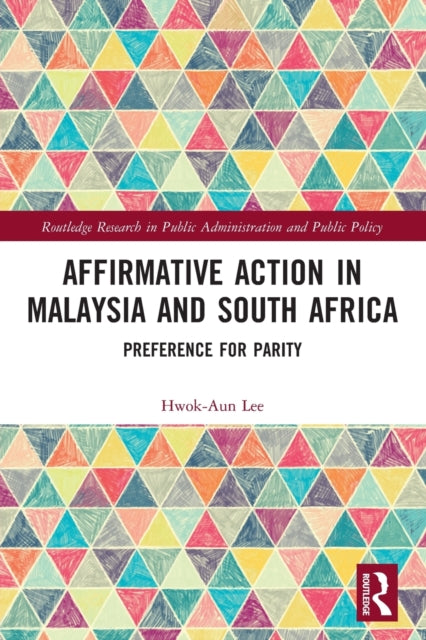
Hwok-Aun Lee
Affirmative Action in Malaysia and South Africa: Preference for Parity
Affirmative Action in Malaysia and South Africa: Preference for Parity
💎 Earn 221 Points (£2.21) on this item.
We can order this item for you. Delivery usually takes about 4 to 6 weeks.
This item is not held in our immediate stock. We will order it for you after checkout.
Estimated delivery: About 4 to 6 weeks
YOU SAVE £2.63
- Condition: Brand new
- UK Delivery times: Usually arrives within 2 - 3 working days
- UK Shipping: Fee starts at £2.39. Subject to product weight & dimension
Bulk ordering. Want 15 or more copies? Get a personalised quote and bigger discounts. Learn more about bulk orders.
Couldn't load pickup availability
- More about Affirmative Action in Malaysia and South Africa: Preference for Parity
Malaysia and South Africa have the most extensive affirmative action programs in the world. This book examines why and how to effect preferential treatment to increase majority representation in education, employment, enterprise, and ownership. It evaluates the objectives, attainments, and limitations of ethnic preferential treatment and considers policy reforms.
Format: Paperback / softback
Length: 296 pages
Publication date: 29 April 2022
Publisher: Taylor & Francis Ltd
Malaysia and South Africa stand out as global leaders in implementing comprehensive affirmative action programs. This insightful volume delves into the compelling reasons behind and practical strategies for achieving preferential treatment, with a particular focus on its application in advancing inter-ethnic parity, particularly in higher education, high-level professions, business development, and wealth ownership. By meticulously analyzing extensive data on education, workforce, and population, the book evaluates the primary goals of boosting majority representation in these critical domains. Furthermore, it critically examines the achievements and limitations of ethnic preferential treatment in reducing disparities, the complexities of fostering capability and reducing dependency, and the potential for policy reforms.
Malaysia and South Africa are notable examples of countries that have implemented extensive affirmative action programs. These programs aim to address historical and systemic inequalities and promote greater diversity and inclusion in various sectors, including education, employment, and business ownership.
In Malaysia, the National Economic Development Policy (NEDP) has been a key driver of affirmative action. The policy seeks to promote equitable opportunities for all Malaysians, regardless of their race or ethnicity. It includes measures such as targeted scholarships, employment quotas, and business grants for marginalized communities.
Similarly, South Africa's Reconstruction and Development Program (RDP) was launched in 1994 to address the legacy of apartheid and promote social and economic equality. The RDP includes policies such as BEE (Black Economic Empowerment), which encourages the participation of black people in the economy, and housing subsidies for low-income households.
The implementation of affirmative action programs has been met with both praise and criticism. Supporters argue that these programs are necessary to address historical inequalities and promote social mobility. They argue that affirmative action can help level the playing field and provide opportunities for marginalized communities that would otherwise be limited by systemic barriers.
Critics, on the other hand, argue that affirmative action programs can perpetuate stereotypes and discrimination. They argue that affirmative action should be based on merit rather than race or ethnicity and that it can lead to unintended consequences, such as creating a sense of entitlement among beneficiaries.
Despite these criticisms, affirmative action programs continue to be implemented in many countries around the world. However, it is important to ensure that these programs are designed and implemented in a way that promotes diversity and inclusion while also addressing the underlying social and economic issues that contribute to inequality.
One of the key challenges of affirmative action programs is the need to balance the goals of promoting diversity and inclusion with the need to ensure that beneficiaries are capable and independent. Affirmative action programs should aim to provide support and opportunities to marginalized communities, but they should also encourage these communities to develop their skills and capabilities so that they can thrive in the competitive job market and become self-sufficient.
Another challenge is the need to address the issue of dependency. Affirmative action programs can create a sense of dependency among beneficiaries, who may rely on these programs for their economic and social well-being. This can lead to a cycle of poverty and inequality, as beneficiaries may not be able to develop the skills and resources necessary to break free from the cycle.
To address these challenges, it is important to develop comprehensive and sustainable affirmative action programs that are tailored to the specific needs and circumstances of each community. These programs should include training and education programs to help beneficiaries develop their skills and capabilities, as well as support services to help them transition to independent and self-sufficient lives.
In addition to these challenges, affirmative action programs should also be evaluated and monitored to ensure that they are achieving their intended goals. This evaluation should include data on the number of beneficiaries, the impact of the programs on social and economic outcomes, and the effectiveness of the policies and programs in addressing the underlying social and economic issues that contribute to inequality.
Overall, affirmative action programs can play a crucial role in promoting diversity and inclusion and addressing historical inequalities. However, it is important to design and implement these programs in a way that is sustainable, effective, and promotes the development of marginalized communities. By doing so, we can create a more equitable and inclusive society for all.
Weight: 550g
Dimension: 234 x 156 (mm)
ISBN-13: 9780367568016
This item can be found in:
UK and International shipping information
UK and International shipping information
UK Delivery and returns information:
- Delivery within 2 - 3 days when ordering in the UK.
- Shipping fee for UK customers from £2.39. Fully tracked shipping service available.
- Returns policy: Return within 30 days of receipt for full refund.
International deliveries:
Shulph Ink now ships to Australia, Belgium, Canada, France, Germany, Ireland, Italy, India, Luxembourg Saudi Arabia, Singapore, Spain, Netherlands, New Zealand, United Arab Emirates, United States of America.
- Delivery times: within 5 - 10 days for international orders.
- Shipping fee: charges vary for overseas orders. Only tracked services are available for most international orders. Some countries have untracked shipping options.
- Customs charges: If ordering to addresses outside the United Kingdom, you may or may not incur additional customs and duties fees during local delivery.