ElisabethLeake
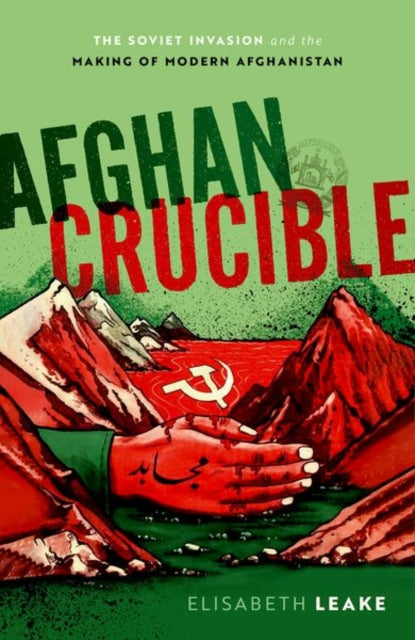
Afghan Crucible: The Soviet Invasion and the Making of Modern Afghanistan
Afghan Crucible: The Soviet Invasion and the Making of Modern Afghanistan
💎 Earn 120 Points (£1.20) on this item.
YOU SAVE £9.93
- Condition: Brand new
- UK Delivery times: Usually arrives within 2 - 3 working days
- UK Shipping: Fee starts at £2.39. Subject to product weight & dimension
Bulk ordering. Want 15 or more copies? Get a personalised quote and bigger discounts. Learn more about bulk orders.
Couldn't load pickup availability
- More about Afghan Crucible: The Soviet Invasion and the Making of Modern Afghanistan
The Soviet invasion of Afghanistan in 1979 led to a decade of occupation and a political crisis that shook the world. It was part of a broader movement for local articulations of social and political modernity that did not derive from foreign models, and Afghans set many of the parameters of the conflict in conversation with foreigners. This global history of a moment of crisis not just for Afghanistan or the Cold War but international relations and the postcolonial state.
Format: Hardback
Length: 368 pages
Publication date: 28 April 2022
Publisher: Oxford University Press
The Soviet invasion of Afghanistan, which occurred on December 24, 1979, marked a significant turning point in global history. This occupation, which lasted nearly a decade, had far-reaching consequences that are still felt in Afghanistan and across the world. To many observers, the Soviet invasion showcased the lengths to which one of the world's superpowers would go to assert its dominance in the global Cold War. The Soviet war, coupled with parallel covert American aid to Afghan resistance fighters, became a defining event in international politics during the final years of the Cold War. It lingered far beyond the collapse of the Soviet Union, shaping the political landscape of the region.
However, the Soviet invasion of Afghanistan was not merely a result of Cold War competition. The country had been embroiled in a century-long debate over the nature of modern nationhood, culminating in a 1978 coup by self-described Afghan communists. Instead of the promised transformation, what emerged was a civil war, pitting Afghans against each other in competing models of Afghan statehood. Afghan socialists and Islamists gained prominence in the 1980s, partly due to Soviet and American involvement, but their rise represented a broader movement for local articulations of social and political modernity that were not directly influenced by foreign models.
The Afghan people played a crucial role in shaping the conflict. In their interactions with foreigners, they set many of the parameters that defined the conflict. This sweeping history spans various centers of state in Kabul, Moscow, Islamabad, and Washington, as well as global governance institutions in Geneva and New York. It also delves into resistance hubs in Peshawar and Panjshir, as well as refugee camps scattered across Pakistan's borderlands. By examining these diverse locations, the history provides a more comprehensive understanding of the Soviet invasion of Afghanistan and its lasting impact on the region.
The Soviet invasion of Afghanistan was a complex and multifaceted event that had far-reaching consequences for the country and the world. It marked the beginning of a protracted occupation that would shape Afghanistan's political and social landscape for decades to come. The civil war that followed the invasion further complicated the situation, pitting Afghans against each other in a struggle for power and control. The involvement of foreign powers, including the Soviet Union, the United States, and Pakistan, further complicated the dynamics of the conflict.
The Soviet invasion of Afghanistan also had significant implications for the global Cold War. It marked a significant victory for the Soviet Union, which had been struggling to maintain its influence in the region. The invasion also demonstrated the power of the United States, which had been providing covert aid to Afghan resistance fighters. The conflict also highlighted the limitations of the Soviet model of governance, which was unable to effectively address the complex social and political issues facing Afghanistan.
Despite the many challenges faced by Afghanistan, the country has made significant progress in recent years. The establishment of a democratic government in 2001, the withdrawal of foreign troops in 2014, and the ongoing efforts to promote peace and stability have all contributed to a better future for the country. However, there are still many challenges that need to be addressed, including poverty, corruption, and the ongoing threat of terrorism.
In conclusion, the Soviet invasion of Afghanistan was a significant event in global history that had far-reaching consequences for the country and the world. It marked the beginning of a protracted occupation that would shape Afghanistan's political and social landscape for decades to come. The civil war that followed the invasion further complicated the situation, pitting Afghans against each other in a struggle for power and control. The involvement of foreign powers, including the Soviet Union, the United States, and Pakistan, further complicated the dynamics of the conflict. Despite the many challenges faced by Afghanistan, the country has made significant progress in recent years, and there is hope for a better future. However, there is still much work to be done to address the many issues that continue to threaten the country's stability and development.
Weight: 586g
Dimension: 162 x 242 x 36 (mm)
ISBN-13: 9780198846017
UK and International shipping information
UK and International shipping information
UK Delivery and returns information:
- Delivery within 2 - 3 days when ordering in the UK.
- Shipping fee for UK customers from £2.39. Fully tracked shipping service available.
- Returns policy: Return within 30 days of receipt for full refund.
International deliveries:
Shulph Ink now ships to Australia, Belgium, Canada, France, Germany, Ireland, Italy, India, Luxembourg Saudi Arabia, Singapore, Spain, Netherlands, New Zealand, United Arab Emirates, United States of America.
- Delivery times: within 5 - 10 days for international orders.
- Shipping fee: charges vary for overseas orders. Only tracked services are available for most international orders. Some countries have untracked shipping options.
- Customs charges: If ordering to addresses outside the United Kingdom, you may or may not incur additional customs and duties fees during local delivery.