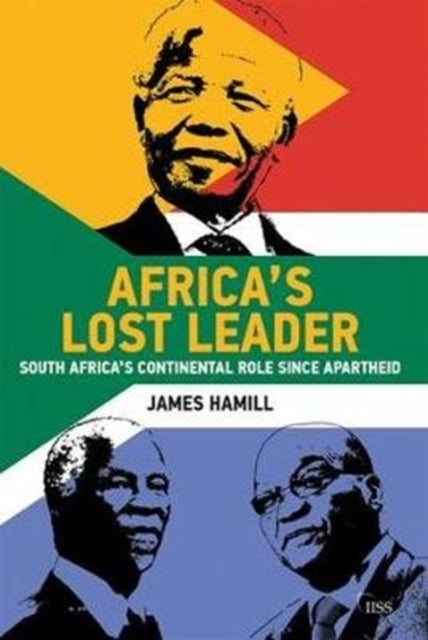
James Hamill
Africa's Lost Leader: South Africa's continental role since apartheid
Africa's Lost Leader: South Africa's continental role since apartheid
💎 Earn 94 Points (£0.94) on this item.
We can order this item for you. Delivery usually takes about 4 to 6 weeks.
This item is not held in our immediate stock. We will order it for you after checkout.
Estimated delivery: About 4 to 6 weeks
YOU SAVE £1.12
- Condition: Brand new
- UK Delivery times: Usually arrives within 2 - 3 working days
- UK Shipping: Fee starts at £2.39. Subject to product weight & dimension
Bulk ordering. Want 15 or more copies? Get a personalised quote and bigger discounts. Learn more about bulk orders.
Couldn't load pickup availability
- More about Africa's Lost Leader: South Africa's continental role since apartheid
South Africa was seen as a dominant power on the continent in 1994, but has failed to deliver on this promise. Its reluctance to lead, African hostility to its economic expansion, and skepticism about its suitability as Africa's global representative have hindered its continental primacy. The country must adapt to an emerging multipolarity on the continent, which could lead to a new concert of African powers or fragmentation, discord, and gridlock. This Adelphi book challenges the received wisdom that South Africa is a dominant power in Africa and examines the country's complex relationship with the rest of the continent in the post-apartheid era.
Format: Paperback / softback
Length: 128 pages
Publication date: 16 January 2018
Publisher: Taylor & Francis Ltd
When Nelson Mandela was sworn in as president on May 10, 1994, South Africa enjoyed an unprecedented global standing. The international community, particularly Western states, saw the new South Africa as well-equipped to play a dynamic and dominant role on the continent, promoting conflict resolution, economic development, and acting as a standard-bearer for democracy and human rights. However, throughout the presidencies of Nelson Mandela, Thabo Mbeki, and Jacob Zuma, South Africa has failed to deliver on this early promise. Its continental primacy has been circumscribed by its own reluctance to lead, combined with widespread African hostility to its economic expansion, antipathy towards its democratic ideals, and skepticism about its suitability as Africa's global representative. With an onerous domestic agenda, as it continues to tackle the profound socio-economic legacies of apartheid, and with its military power also on the wane, South Africa must now adapt to an emerging multipolarity on the continent. This transition, which may produce a new concert of African powers working in constructive collaboration or lead to fragmentation, discord, and gridlock, is likely to determine Africa's prospects for decades to come.
This Adelphi book squarely challenges the received wisdom that South Africa is a dominant power in Africa. It explores the country's complex and difficult relationship with the rest of the continent in the post-apartheid era and examines the ways in which the country has struggled to translate its economic, military, and diplomatic weight into tangible foreign policy successes and enduring influence on the ground. The conclusions of this book will be valuable to academics, policymakers, journalists, and business leaders seeking to understand the evolution and future trajectory of South Africa's role in Africa and the broader global context.
In conclusion, South Africa's journey to the presidency in 1994 held great promise for the country and the continent. However, the subsequent presidencies of Mandela, Mbeki, and Zuma have seen South Africa fail to deliver on its early promise. The country's reluctance to lead, combined with widespread African hostility to its economic expansion, antipathy towards its democratic ideals, and skepticism about its suitability as Africa's global representative, has circumscribed its continental primacy. As South Africa faces an emerging multipolarity on the continent, it must adapt to this new reality and work towards achieving its foreign policy goals and building enduring influence on the ground. This Adelphi book provides valuable insights into South Africa's complex relationship with the rest of the continent and challenges the received wisdom that South Africa is a dominant power in Africa. By examining the country's struggles to translate its economic, military, and diplomatic weight into tangible foreign policy successes and enduring influence, it offers valuable conclusions for academics, policymakers, journalists, and business leaders seeking to understand the evolution and future trajectory of South Africa's role in Africa and the broader global context.
Weight: 384g
Dimension: 233 x 160 x 11 (mm)
ISBN-13: 9781138549654
UK and International shipping information
UK and International shipping information
UK Delivery and returns information:
- Delivery within 2 - 3 days when ordering in the UK.
- Shipping fee for UK customers from £2.39. Fully tracked shipping service available.
- Returns policy: Return within 30 days of receipt for full refund.
International deliveries:
Shulph Ink now ships to Australia, Belgium, Canada, France, Germany, Ireland, Italy, India, Luxembourg Saudi Arabia, Singapore, Spain, Netherlands, New Zealand, United Arab Emirates, United States of America.
- Delivery times: within 5 - 10 days for international orders.
- Shipping fee: charges vary for overseas orders. Only tracked services are available for most international orders. Some countries have untracked shipping options.
- Customs charges: If ordering to addresses outside the United Kingdom, you may or may not incur additional customs and duties fees during local delivery.