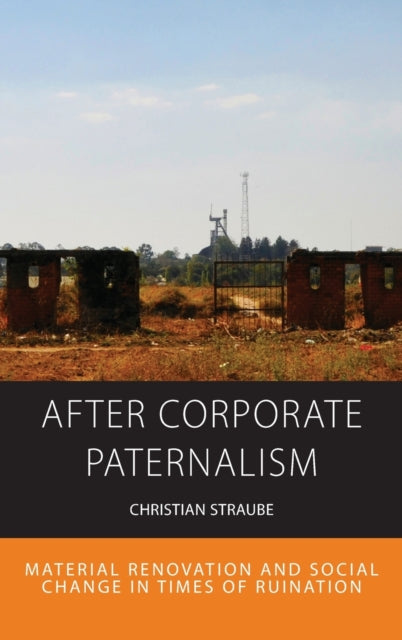
Christian Straube
After Corporate Paternalism: Material Renovation and Social Change in Times of Ruination
After Corporate Paternalism: Material Renovation and Social Change in Times of Ruination
We can order this item for you. Delivery usually takes about 4 to 6 weeks.
This item is not held in our immediate stock. We will order it for you after checkout.
Estimated delivery: About 4 to 6 weeks
YOU SAVE £2.75
- Condition: Brand new
- UK Delivery times: Usually arrives within 2 - 3 working days
- UK Shipping: Fee starts at £3.89. Subject to product weight & dimension
Bulk ordering. Want 15 or more copies? Get a personalised quote and bigger discounts. Learn more about bulk orders.
Couldn't load pickup availability
- More about After Corporate Paternalism: Material Renovation and Social Change in Times of Ruination
In this ethnographic study, Christian Straube explores how post-paternalist ruination and renovation intersect in Mpatamatu, a former mining town on the Zambian Copperbelt, offering insights into how people reappropriate former corporate spaces and transform them into personal projects of renovation.
Format: Hardback
Length: 178 pages
Publication date: 16 July 2021
Publisher: Berghahn Books
In this captivating ethnographic exploration, Christian Straube delves deep into the intricate dynamics of post-paternalist ruination and renovation, shedding light on the profound social transformations occurring at the crossroads of material decay and social disconnection in the historic mining township of Mpatamatu, situated on the Zambian Copperbelt. Spanning a wide range of topics, including industrial history, colonial town planning, social control, materiality, gender relations, and neoliberal structural change, After Corporate Paternalism provides a unique and insightful perspective on how individuals reclaim and repurpose former corporate spaces, transforming them into personal endeavors of renovation. This transformative process not only reshapes the physical landscape of the community but also profoundly alters its character, fostering a sense of empowerment, resilience, and community cohesion among its residents.
Through meticulous fieldwork and detailed analysis, Straube unravels the complex web of social, economic, and cultural factors that have shaped Mpatamatu's history and present-day reality. He explores how the legacy of corporate paternalism, characterized by the dominance of multinational corporations and their extractive practices, has left a lasting imprint on the community. The residents of Mpatamatu, however, have responded to this adversity with remarkable creativity and determination, repurposing abandoned buildings, factories, and infrastructure into vibrant spaces for community development, education, and cultural expression.
One of the key themes of Straube's study is the role of gender in shaping these transformations. He highlights how women have played a pivotal role in reclaiming and revitalizing the community, often taking on leadership roles in community projects and advocating for gender equality. Women have also been instrumental in developing sustainable livelihoods, such as small-scale agriculture and artisanal crafts, which provide economic opportunities and contribute to the preservation of local traditions and knowledge.
Another important aspect of Straube's analysis is the impact of neoliberal structural change on the community. He explores how the introduction of market-oriented policies and the privatization of public resources have led to social disconnection, economic marginalization, and environmental degradation. However, the residents of Mpatamatu have also found ways to adapt to these challenges, leveraging their collective knowledge and resources to create innovative solutions and build resilient communities.
Through his ethnographic study, Christian Straube offers a powerful testament to the resilience and creativity of human beings in the face of adversity. He demonstrates how individuals and communities can reclaim and transform former corporate spaces into hubs of social activity, cultural heritage, and economic empowerment. After Corporate Paternalism is a valuable contribution to the field of anthropology, sociology, and urban studies, providing insights into the complex processes of social change and the potential for positive transformation in the aftermath of corporate dominance.
Dimension: 229 x 152 (mm)
ISBN-13: 9781800731332
UK and International shipping information
UK and International shipping information
We deliver throughout the United Kingdom and to 128 countries and territories worldwide, including the United States, Australia, Canada, Germany, Spain and France.