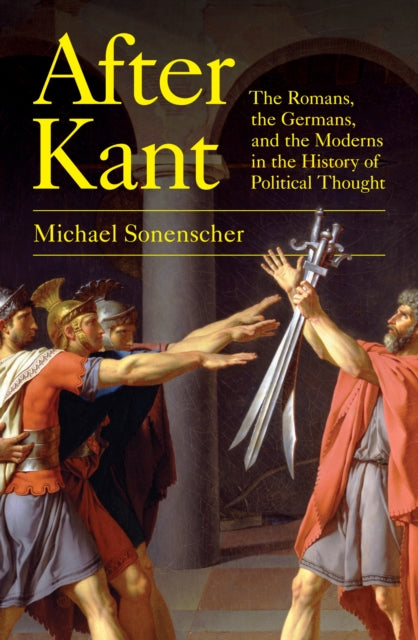
Michael Sonenscher
After Kant: The Romans, the Germans, and the Moderns in the History of Political Thought
After Kant: The Romans, the Germans, and the Moderns in the History of Political Thought
💎 Earn 424 Points (£4.24) on this item.
YOU SAVE £20.03
- Condition: Brand new
- UK Delivery times: Usually arrives within 2 - 3 working days
- UK Shipping: Fee starts at £2.39. Subject to product weight & dimension
Bulk ordering. Want 15 or more copies? Get a personalised quote and bigger discounts. Learn more about bulk orders.
Couldn't load pickup availability
- More about After Kant: The Romans, the Germans, and the Moderns in the History of Political Thought
Michael Sonenscher's book explores the origins of modern political thought by tracing three sets of arguments over history, morality, and freedom. He argues that Kant's question about comparing individual human lives to human history introduced a future-oriented dimension into discussions of prevailing norms, challenging their orientation toward the past. The book connects the genealogy of modern political ideologies to discussions of time, history, and values in France, Germany, Switzerland, and Britain during the period between the French and Industrial revolutions. It examines the enduring impact of this intellectual upheaval on the history and historiography of political thought.
Format: Hardback
Length: 584 pages
Publication date: 11 July 2023
Publisher: Princeton University Press
Tracing the origins of modern political thought through three sets of arguments over history, morality, and freedom, this comprehensive work by Michael Sonenscher delves into the question raised by Immanuel Kant: how can we compare individual human lives to the entirety of human history? Kant's inquiry introduced a future-oriented dimension into existing discussions of prevailing norms, challenging their orientation toward the past. This reversal made Kant's question a bridge between three successive sets of arguments: between the supporters of the ancients and moderns, the classics and romantics, and the Romans and the Germans.
Sonenscher argues that the genealogy of modern political ideologies, from liberalism to nationalism to communism, can be connected to the resulting discussions of time, history, and values in France, Germany, Switzerland, and Britain during the period straddling the French and Industrial revolutions.
The core of this intellectual upheaval lies in the struggle to bridge the gap between individual lives and human history, a gap highlighted by Kant. After Kant, the book examines the enduring impact of this struggle on the history and historiography of political thought.
The first set of arguments revolves around the comparison between the ancients and moderns. The ancients, represented by figures such as Plato and Aristotle, were seen as defenders of traditional values and institutions. They believed in the importance of hierarchy, authority, and the rule of law. On the other hand, the moderns, led by figures like John Locke and Jean-Jacques Rousseau, advocated for individual rights, freedom, and equality. They challenged the authority of the state and emphasized the importance of natural law and human nature.
The second set of arguments concerns the comparison between the classics and romantics. The classics, influenced by thinkers like Cicero and Virgil, emphasized the importance of tradition, culture, and the preservation of the past. They saw history as a narrative of progress, with each generation building upon the achievements of the previous one. The romantics, on the other hand, were more interested in the individual and the subjective experience. They emphasized the power of imagination, emotion, and the natural world and saw history as a series of ruptures and transformations.
The third set of arguments revolves around the comparison between the Romans and the Germans. The Romans, known for their rigid hierarchy and disciplined society, were seen as defenders of order and stability. They believed in the importance of hierarchy, authority, and the rule of law. The Germans, on the other hand, were known for their emphasis on individualism, freedom, and creativity. They challenged the authority of the state and emphasized the importance of personal responsibility and self-expression.
Through these three sets of arguments, Sonenscher demonstrates how modern political thought and ideologies emerged as a response to the challenges posed by the changing world. The ancients and moderns argued about the balance between tradition and innovation, the classics and romantics debated the role of the individual and the collective, and the Romans and the Germans struggled with the balance between order and freedom.
The book also explores the enduring impact of Kant's question on the history and historiography of political thought. Kant's emphasis on the importance of comparing individual lives to human history challenged the traditional view of history as a narrative of progress and instead emphasized the complexity and diversity of human experience. This shift in perspective has led to a more nuanced understanding of political ideologies and their historical context.
In conclusion, Tracing the Origins of Modern Political Thought through Three Sets of Arguments over History, Morality, and Freedom is a thought-provoking exploration of the origins of modern political thought and ideologies. By tracing the connections between these three sets of arguments and the resulting discussions of time, history, and values, Sonenscher provides a comprehensive account of the intellectual upheaval that shaped the development of modern political thought. The book's examination of Kant's question and its enduring impact on the history and historiography of political thought is particularly insightful, highlighting the importance of comparing individual lives to human history and the complexity of the resulting discussions. This book is a valuable resource for scholars and students interested in political thought, history, and the study of human values.
Dimension: 235 x 156 (mm)
ISBN-13: 9780691245621
This item can be found in:
UK and International shipping information
UK and International shipping information
UK Delivery and returns information:
- Delivery within 2 - 3 days when ordering in the UK.
- Shipping fee for UK customers from £2.39. Fully tracked shipping service available.
- Returns policy: Return within 30 days of receipt for full refund.
International deliveries:
Shulph Ink now ships to Australia, Belgium, Canada, France, Germany, Ireland, Italy, India, Luxembourg Saudi Arabia, Singapore, Spain, Netherlands, New Zealand, United Arab Emirates, United States of America.
- Delivery times: within 5 - 10 days for international orders.
- Shipping fee: charges vary for overseas orders. Only tracked services are available for most international orders. Some countries have untracked shipping options.
- Customs charges: If ordering to addresses outside the United Kingdom, you may or may not incur additional customs and duties fees during local delivery.