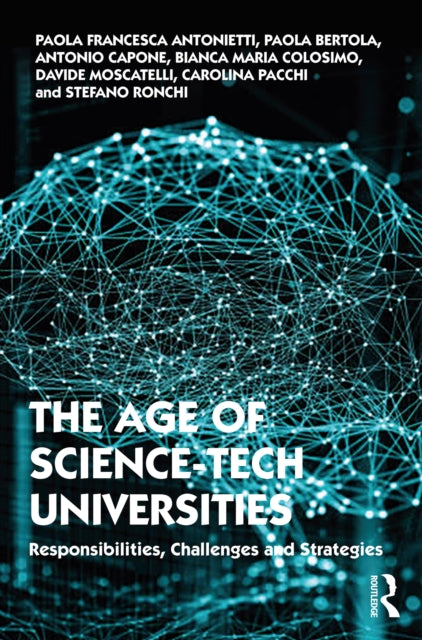
Paola Francesca Antonietti,Paola Bertola,Antonio Capone,Bianca Maria Colosimo,Davide Moscatelli,Carolina Pacchi,Stefano Ronchi
Age of Science-Tech Universities: Responsibilities, Challenges and Strategies
Age of Science-Tech Universities: Responsibilities, Challenges and Strategies
We can order this item for you. Delivery usually takes about 4 to 6 weeks.
This item is not held in our immediate stock. We will order it for you after checkout.
Estimated delivery: About 4 to 6 weeks
YOU SAVE £3.60
- Condition: Brand new
- UK Delivery times: Usually arrives within 2 - 3 working days
- UK Shipping: Fee starts at £3.89. Subject to product weight & dimension
Bulk ordering. Want 15 or more copies? Get a personalised quote and bigger discounts. Learn more about bulk orders.
Couldn't load pickup availability
- More about Age of Science-Tech Universities: Responsibilities, Challenges and Strategies
This book examines and analyzes trends in science and technical universities in Europe to ensure their contribution to society, including their role in knowledge-based economies and societies. It provides recommendations for adapting and employing current models.
\n Format: Paperback / softback
\n Length: 154 pages
\n Publication date: 29 December 2021
\n Publisher: Taylor & Francis Ltd
\n
This comprehensive book delves into the examination and analysis of current and emerging trends within European science and technical universities, with a primary focus on exploring the necessary actions these institutions must undertake to ensure their continued contribution to society. Through an in-depth exploration, it sheds light on the pivotal role of science-tech universities in knowledge-based economies and societies, offering valuable insights into their potential for growth and development. Additionally, this title provides valuable recommendations for adapting and leveraging current models to meet the evolving demands of the future.
Introduction:
The landscape of higher education in Europe is undergoing a profound transformation, driven by a multitude of factors such as technological advancements, changing societal needs, and global competition. Science and technical universities, as key players in this ecosystem, are facing significant challenges and opportunities in their quest to remain relevant and impactful. This book aims to provide a comprehensive examination of these trends and their implications for science and technical universities in Europe.
The Role of Science-Tech Universities in Knowledge-Based Economies and Societies:
Science-tech universities play a vital role in shaping the knowledge-based economies and societies of the 21st century. They are hubs of innovation, research, and education, producing graduates who are equipped with the skills and knowledge necessary to drive economic growth and address societal challenges. In the context of knowledge-based economies, science-tech universities are crucial in fostering entrepreneurship, promoting technological advancements, and creating new industries. They collaborate with industry partners, government agencies, and other stakeholders to develop cutting-edge solutions and address complex problems.
Furthermore, science-tech universities contribute to the development of well-informed citizens and the growth of democratic societies. They provide access to high-quality education and research opportunities, promoting critical thinking, creativity, and problem-solving skills. Through their teaching and research programs, they contribute to the dissemination of knowledge and the advancement of scientific and technological knowledge, fostering a culture of lifelong learning and intellectual curiosity.
Current Models and Challenges:
While science-tech universities have achieved significant success in the past, they are also facing several challenges. One of the primary challenges is the need to adapt to rapidly changing technological and societal trends. The pace of innovation is accelerating, and universities must constantly update their curriculum, research programs, and teaching methodologies to remain relevant. This requires a significant investment in resources, including funding, infrastructure, and human capital.
Another challenge is the increasing competition for talent and resources. With the rise of online education and the globalization of the job market, universities are facing a fierce competition for students, faculty, and research funding. This has led to a need for universities to differentiate themselves and offer unique value propositions to their stakeholders.
In addition, science-tech universities are also grappling with issues related to sustainability and social responsibility. As they contribute to economic growth and address societal challenges, they must also consider their environmental impact and their role in promoting social justice and equity. This requires a commitment to sustainable practices, such as reducing carbon emissions, promoting diversity and inclusion, and addressing social inequalities.
Recommendations for Adaptation and Employment:
To address these challenges and ensure the continued contribution of science-tech universities to society, there are several recommendations that can be adopted. Firstly, universities must prioritize investment in research and innovation. This includes funding research programs that address pressing societal needs, such as healthcare, climate change, and sustainable development. It also involves fostering collaboration between academia, industry, and government to promote innovation and entrepreneurship.
Secondly, universities must adapt their curriculum and teaching methodologies to meet the changing demands of the job market. This includes incorporating digital technologies, interdisciplinary approaches, and skills training programs that align with the needs of industry. It also involves providing students with practical experience and opportunities to apply their knowledge in real-world settings.
Thirdly, universities must prioritize sustainability and social responsibility. This includes implementing sustainable practices in their operations, such as reducing carbon emissions, promoting diversity and inclusion, and addressing social inequalities. It also involves engaging with local communities and stakeholders to promote social change and contribute to the well-being of society.
Finally, universities must embrace lifelong learning and continuous improvement. This includes providing opportunities for faculty and staff to develop their skills and knowledge, and encouraging students to pursue lifelong learning and personal development. It also involves evaluating and adapting their programs and policies based on feedback and data to ensure their continued relevance and effectiveness.
Conclusion:
In conclusion, this book provides a comprehensive examination of current and future trends in science and technical universities in Europe. It highlights the role of these institutions in knowledge-based economies and societies, and the challenges and opportunities they face. By adopting appropriate recommendations for adaptation and employment, science-tech universities can continue to contribute to society and shape the future of higher education in Europe.
\n Weight: 272g\n
Dimension: 172 x 375 x 15 (mm)\n
ISBN-13: 9781032138350\n \n
UK and International shipping information
UK and International shipping information
We deliver throughout the United Kingdom and to 128 countries and territories worldwide, including the United States, Australia, Canada, Germany, Spain and France.