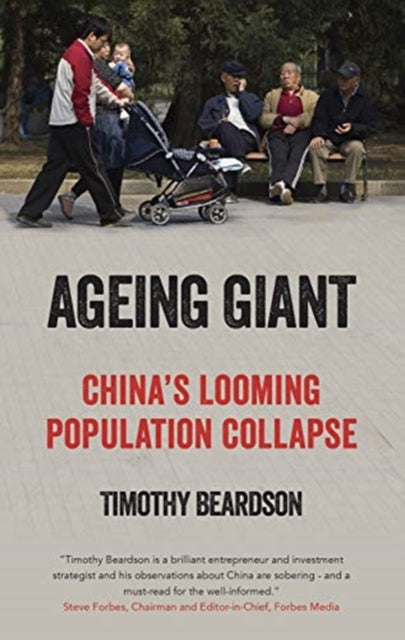
Timothy Beardson
Ageing Giant: China's Looming Population Collapse
Ageing Giant: China's Looming Population Collapse
💎 Earn 79 Points (£0.79) on this item.
YOU SAVE £3.17
- Condition: Brand new
- UK Delivery times: Usually arrives within 2 - 3 working days
- UK Shipping: Fee starts at £2.39. Subject to product weight & dimension
Bulk ordering. Want 15 or more copies? Get a personalised quote and bigger discounts. Learn more about bulk orders.
Couldn't load pickup availability
- More about Ageing Giant: China's Looming Population Collapse
China's population is expected to drop to around half that level as a major and unprecedented demographic crisis begins to bite, with its working-age population already stopped growing and its retired to those working ratio rising. This has created a skewed sex ratio at birth, with over 50 million surplus adult males, unmarried and unhappy. The state has previously sought to impose its will on reproduction, but Chinese families experienced a sharply reduced birthrate even before the introduction of the one-child policy. This book is the first to examine in detail China's demographic history and the impending crisis that will see more people in the United States by 2100 than in China.
\n Format: Hardback
\n Length: 320 pages
\n Publication date: 24 June 2021
\n Publisher: Signal Books Ltd
\n
China's population, currently around 1.4 billion, is expected to drop significantly before the end of the present century due to a major and unprecedented demographic crisis. The country's working-age population has already stopped growing and is now experiencing a contraction, leading to a shrinking labor force. With increasing longevity, by the 2050s, there will be over 400 million Chinese citizens aged 65 or above, with limited provisions for their care in a society where the norm is having a single child. The ratio of retired individuals to those still working is steadily rising, placing significant pressure on families and public finances.
Years of preference for having a male child have resulted in a skewed sex ratio at birth, with an estimated over 50 million surplus adult males expected in the coming years. This exceeds the entire male population of Germany. The Chinese government has previously attempted to control reproduction through policies such as the one-child policy, but these measures have had limited success in increasing birth rates. Despite the relaxation of restrictions on the number of children allowed, births remain stubbornly low.
In his timely and fascinating new book, Timothy Beardson explores the demographic history of China and the impending crisis that will see more people in the United States by 2100 than in China. He highlights how China's ageing and shrinking population will impact various aspects of society, including business ethics, healthcare, and social welfare systems. The book provides a comprehensive analysis of the challenges China faces and offers insights into how the country can navigate this demographic transition.
One of the key findings of the book is that China's demographic shift is part of a broader global trend towards low fertility. As countries in the developed world experience lower birth rates and longer life expectancies, China's population is expected to continue to decline. This will have significant implications for the country's economy, as a shrinking labor force may struggle to support a growing elderly population.
The book also explores the social and cultural factors that have contributed to China's demographic crisis. For example, the preference for having a male child has led to a skewed sex ratio at birth, with many families having only one child due to the cultural belief that a son is more valuable and can provide for the family in old age. This has resulted in a large number of unmarried and unhappy adult males, who face significant social and economic challenges.
Another factor contributing to China's demographic crisis is urbanization. As more people move from rural areas to cities, the demand for housing, healthcare, and social services increases, putting pressure on urban infrastructure and resources. The government has attempted to address this issue through policies such as the "Housing Provident Fund" and "Urbanization Plan," but these measures have had limited success in improving the living conditions of urban residents.
The book also raises concerns about the impact of China's demographic crisis on the country's social welfare systems. With an aging population, the burden of providing healthcare and social security benefits will increase significantly, placing pressure on the government's finances. The government has implemented policies such as the "New Health Insurance" and "Social Security System" to address these issues, but there are still gaps in coverage and access to healthcare services.
Despite the challenges China faces, the book offers some hope for the future. Beardson suggests that the country can leverage its demographic advantage by investing in education, innovation, and infrastructure development. By promoting lifelong learning and skills development, China can ensure that its workforce can adapt to changing economic and social conditions and maintain a competitive edge in the global marketplace.
In conclusion, China's population is expected to drop significantly before the end of the present century due to a major and unprecedented demographic crisis. The country's working-age population has already stopped growing and is now experiencing a contraction, leading to a shrinking labor force. With increasing longevity, by the 2050s, there will be over 400 million Chinese citizens aged 65 or above, with limited provisions for their care in a society where the norm is having a single child. The ratio of retired individuals to those still working is steadily rising, placing significant pressure on families and public finances. The preference for having a male child has resulted in a skewed sex ratio at birth, with many families having only one child due to cultural beliefs. Urbanization has also contributed to the crisis, as more people move from rural areas to cities, putting pressure on urban infrastructure and resources. The book highlights the challenges China faces and offers some hope for the future by suggesting that the country.
\n Weight: 596g\n
Dimension: 147 x 223 x 36 (mm)\n
ISBN-13: 9781909930988\n \n
This item can be found in:
UK and International shipping information
UK and International shipping information
UK Delivery and returns information:
- Delivery within 2 - 3 days when ordering in the UK.
- Shipping fee for UK customers from £2.39. Fully tracked shipping service available.
- Returns policy: Return within 30 days of receipt for full refund.
International deliveries:
Shulph Ink now ships to Australia, Belgium, Canada, France, Germany, Ireland, Italy, India, Luxembourg Saudi Arabia, Singapore, Spain, Netherlands, New Zealand, United Arab Emirates, United States of America.
- Delivery times: within 5 - 10 days for international orders.
- Shipping fee: charges vary for overseas orders. Only tracked services are available for most international orders. Some countries have untracked shipping options.
- Customs charges: If ordering to addresses outside the United Kingdom, you may or may not incur additional customs and duties fees during local delivery.