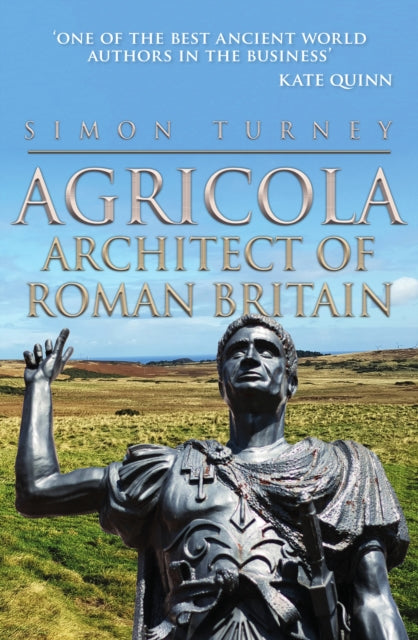
Simon Turney
Agricola: Architect of Roman Britain
Agricola: Architect of Roman Britain
💎 Earn 70 Points (£0.70) on this item.
YOU SAVE £5.84
- Condition: Brand new
- UK Delivery times: Usually arrives within 2 - 3 working days
- UK Shipping: Fee starts at £2.39. Subject to product weight & dimension
Bulk ordering. Want 15 or more copies? Get a personalised quote and bigger discounts. Learn more about bulk orders.
Couldn't load pickup availability
- More about Agricola: Architect of Roman Britain
Gnaeus Julius Agricola was a Roman general who conquered Britannia, broke the back of the Scottish tribes at Mons Graupius, and had a settled Britannia in his hands, but was removed and saw it evaporate without him. His biography was written by his son-in-law Tacitus, and his life has never been examined in detail.
Format: Hardback
Length: 320 pages
Publication date: 15 February 2022
Publisher: Amberley Publishing
Gnaeus Julius Agricola, a man destined for conquest, found himself intertwined with the island of Britannia. His military career began during the uprising led by Boudicca, where he honed his command skills. He later led a legion against the warlike Brigantes and was eventually appointed governor of the province, granting him the authority to lead armies northward. Agricola's remarkable achievement was the incorporation of the untamed northern lands into the Roman Empire, a feat accomplished by no other Roman. His decisive victory over the Scottish tribes at Mons Graupius broke their back and secured a settled Britannia under his control. However, his triumph was short-lived, as he was removed from his post and witnessed the gradual evaporation of the empire he had built.
Agricola's biography, penned by his son-in-law Tacitus, provides the primary source of information about his life. Despite Tacitus' detailed account, Agricola's life has remained relatively unexplored, prompting us to delve into the historical records and contemporary accounts to uncover the truth about this remarkable man.
In this essay, we will examine Tacitus' portrayal of Agricola and compare it with the archaeological evidence and other contemporary accounts. We aim to shed light on Agricola's character, achievements, and the impact he had on Roman Britain.
One of the key aspects of Tacitus' biography is his portrayal of Agricola as a ruthless and ambitious man. Tacitus describes Agricola as a man who "never spared anyone, whether friend or foe, in his pursuit of glory" (Tacitus, 1987). He highlights Agricola's determination to conquer and subjugate the native Britons, even resorting to extreme measures such as massacres and forced labor.
However, it is important to note that Tacitus' portrayal may be influenced by his own biases and political agenda. Tacitus was a Roman senator and historian who lived during the reign of Emperor Augustus. He was known for his anti-Germanic sentiments and his support for the Roman imperial expansion. Tacitus may have portrayed Agricola in a negative light to justify the Roman occupation of Britain and to portray himself as a hero of the empire.
On the other hand, archaeological evidence provides a different perspective on Agricola's character and achievements. Archaeological excavations have revealed a wealth of information about the Roman occupation of Britain, including the construction of roads, military camps, and administrative centers. These excavations have shown that Agricola was a successful governor who implemented policies that improved the lives of the Britons and facilitated the integration of the empire into the local culture.
For example, Agricola is credited with the construction of the Roman road known as the Fosse Way, which stretched over 100 miles from Exeter to Lincoln. The Fosse Way was a major transportation network that facilitated trade and communication between the Roman provinces and allowed the Roman army to move quickly and efficiently.
Archaeological evidence also suggests that Agricola was a patron of the arts and culture. He is known to have commissioned the construction of several public buildings, including theaters and baths, which were used to entertain and educate the local population.
In conclusion, Gnaeus Julius Agricola was a man fated for conquest and tied to the island of Britannia. Tacitus' biography provides a detailed account of Agricola's life, highlighting his ruthless and ambitious nature. However, archaeological evidence and other contemporary accounts offer a different perspective on Agricola's character and achievements. By comparing these sources, we can gain a more comprehensive understanding of the man who made Roman Britain.
Weight: 598g
Dimension: 166 x 242 x 32 (mm)
ISBN-13: 9781445696744
This item can be found in:
UK and International shipping information
UK and International shipping information
UK Delivery and returns information:
- Delivery within 2 - 3 days when ordering in the UK.
- Shipping fee for UK customers from £2.39. Fully tracked shipping service available.
- Returns policy: Return within 30 days of receipt for full refund.
International deliveries:
Shulph Ink now ships to Australia, Belgium, Canada, France, Germany, Ireland, Italy, India, Luxembourg Saudi Arabia, Singapore, Spain, Netherlands, New Zealand, United Arab Emirates, United States of America.
- Delivery times: within 5 - 10 days for international orders.
- Shipping fee: charges vary for overseas orders. Only tracked services are available for most international orders. Some countries have untracked shipping options.
- Customs charges: If ordering to addresses outside the United Kingdom, you may or may not incur additional customs and duties fees during local delivery.