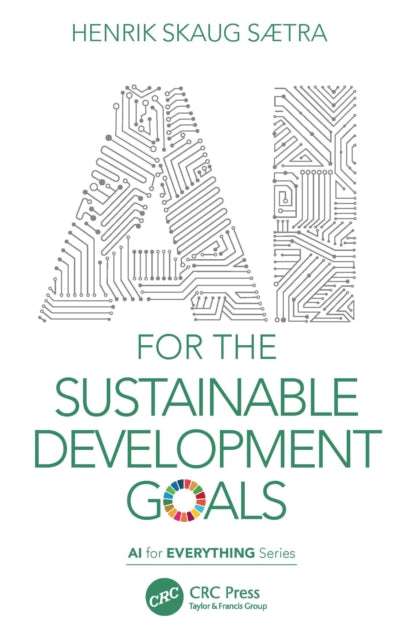
Henrik Skaug Saetra
AI for the Sustainable Development Goals
AI for the Sustainable Development Goals
💎 Earn 132 Points (£1.32) on this item.
YOU SAVE £1.57
- Condition: Brand new
- UK Delivery times: Usually arrives within 2 - 3 working days
- UK Shipping: Fee starts at £2.39. Subject to product weight & dimension
Bulk ordering. Want 15 or more copies? Get a personalised quote and bigger discounts. Learn more about bulk orders.
Couldn't load pickup availability
- More about AI for the Sustainable Development Goals
Artificial intelligence (AI) significantly impacts our lives and environment, and the Sustainable Development Goals (SDGs) provide a framework to evaluate these impacts. This book emphasizes the importance of understanding the context of AI, including its infrastructure, development, ownership, access, and use, to analyze its direct and indirect effects on sustainability. AI can positively and negatively affect all SDGs, and this book highlights the need to consider these impacts when implementing AI solutions.
Format: Paperback / softback
Length: 120 pages
Publication date: 24 February 2022
Publisher: Taylor & Francis Ltd
The book also provides a roadmap for policymakers, businesses, and other stakeholders to use AI to achieve the SDGs.
Artificial intelligence (AI) is a rapidly evolving field that has the potential to revolutionize various aspects of our lives, from healthcare to transportation to finance. It involves the development of computer systems that can perform tasks that traditionally require human intelligence, such as learning, reasoning, and problem-solving. AI has the ability to analyze large amounts of data and make predictions based on that data, which can help us make more informed decisions and solve complex problems.
One of the key challenges facing AI is ensuring that it is developed and used in a responsible and ethical manner. There are concerns about the potential risks associated with AI, such as job displacement, privacy breaches, and the misuse of data. To address these concerns, it is important to develop guidelines and regulations for the development and use of AI.
Another challenge facing AI is ensuring that it is developed and used in a way that aligns with the Sustainable Development Goals (SDGs). The SDGs are a set of 17 goals set by the United Nations to address global challenges such as poverty, inequality, climate change, and environmental degradation. AI has the potential to contribute to the achievement of these goals, but it is important to ensure that it is developed and used in a way that is sustainable and socially responsible.
One way that AI can contribute to the achievement of the SDGs is by helping to improve the efficiency and effectiveness of sustainable development practices. For example, AI can be used to monitor and analyze environmental data, which can help us identify areas where conservation efforts are needed and track the progress of these efforts. AI can also be used to develop new technologies and solutions that can help us reduce our carbon footprint and promote renewable energy sources.
Another way that AI can contribute to the achievement of the SDGs is by helping to improve the quality of life for people around the world. For example, AI can be used to develop new medical treatments and therapies that can help people live longer and healthier lives. AI can also be used to develop new educational tools and resources that can help people learn new skills and improve their job prospects.
However, it is important to note that AI cannot solve all of the world's problems. It is important to recognize that AI is a tool that can be used to enhance human capabilities and improve our ability to address global challenges. It is not a replacement for human intelligence or creativity, and it is important to ensure that AI is developed and used in a way that is complementary to human efforts.
In conclusion, artificial intelligence has the potential to have a significant impact on our lives and on the environment. It is important to ensure that AI is developed and used in a responsible and ethical manner, and that it is developed and used in a way that aligns with the Sustainable Development Goals. By doing so, we can create a more sustainable and prosperous future for all.
The Sustainable Development Goals (SDGs) are a set of 17 goals set by the United Nations in 2015 to address global challenges such as poverty, inequality, climate change, and environmental degradation. The SDGs are designed to promote sustainable development and ensure that all people have access to basic human rights, such as food, water, healthcare, education, and housing.
One of the ways in which AI can contribute to the achievement of the SDGs is by helping to improve the efficiency and effectiveness of sustainable development practices. For example, AI can be used to monitor and analyze environmental data, which can help us identify areas where conservation efforts are needed and track the progress of these efforts. AI can also be used to develop new technologies and solutions that can help us reduce our carbon footprint and promote renewable energy sources.
Another way in which AI can contribute to the achievement of the SDGs is by helping to improve the quality of life for people around the world. For example, AI can be used to develop new medical treatments and therapies that can help people live longer and healthier lives. AI can also be used to develop new educational tools and resources that can help people learn new skills and improve their job prospects.
However, it is important to note that AI cannot solve all of the world's problems. It is important to recognize that AI is a tool that can be used to enhance human capabilities and improve our ability to address global challenges. It is not a replacement for human intelligence or creativity, and it is important to ensure that AI is developed and used in a way that is complementary to human efforts.
In conclusion, artificial intelligence has the potential to have a significant impact on the achievement of the Sustainable Development Goals. It is important to ensure that AI is developed and used in a responsible and ethical manner, and that it is developed and used in a way that aligns with the Sustainable Development Goals. By doing so, we can create a more sustainable and prosperous future for all.
Weight: 136g
Dimension: 127 x 196 x 15 (mm)
ISBN-13: 9781032044064
This item can be found in:
UK and International shipping information
UK and International shipping information
UK Delivery and returns information:
- Delivery within 2 - 3 days when ordering in the UK.
- Shipping fee for UK customers from £2.39. Fully tracked shipping service available.
- Returns policy: Return within 30 days of receipt for full refund.
International deliveries:
Shulph Ink now ships to Australia, Belgium, Canada, France, Germany, Ireland, Italy, India, Luxembourg Saudi Arabia, Singapore, Spain, Netherlands, New Zealand, United Arab Emirates, United States of America.
- Delivery times: within 5 - 10 days for international orders.
- Shipping fee: charges vary for overseas orders. Only tracked services are available for most international orders. Some countries have untracked shipping options.
- Customs charges: If ordering to addresses outside the United Kingdom, you may or may not incur additional customs and duties fees during local delivery.