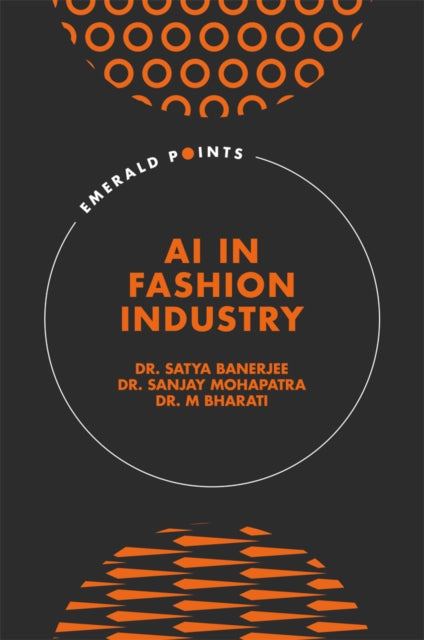
Dr. SatyaBanerjee,Dr. SanjayMohapatra,Dr. M.Bharati
AI in Fashion Industry
AI in Fashion Industry
💎 Earn 228 Points (£2.28) on this item.
YOU SAVE £2.31
- Condition: Brand new
- UK Delivery times: Usually arrives within 2 - 3 working days
- UK Shipping: Fee starts at £2.39. Subject to product weight & dimension
Bulk ordering. Want 15 or more copies? Get a personalised quote and bigger discounts. Learn more about bulk orders.
Couldn't load pickup availability
- More about AI in Fashion Industry
The fashion industry is worth $3 billion and is characterized by short shelf-life, wrong forecasts, low profits, and increasing competition. Technology is rapidly invading the industry, with emerging forms such as AI, Machine Learning, Deep Learning, Artificial Neural Networks, and Human-Robot Interface. This book discusses recent developments in fashion forecasting, developing a framework of AI-based fashion forecasting, and validating the framework with a qualitative case study of the world's first fashion intelligence company. It also studies the relationship between fashion and social media engagement of consumers and creates a conceptual framework of fashion e-forecasting.
Format: Hardback
Length: 192 pages
Publication date: 14 February 2022
Publisher: Emerald Publishing Limited
The fashion industry is a captivating realm, adorned with the allure of beauty, wealth, fame, and substantial profits. Yet, upon closer inspection, it becomes evident that the industry is grappling with internal challenges. Valued at $3 Billion (USD), the fashion industry is distinguished by its products' short shelf-life, inaccurate forecasts, limited profits, and relentless competition. At the periphery, technology is swiftly encroaching upon the fashion industry, with emerging forms such as Artificial Intelligence, Machine Learning, Deep Learning, Artificial Neural Networks, Human-Robot Interface, making their way into this domain in recent years.
AI in Fashion Industry delves into the latest advancements in fashion forecasting, crafting a framework rooted in Artificial Intelligence (AI) for fashion forecasting and substantiating it through a qualitative case study of the world's pioneering fashion intelligence company headquartered in Bengaluru, India. This book explores the intricate relationship between fashion and consumer social media engagement, paving the way for the development of a conceptual framework for fashion e-forecasting. The case study addresses the forecasting-based business problem of a family-owned fashion retail business.
What sets this book apart is its innovative approach to fashion product development, harnessing data-driven intelligence. It documents some of the rapid developments in the field with the advent of technology and addresses fundamental questions that have gained increasing relevance in recent years. The fashion industry is undergoing a transformative era, driven by the fusion of technology and creativity. The implementation of AI and other advanced technologies is revolutionizing the way fashion products are designed, manufactured, and marketed. By leveraging data and analytics, fashion companies can gain a deeper understanding of consumer preferences, trends, and behaviors, allowing them to create more personalized and effective products.
One of the key areas where AI is making significant strides in the fashion industry is in fashion forecasting. Traditional forecasting methods rely heavily on human expertise and intuition, often resulting in inaccurate predictions and missed opportunities. However, AI algorithms can analyze vast amounts of data, including historical sales patterns, social media trends, and weather data, to generate more accurate and timely fashion forecasts. This not only helps fashion companies optimize their inventory management and production processes but also enables them to make informed decisions about product development and marketing strategies.
Another area where AI is making a significant impact is in the realm of product design and development. AI-powered design tools can generate endless variations of designs, allowing fashion designers to explore new and innovative concepts quickly and efficiently. These tools can also analyze consumer feedback and preferences to refine designs and improve their appeal. Moreover, AI can assist in the production of fashion products by automating certain processes, such as pattern cutting and sewing. This not only reduces production costs but also improves the quality and consistency of the products.
In addition to its benefits in forecasting and product design, AI is also being used in the marketing and promotion of fashion products. Social media platforms, in particular, have become an essential tool for fashion brands to connect with consumers and promote their products. AI algorithms can analyze social media data to identify trends, patterns, and preferences of consumers, allowing fashion companies to tailor their marketing strategies accordingly. This can lead to increased engagement, sales, and brand awareness.
However, the integration of AI and other advanced technologies in the fashion industry also presents challenges. One of the main concerns is the potential impact on job displacement. As AI algorithms become more sophisticated, they may replace human workers in certain tasks, such as pattern cutting and sewing. This could lead to job losses and economic inequality in the fashion industry.
Another challenge is the ethical considerations surrounding the use of AI in fashion. As AI algorithms are trained on large datasets, they may perpetuate biases and stereotypes that exist in society industry. This could lead to discrimination and inequality in the fashion industry, particularly for marginalized communities.
To address these challenges, the fashion industry needs to adopt a responsible and ethical approach to the integration of AI and other advanced technologies. This includes investing in training and education programs to upskill human workers and ensure they are equipped with the necessary skills to adapt to the changing landscape. It also involves developing guidelines and regulations to ensure that the use of AI in fashion is transparent, fair, and inclusive.
In conclusion, the fashion industry is undergoing a transformative era, driven by the fusion of technology and creativity. The implementation of AI and other advanced technologies is revolutionizing the way the fashion industry operates, from fashion forecasting to product design and development to marketing and promotion. While these technologies offer significant benefits, they also present challenges that need to be addressed. By adopting a responsible and ethical approach, the fashion industry can harness the power of AI and other advanced technologies to create a more sustainable, inclusive, and sustainable future.
Weight: 398g
Dimension: 160 x 239 x 27 (mm)
ISBN-13: 9781802626346
This item can be found in:
UK and International shipping information
UK and International shipping information
UK Delivery and returns information:
- Delivery within 2 - 3 days when ordering in the UK.
- Shipping fee for UK customers from £2.39. Fully tracked shipping service available.
- Returns policy: Return within 30 days of receipt for full refund.
International deliveries:
Shulph Ink now ships to Australia, Belgium, Canada, France, Germany, Ireland, Italy, India, Luxembourg Saudi Arabia, Singapore, Spain, Netherlands, New Zealand, United Arab Emirates, United States of America.
- Delivery times: within 5 - 10 days for international orders.
- Shipping fee: charges vary for overseas orders. Only tracked services are available for most international orders. Some countries have untracked shipping options.
- Customs charges: If ordering to addresses outside the United Kingdom, you may or may not incur additional customs and duties fees during local delivery.