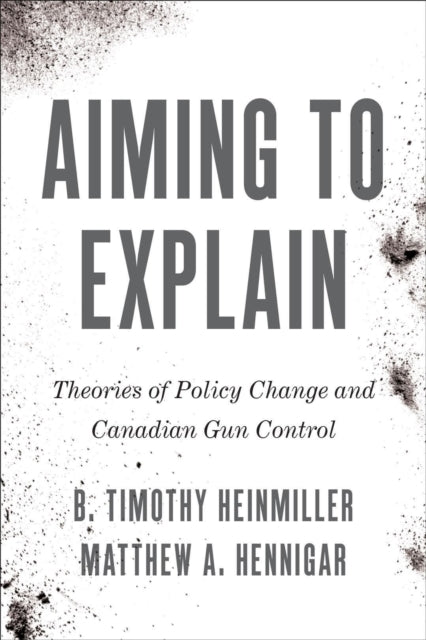
B. Timothy Heinmiller,Matthew A. Hennigar
Aiming to Explain: Theories of Policy Change and Canadian Gun Control
Aiming to Explain: Theories of Policy Change and Canadian Gun Control
💎 Earn 102 Points (£1.02) on this item.
YOU SAVE £2.47
- Condition: Brand new
- UK Delivery times: Usually arrives within 2 - 3 working days
- UK Shipping: Fee starts at £2.39. Subject to product weight & dimension
Bulk ordering. Want 15 or more copies? Get a personalised quote and bigger discounts. Learn more about bulk orders.
Couldn't load pickup availability
- More about Aiming to Explain: Theories of Policy Change and Canadian Gun Control
Firearms policy has dominated Canadian politics since the late 1960s, but there is little scholarship on the topic compared to the United States. Aiming to Explain examines five prominent policy process theories employed during the period from the 1989 Montreal Massacre to the 2012 cancellation of the universal firearms registry, using rigorous applications of rational choice institutionalism, social constructivism, the advocacy coalition framework, the multiple streams framework, and punctuated equilibrium. The goal is to compare their relative strengths and weaknesses to direct future research and theoretical development efforts in the study of Canadian public policy.
Format: Paperback / softback
Length: 260 pages
Publication date: 14 July 2022
Publisher: University of Toronto Press
Since the late 1960s, firearms policy has played a significant role in Canadian politics. However, compared to the United States, there has been limited scholarly attention given to firearms policy in the neighboring North. Aiming to Explain, a book by B. Timothy Heinmiller and Matthew A. Hennigar, seeks to address this gap by examining five prominent policy process theories employed during the period from the 1989 Montreal Massacre to the 2012 cancellation of the universal firearms registry.
Throughout the book, Heinmiller and Hennigar present rigorous applications of rational choice institutionalism, social constructivism, the advocacy coalition framework, the multiple streams framework, and punctuated equilibrium. These theories are used to analyze the political dynamics and decision-making processes surrounding Canadian firearms policy.
The investigations in Aiming to Explain draw on a wide range of data collection and analysis techniques, including inferential statistics, descriptive statistics, process tracing, congruence analysis, and qualitative content analysis. The goal of the book is not to select a single best theory but to compare their relative strengths and weaknesses in an effort to guide future research and theoretical development efforts in the study of Canadian public policy.
One of the key strengths of Aiming to Explain is its comprehensive coverage of the policy process theories employed during the studied period. The authors provide detailed explanations of each theory and their applications to Canadian firearms policy. They also discuss the limitations and challenges of each theory and how they can be improved to better understand the policy process.
Another strength of the book is its use of rigorous research methods. The authors employ method-based best practices, drawing on a wide range of literature and empirical evidence to support their arguments. They also use a variety of data collection and analysis techniques, which allow them to examine the policy process from different perspectives and identify key factors that influence decision-making.
One of the challenges of Aiming to Explain is its focus on Canadian firearms policy. While the book provides valuable insights into the policy process and the factors that influence decision-making, it may be less relevant to other countries or policy domains. However, the authors suggest that the theories and methods employed in the book can be applied to other policy areas, such as health policy or environmental policy, with some modifications.
In conclusion, Aiming to Explain is a valuable contribution to the study of Canadian public policy. The book provides a comprehensive analysis of five prominent policy process theories employed during the period from the 1989 Montreal Massacre to the 2012 cancellation of the universal firearms registry. By employing rigorous research methods and drawing on a wide range of data collection and analysis techniques, the authors offer valuable insights into the policy process and the factors that influence decision-making. While the book may have a limited audience, its insights and methods can be applied to other policy areas, and it is a valuable resource for scholars and policymakers interested in understanding the dynamics of public policy.
Weight: 440g
Dimension: 229 x 152 x 17 (mm)
ISBN-13: 9781487542337
This item can be found in:
UK and International shipping information
UK and International shipping information
UK Delivery and returns information:
- Delivery within 2 - 3 days when ordering in the UK.
- Shipping fee for UK customers from £2.39. Fully tracked shipping service available.
- Returns policy: Return within 30 days of receipt for full refund.
International deliveries:
Shulph Ink now ships to Australia, Belgium, Canada, France, Germany, Ireland, Italy, India, Luxembourg Saudi Arabia, Singapore, Spain, Netherlands, New Zealand, United Arab Emirates, United States of America.
- Delivery times: within 5 - 10 days for international orders.
- Shipping fee: charges vary for overseas orders. Only tracked services are available for most international orders. Some countries have untracked shipping options.
- Customs charges: If ordering to addresses outside the United Kingdom, you may or may not incur additional customs and duties fees during local delivery.