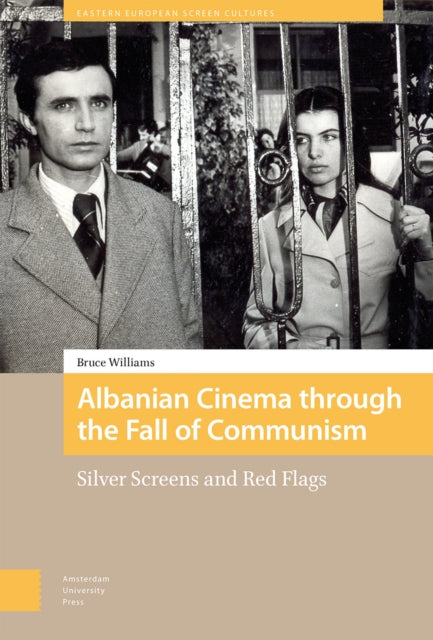
Bruce Williams
Albanian Cinema through the Fall of Communism: Silver Screens and Red Flags
Albanian Cinema through the Fall of Communism: Silver Screens and Red Flags
💎 Earn 689 Points (£6.89) on this item.
We can order this item for you. Delivery usually takes about 4 to 6 weeks.
This item is not held in our immediate stock. We will order it for you after checkout.
Estimated delivery: About 4 to 6 weeks
YOU SAVE £8.18
- Condition: Brand new
- UK Delivery times: Usually arrives within 2 - 3 working days
- UK Shipping: Fee starts at £3.89. Subject to product weight & dimension
Bulk ordering. Want 15 or more copies? Get a personalised quote and bigger discounts. Learn more about bulk orders.
Couldn't load pickup availability
- More about Albanian Cinema through the Fall of Communism: Silver Screens and Red Flags
Albanian cinema has a rich history, despite being isolated during the Cold War era. The book explores moving images in Albania from the Ottoman period to the postcommunist period, highlighting the transformations in Kinostudio's films.
Format: Hardback
Length: 246 pages
Publication date: 26 October 2023
Publisher: Amsterdam University Press
Albanian cinema, a largely unexplored territory for most of the world, holds a unique place in European history. During the Cold War era, communist Albania was one of the westernmost outposts of the Ottoman Empire, isolated from the West for centuries. Despite this isolation, Albania had a vibrant cinema tradition that was often overlooked by the rest of the world. The state-run Kinostudio enterprise produced films that were surprisingly innovative and, at times, daringly subversive. This book explores the evolution of moving images in Albania, from the Ottoman period to the present day. It begins by examining the moving images during the Ottoman period, followed by those captured under independence and the Fascist occupation. The book then focuses on the transformations in Kinostudio, from the early optimism of socialist realism to the brooding social angst of the 1980s, which laid the foundation for the socioeconomic concerns of Albanian films in the postcommunist period.
Albania's isolation during the Cold War era had a significant impact on its cinema. The country was cut off from the West, and its film industry was heavily influenced by the Soviet Union. However, despite these limitations, Albanian filmmakers were able to create films that were both innovative and reflective of their country's unique cultural and political landscape.
One of the most notable features of Albanian cinema is its use of symbolism. Many of the films produced during the communist era were filled with symbols that represented the struggle of the Albanian people against oppression. These symbols included the flag of Albania, the hammer and sickle, and the image of the Albanian peasant.
Another important aspect of Albanian cinema is its focus on social issues. Many of the films produced during the communist era dealt with issues such as poverty, unemployment, and corruption. These films were often critical of the government and the ruling party, and they helped to raise awareness of these issues among the Albanian people.
Despite the challenges that Albania faced during the Cold War era, its cinema has continued to thrive in the postcommunist period. The country has produced a number of films that have been recognized internationally, including "The Forgiveness of Blood" (2011), which won the Academy Award for Best Foreign Language Film.
In recent years, Albania has also been making efforts to promote its cinema internationally. The country has hosted film festivals, and it has been working to establish relationships with other film industries around the world. This has helped to increase the visibility of Albanian films and to attract more international funding.
However, despite these efforts, Albania's cinema still faces a number of challenges. The country's film industry is still relatively small, and it lacks the resources and infrastructure that are necessary to produce high-quality films. Additionally, the country's political climate can be unstable, which can make it difficult for filmmakers to produce films that are critical of the government.
Despite these challenges, Albanian cinema continues to be a source of pride for the Albanian people. The country's films have been praised for their creativity, their emotional depth, and their ability to capture the essence of Albanian culture. They have also been used as a tool for social change, and they have helped to raise awareness of important issues among the Albanian people.
In conclusion, Albanian cinema is a terra incognita for most of the world. Despite its isolation during the Cold War era, Albania had a vibrant cinema tradition that was often overlooked by the rest of the world. The state-run Kinostudio enterprise produced films that were innovative and daringly subversive, and they helped to raise awareness of social issues among the Albanian people. Despite the challenges that Albania faces in the postcommunist period, its cinema continues to thrive, and it is a source of pride for the Albanian people.
Dimension: 234 x 156 (mm)
ISBN-13: 9789462980150
UK and International shipping information
UK and International shipping information
We deliver throughout the United Kingdom and to 128 countries and territories worldwide, including the United States, Australia, Canada, Germany, Spain and France.