Shulph Ink
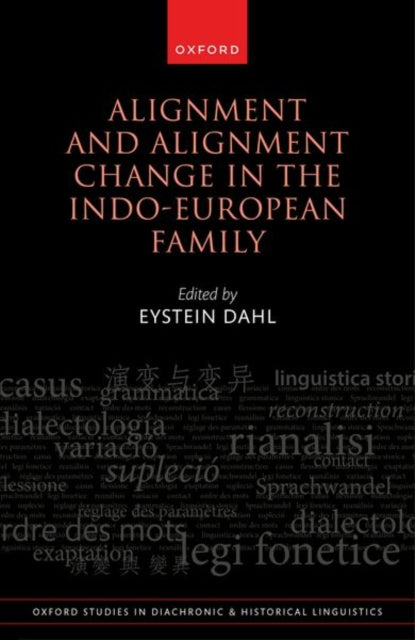
Alignment and Alignment Change in the Indo-European Family
Alignment and Alignment Change in the Indo-European Family
💎 Earn 700 Points (£7.00) on this item.
- Condition: Brand new
- UK Delivery times: Usually arrives within 2 - 3 working days
- UK Shipping: Fee starts at £2.39. Subject to product weight & dimension
Bulk ordering. Want 15 or more copies? Get a personalised quote and bigger discounts. Learn more about bulk orders.
Couldn't load pickup availability
- More about Alignment and Alignment Change in the Indo-European Family
This volume explores the macro- and micro-dynamic factors that contribute to variation and change in alignment and argument realization in Indo-European languages. It examines synchronic and diachronic aspects of alignment morphosyntax based on data from various languages and has a strong empirical focus. The book contributes to a greater understanding of the roles played by analogy/extension, reanalysis, and areal factors in alignment change and demonstrates the extent of variation found in the morphosyntax of argument realization in genetically-related languages.
Format: Hardback
Length: 400 pages
Publication date: 26 August 2022
Publisher: Oxford University Press
This comprehensive volume brings together the expertise of leading specialists in Indo-European languages to delve into the intricate factors that shape variation and change in alignment and argument realization. Alignment encompasses a wide range of patterns associated with major construction types, as well as valency-decreasing constructions like passives, anticausatives, and impersonals. The chapters explore both synchronic and diachronic aspects of alignment morphosyntax, drawing on data from Anatolian, Indo-Iranian, Greek, Italic, Armenian, and Slavic languages. With a strong empirical focus, the book employs a combination of qualitative and quantitative methods to examine diverse topics, ranging from broad comparative studies to in-depth investigations of specific constructions within individual languages.
One of the notable features of this book is its unique approach to examining variation and change in alignment typology across languages within a single family. By exploring the similarities and differences between genetically-related languages, it sheds light on the roles played by analogy/extension, reanalysis, and areal factors in alignment change. The authors demonstrate the extensive variability found in the morphosyntax of argument realization across these languages, highlighting the rich and complex nature of the linguistic phenomenon.
The chapters in this volume are organized into three sections. The first section focuses on synchronic aspects of alignment, exploring the patterns and processes that govern alignment in different languages at a given time. The second section examines diachronic aspects of alignment, tracing the historical development and evolution of alignment patterns across languages. The third section explores the interface between alignment and argument realization, examining how argument structure and realization are interconnected in different languages.
Each chapter in the book provides a detailed and comprehensive analysis of its respective topic, drawing on a wealth of empirical data and theoretical frameworks. The authors employ a range of analytical methods, including structural and semantic analysis, cognitive linguistics, and computational linguistics, to unravel the complexities of alignment and argument realization. The book is well-illustrated with examples from various languages, which help to illustrate the theoretical concepts and make them accessible to a broader audience.
In conclusion, this volume is a valuable resource for scholars and researchers interested in Indo-European languages, linguistics, and cognitive science. It offers a comprehensive and up-to-date examination of the factors that contribute to variation and change in alignment and argument realization, providing insights into the complex interplay between syntax, semantics, and cognitive processes. The book will be of particular interest to students and professionals working in the fields of comparative linguistics, language acquisition, and computational linguistics.
Weight: 824g
Dimension: 240 x 164 x 25 (mm)
ISBN-13: 9780198857907
This item can be found in:
UK and International shipping information
UK and International shipping information
UK Delivery and returns information:
- Delivery within 2 - 3 days when ordering in the UK.
- Shipping fee for UK customers from £2.39. Fully tracked shipping service available.
- Returns policy: Return within 30 days of receipt for full refund.
International deliveries:
Shulph Ink now ships to Australia, Belgium, Canada, France, Germany, Ireland, Italy, India, Luxembourg Saudi Arabia, Singapore, Spain, Netherlands, New Zealand, United Arab Emirates, United States of America.
- Delivery times: within 5 - 10 days for international orders.
- Shipping fee: charges vary for overseas orders. Only tracked services are available for most international orders. Some countries have untracked shipping options.
- Customs charges: If ordering to addresses outside the United Kingdom, you may or may not incur additional customs and duties fees during local delivery.