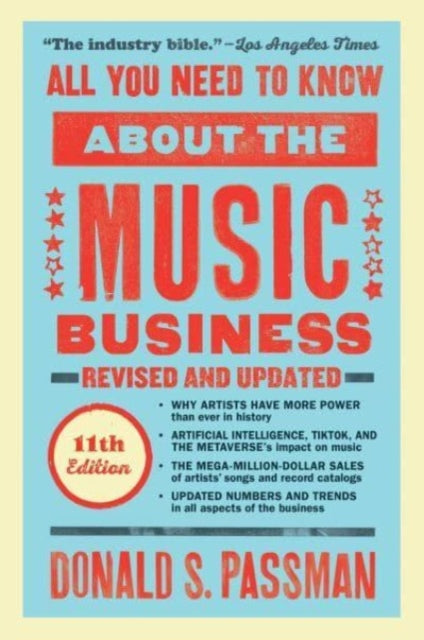
Donald S. Passman
All You Need to Know About the Music Business: Eleventh Edition
All You Need to Know About the Music Business: Eleventh Edition
💎 Earn 88 Points (£0.88) on this item.
YOU SAVE £7.30
- Condition: Brand new
- UK Delivery times: Usually arrives within 2 - 3 working days
- UK Shipping: Fee starts at £3.89. Subject to product weight & dimension
Bulk ordering. Want 15 or more copies? Get a personalised quote and bigger discounts. Learn more about bulk orders.
Couldn't load pickup availability
- More about All You Need to Know About the Music Business: Eleventh Edition
The 11th edition of "All You Need to Know About the Music Business" by veteran music lawyer Donald Passman is the go-to guide for anyone in the music business, explaining why musicians have more power today than ever in history, the mega-million-dollar sales of artists' songs and record catalogs, how artist access to streaming media has reshaped the industry, and the latest numbers and trends.
Format: Hardback
Length: 560 pages
Publication date: 26 October 2023
Publisher: Simon & Schuster
The Music Business, widely regarded as the industry's "bible," has been a trusted resource for professionals across the music industry for over three decades. Authored by renowned music lawyer Donald Passman, this comprehensive guide has been revised and updated to reflect the significant changes that have taken place in the music industry over the past few years.
In the past, the music business was primarily driven by the sale of physical records and CDs. However, with the advent of digital streaming services like Spotify, Apple Music, and YouTube, the landscape of the music industry has undergone a radical transformation. Streaming has become the primary means of music consumption, with millions of people around the world accessing and listening to music on a daily basis.
One of the most significant changes brought about by streaming is the power shift that has occurred in favor of artists. Traditionally, record labels and publishers had a significant control over the distribution and promotion of music. However, with the rise of streaming, artists now have more control over their own careers and the revenue they generate from their music.
One of the key reasons for this power shift is the fact that streaming services pay artists a fixed rate for each stream of their music. This means that regardless of whether a song is played on a million or a thousand times, the artist will receive the same amount of compensation. This contrasts with the traditional model, where artists were paid based on the number of records or CDs sold.
Another factor that has contributed to the power shift in favor of artists is the rise of independent music labels and artists. With the decline of major record labels, independent labels have become more prevalent, giving artists more control over their music and the creative process. Independent artists also have access to digital distribution platforms, such as Bandcamp and SoundCloud, which allow them to reach a global audience without the need for a record label.
In addition to the power shift in favor of artists, the music industry has also seen a significant increase in the sales of artists' songs and record catalogs. Many artists have achieved multi-platinum sales, with some even selling millions of records worldwide. This has led to a rise in the value of music rights, with some artists earning millions of dollars for their music.
The rise of streaming has also had a significant impact on the music business in terms of artist access to streaming media. Platforms like TikTok have become increasingly popular among artists, allowing them to reach a younger audience and promote their music in a more creative and engaging way. TikTok has also provided artists with a platform way
Another significant change brought about by streaming is the rise
Another significant change brought about by streaming is the rise of artificial intelligence (AI) in music production and composition. AI has been used to create music that is more personalized and tailored to individual listeners, with algorithms analyzing data such as user preferences and listening habits to create music that is more likely to be streamed and shared. This has led to a rise in the popularity of genres such as "auto-tuned" and "lo-fi" music, which are often created using AI and have gained a significant following among younger listeners.
In conclusion, the music industry has undergone a profound transformation over the past few years, with streaming becoming the primary means of music consumption and the power shift in favor of artists. This has been driven by the rise of independent music labels and artists, the increase in the sales of artists' songs and record catalogs, the rise of artificial intelligence in music production and composition, and the rise of platforms like TikTok that allow artists to reach a younger audience and promote their music in a more creative and engaging way. As the music industry continues to evolve, it will be interesting to see how these trends continue to shape the industry and the way artists and industry professionals interact with each other.
Weight: 728g
Dimension: 163 x 242 x 42 (mm)
ISBN-13: 9781668011065
UK and International shipping information
UK and International shipping information
We deliver throughout the United Kingdom and to 128 countries and territories worldwide, including the United States, Australia, Canada, Germany, Spain and France.