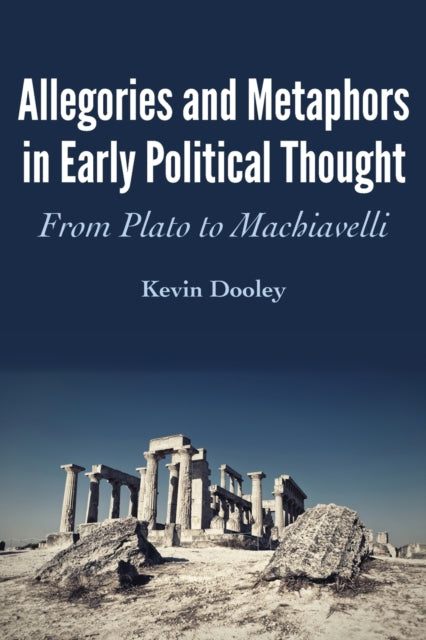
Kevin Dooley
Allegories and Metaphors in Early Political Thought: From Plato to Machiavelli
Allegories and Metaphors in Early Political Thought: From Plato to Machiavelli
💎 Earn 205 Points (£2.05) on this item.
We can order this item for you. Delivery usually takes about 4 to 6 weeks.
This item is not held in our immediate stock. We will order it for you after checkout.
Estimated delivery: About 4 to 6 weeks
YOU SAVE £5.34
- Condition: Brand new
- UK Delivery times: Usually arrives within 2 - 3 working days
- UK Shipping: Fee starts at £2.39. Subject to product weight & dimension
Bulk ordering. Want 15 or more copies? Get a personalised quote and bigger discounts. Learn more about bulk orders.
Couldn't load pickup availability
- More about Allegories and Metaphors in Early Political Thought: From Plato to Machiavelli
Allegories and Metaphors in Early Political Thought: From Plato to Machiavelli explores the use of allegories and metaphors by key political thinkers, such as Plato, Aristotle, St. Augustine, St. Thomas Aquinas, and Niccolo Machiavelli, to understand their ideologies better.
\n Format: Paperback / softback
\n Length: 130 pages
\n Publication date: 05 December 2018
\n Publisher: Peter Lang Publishing Inc
\n
Allegories and Metaphors in Early Political Thought: From Plato to Machiavelli
This book delves into the examination of allegories and metaphors that serve as the most effective representations of the ideologies of Plato, Aristotle, St. Augustine, St. Thomas Aquinas, and Niccolo Machiavelli. Author Kevin Dooleys approach enables readers to gain a deeper comprehension of each thinker's ideas by employing the metaphorical lens, which fosters imaginative discussions and encourages more thoughtful reflections.
Plato, a renowned philosopher, believed in the power of allegories to convey profound truths about the human condition. He used allegorical narratives such as the Allegory of the Cave and the Republic to explore themes such as the nature of reality, the role of the individual in society, and the pursuit of justice. Plato's allegories were often complex and multi-layered, requiring readers to engage in critical thinking and interpretation to fully understand their meanings.
Aristotle, another influential philosopher, also employed allegories to explain his ideas. He used the metaphor of the "universal man" to describe the ideal human being, who possesses both rational and irrational faculties. Aristotle's allegories were aimed at promoting moral and ethical behavior and were often used to illustrate the consequences of different actions.
St. Augustine, a Christian theologian and philosopher, used allegories extensively in his writings to convey spiritual truths and to explore the relationship between faith and reason. He used the metaphor of the "city of God" to describe the ideal society, which is governed by divine law and is filled with love and peace. St. Augustine's allegories were often used to address the challenges of living in a fallen world and to encourage believers to live lives of virtue and holiness.
St. Thomas Aquinas, a Catholic theologian and philosopher, also relied on allegories to explain his ideas. He used the metaphor of the "ladder of ascent" to describe the path to salvation, which involves the ascent of the mind, the heart, and the will. St. Thomas Aquinas's allegories were aimed at promoting spiritual growth and understanding and were often used to address the complexities of religious belief and practice.
Niccolo Machiavelli, a political philosopher and author of The Prince, was known for his use of metaphors and allegories to explain his ideas about power and politics. He used the metaphor of the "fox" to describe a cunning and deceitful politician, who is willing to do anything to gain and maintain power. Machiavelli's allegories were often used to critique the corrupt practices of political leaders and to advocate for a more pragmatic and effective approach to governance.
In conclusion, Allegories and Metaphors in Early Political Thought: From Plato to Machiavelli is a valuable resource for anyone interested in exploring the ideas of these influential thinkers. Author Kevin Dooleys approach allows readers to gain a deeper understanding of each thinker's ideas through the lens of metaphor, which fosters imaginative discussions and encourages more thoughtful reflections. By examining the use of allegories and metaphors in these thinkers' writings, readers can gain a broader perspective on the complexities of political thought and the role of philosophy in shaping society.
\n Weight: 212g\n
Dimension: 152 x 224 x 6 (mm)\n
ISBN-13: 9781433154676\n
Edition number: New ed\n
UK and International shipping information
UK and International shipping information
UK Delivery and returns information:
- Delivery within 2 - 3 days when ordering in the UK.
- Shipping fee for UK customers from £2.39. Fully tracked shipping service available.
- Returns policy: Return within 30 days of receipt for full refund.
International deliveries:
Shulph Ink now ships to Australia, Belgium, Canada, France, Germany, Ireland, Italy, India, Luxembourg Saudi Arabia, Singapore, Spain, Netherlands, New Zealand, United Arab Emirates, United States of America.
- Delivery times: within 5 - 10 days for international orders.
- Shipping fee: charges vary for overseas orders. Only tracked services are available for most international orders. Some countries have untracked shipping options.
- Customs charges: If ordering to addresses outside the United Kingdom, you may or may not incur additional customs and duties fees during local delivery.