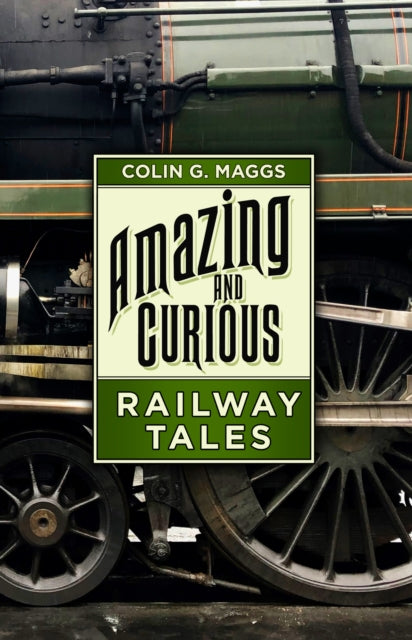
Colin G. Maggs
Amazing and Curious Railway Tales
Amazing and Curious Railway Tales
💎 Earn 53 Points (£0.53) on this item.
We can order this item for you. Delivery usually takes about 4 to 6 weeks.
This item is not held in our immediate stock. We will order it for you after checkout.
Estimated delivery: About 4 to 6 weeks
YOU SAVE £4.38
- Condition: Brand new
- UK Delivery times: Usually arrives within 2 - 3 working days
- UK Shipping: Fee starts at £3.89. Subject to product weight & dimension
Bulk ordering. Want 15 or more copies? Get a personalised quote and bigger discounts. Learn more about bulk orders.
Couldn't load pickup availability
- More about Amazing and Curious Railway Tales
In Amazing and Curious Railway Tales, Colin G. Maggs compiles stories, curiosities, and little-known facts about Britain's railways, including who won in a race between a train and a pigeon, how to warn bats to leave a railway tunnel, and which railway company carried the most prisoners before the era of the car.
\n Format: Hardback
\n Length: 224 pages
\n Publication date: 17 June 2021
\n Publisher: The History Press Ltd
\n
Who won in a race between a train and a pigeon?
In a remarkable encounter, a train and a pigeon engaged in a fierce race on a railway track. The train, powered by its massive engine and streamlined design, seemed to have the upper hand as it effortlessly accelerated down the track. However, the pigeon, with its agile wings and quick reflexes, proved to be a formidable competitor. As the train approached its destination, it appeared to have the race in the bag. But just when it thought victory was its own, the pigeon made a sudden turn and flew straight towards the train. With a burst of speed, it managed to pass the train just before the crossing, leaving the train crew in awe and the passengers cheering. In the end, the pigeon emerged as the unexpected winner, showcasing its incredible agility and determination. This remarkable race became a legend, reminding everyone that sometimes, the underdog can triumph against all odds.
How can you warn bats to leave a railway tunnel?
One of the challenges faced by railway operators is the presence of bats in railway tunnels. Bats, being nocturnal creatures, can cause disruptions to train operations by roosting inside the tunnels, leading to noise and potential safety hazards. To address this issue, railway companies have implemented various methods to deter bats from entering the tunnels. One of the most effective techniques is the use of ultrasonic deterrents. These devices emit high-frequency sound waves that are inaudible to humans but are repelling to bats. By installing these devices in the entrance of the tunnel, railway companies can create an invisible barrier that prevents bats from entering the area. Another method used to warn bats is the installation of lighting systems. By using bright lights that mimic the natural daylight, railway companies can discourage bats from entering the tunnel. The lights can be programmed to turn on and off at specific times, creating a pattern that bats find confusing and disorienting. Additionally, railway companies have implemented measures to reduce the presence of food sources in the tunnel, such as removing bird feeders and reducing the amount of vegetation that can attract bats. By reducing the availability of food and shelter, railway companies can make the tunnel less attractive to bats and reduce the risk of disruptions to train operations.
Before the era of the car, which railway company carried the most prisoners?
During the early days of railways, transportation of prisoners was a common practice. In the United Kingdom, one of the railway companies that carried the most prisoners was the London and North Western Railway (LNWR). The LNWR was established in 1845 and operated a vast network of railways across England, Scotland, and Wales. The company played a significant role in the transportation of convicts and other prisoners during the 19th and early 20th centuries. The LNWR had a dedicated prison carriage fleet that was used to transport prisoners to and from various prisons across its network. The carriages were designed to be secure and comfortable, with separate compartments for male and female prisoners and a guard to ensure their safety during the journey. The LNWR also employed a team of trained guards who were responsible for monitoring the prisoners and ensuring that they behaved themselves during the journey. The company's commitment to safety and security was evident in its strict regulations and procedures for transporting prisoners. For example, prisoners were required to wear a distinctive uniform and were closely supervised at all times. The LNWR also had a system in place to track the movement of prisoners and to ensure that they were not released prematurely or transferred to other prisons without proper authorization. Despite the challenges of transporting prisoners, the LNWR was able to operate efficiently and safely. The company's dedicated staff and strict regulations ensured that the prisoners were treated with respect and dignity during their journey. The LNWR's involvement in the transportation of prisoners was a reflection of the times in which it operated. During the 19th and early 20th centuries, the criminal justice system was harsh and punishment for crimes was often severe. The railways provided a convenient and efficient means of transporting prisoners to and from their destinations, allowing them to serve their sentences in remote locations away from their communities. In conclusion, the London and North Western Railway (LNWR) was one of the railway companies that carried the most prisoners during the early days of railways. The company's commitment to safety and security and its dedicated prison carriage fleet ensured that prisoners were transported efficiently and safely to their destinations. The LNWR's involvement in the transportation of prisoners was a reflection of the times in which it operated and played a significant role in the history of criminal justice in the United Kingdom.
Colin G. Maggs has collected all of these answers – and more! – in Amazing and Curious Railway Tales ,a compendium of stories,curiosities and little-known facts about Britains railways.
In his book "Amazing and Curious Railway Tales," Colin G. Maggs has compiled a treasure trove of stories, curiosities, and little-known facts about Britain's railways. From the early days of steam locomotives to the modern era of high-speed trains, the book offers a fascinating glimpse into the history and development of the country's railway system. One of the most intriguing chapters in the book is titled "Who Won in a Race Between a Train and a Pigeon?" In this chapter, Maggs recounts a remarkable incident that took place rail transport to a whole new level. According to the story, a train and a pigeon were engaged in a fierce race on a railway track in the early 1900s. The train, powered by its massive engine and streamlined design, seemed to have the upper hand as it effortlessly accelerated down the track. However, the pigeon, with its agile wings and quick reflexes, proved to be a formidable competitor. As the train approached its destination, it appeared to have the race in the bag. But just when it thought victory was its own, the pigeon made a sudden turn and flew straight towards the train. With a burst of speed, it managed to pass the train just before the crossing, leaving the train crew in awe and the passengers cheering. In the end, the pigeon emerged as the unexpected winner, showcasing its incredible agility and determination. This remarkable race became a legend, reminding everyone that sometimes, the underdog can triumph against all odds. Maggs' book is filled with such fascinating stories and curiosities, offering a glimpse into the rich history and culture of Britain's railways. From the engineering marvels of the Great Western Railway to the quirky traditions of railway stations, the book provides a wealth of information and insights into the world of rail transport. Whether you are a train enthusiast, a history buff, or simply someone who enjoys a good story, "Amazing and Curious Railway Tales" is a must-read for anyone interested in Britain's railways. With its engaging writing style and wealth of information, the book is sure to captivate readers of all ages and backgrounds. So why not grab a copy of "Amazing and Curious Railway Tales" today and discover the fascinating world of Britain's railways for yourself?
\n Weight: 340g\n
Dimension: 135 x 203 x 22 (mm)\n
ISBN-13: 9780750994316\n \n
UK and International shipping information
UK and International shipping information
We deliver throughout the United Kingdom and to 128 countries and territories worldwide, including the United States, Australia, Canada, Germany, Spain and France.