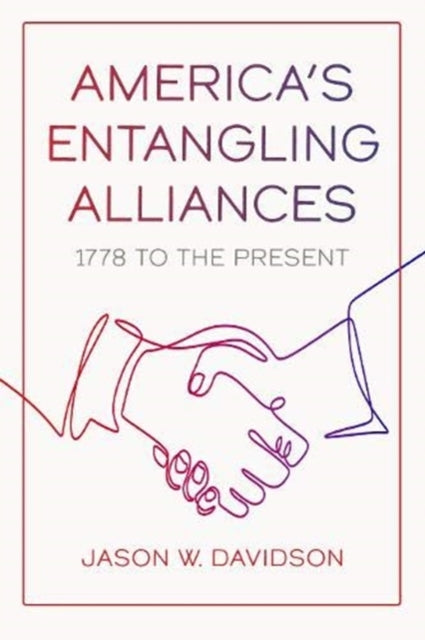
Jason W. Davidson
America's Entangling Alliances: 1778 to the Present
America's Entangling Alliances: 1778 to the Present
💎 Earn 123 Points (£1.23) on this item.
We can order this item for you. Delivery usually takes about 4 to 6 weeks.
This item is not held in our immediate stock. We will order it for you after checkout.
Estimated delivery: About 4 to 6 weeks
YOU SAVE £3.22
- Condition: Brand new
- UK Delivery times: Usually arrives within 2 - 3 working days
- UK Shipping: Fee starts at £2.39. Subject to product weight & dimension
Bulk ordering. Want 15 or more copies? Get a personalised quote and bigger discounts. Learn more about bulk orders.
Couldn't load pickup availability
- More about America's Entangling Alliances: 1778 to the Present
Americas Entangling Alliances challenges long-held assumptions about the costs and benefits of US foreign policy by examining thirty-four alliances and revealing the evolution of American power. The book challenges the belief that the US resists international alliances and shows that it has entered into a variety of security arrangements over the course of its history.
\n Format: Paperback / softback
\n Length: 304 pages
\n Publication date: 02 November 2020
\n Publisher: Georgetown University Press
\n
Since the Revolutionary War, the United States has entered into dozens of alliances with international powers to protect its assets and advance its security interests. Americas Entangling Alliances offers a corrective to long-held assumptions about US foreign policy and is relevant to current public and academic debates about the costs and benefits of Americas allies.
Author Jason W. Davidson examines these alliances to shed light on their nature and what they reveal about the evolution of American power. He challenges the belief that the nation resists international alliances, showing that this has been true in practice only when using a narrow definition of alliance. While there have been more alliances since World War II than before it, US presidents and Congress have viewed it in the countrys best interest to enter into a variety of security arrangements over virtually the entire course of the countrys history. By documenting thirty-four alliances—categorized as defense pacts, military coalitions, or security partnerships—Davidson finds that the US demand for allies is best explained by looking at variance in its relative power and the threats it has faced.
The United States has a long history of forming alliances with other countries to protect its interests and advance its goals. These alliances have taken many different forms, from defense pacts to military coalitions to security partnerships. While some have questioned the value of these alliances, others argue that they are essential for maintaining global stability and security.
One of the key challenges facing Americas entangling alliances is the changing nature of international relations. With the rise of new powers such as China and Russia, the balance of power in the world is shifting, and traditional alliances are being challenged. This has led to questions about whether the United States should continue to prioritize its alliances with traditional partners or seek new partners to balance out the power dynamics.
Another challenge is the cost of maintaining these alliances. The United States spends billions of dollars each year on military and security assistance to its allies, and this can put a strain on its budget. There are also concerns about whether these alliances are actually providing the United States with the security benefits that they claim to offer.
Despite these challenges, Americas entangling alliances remain an important part of US foreign policy. They provide the United States with access to valuable resources and intelligence, and they help to promote stability and security in the world. However, it is important for the United States to carefully evaluate the costs and benefits of these alliances and to ensure that they are aligned with its national interests.
One of the key findings of Americas Entangling Alliances is that the US demand for allies is best explained by looking at variance in its relative power and the threats it has faced. Davidson argues that the United States has sought alliances with countries that are either stronger than it or have resources that it needs to protect its interests. For example, the United States has formed alliances with Japan and South Korea to counter the threat posed by North Korea, and it has formed alliances with Europe and Canada to promote stability in the Middle East.
However, Davidson also notes that the United States has sometimes entered into alliances with countries that are not necessarily in its best interests. For example, the United States has maintained a close relationship with Saudi Arabia, even though the country has been accused of human rights abuses and supporting terrorism. Davidson argues that these alliances are often driven by political considerations rather than strategic ones and that they can have negative consequences for the United States in the long term.
In conclusion, Americas Entangling Alliances offers a valuable perspective on the costs and benefits of US foreign policy. By challenging long-held assumptions about the nations resistance to international alliances, Davidson provides a more nuanced understanding of the US demand for allies. While there are challenges to maintaining these alliances, they remain an important part of US foreign policy and will likely continue to be so in the future. However, it is important for the United States to carefully evaluate the costs and benefits of these alliances and to ensure that they are aligned with its national interests.
\n Weight: 420g\n
Dimension: 228 x 151 x 22 (mm)\n
ISBN-13: 9781647120290\n \n
UK and International shipping information
UK and International shipping information
UK Delivery and returns information:
- Delivery within 2 - 3 days when ordering in the UK.
- Shipping fee for UK customers from £2.39. Fully tracked shipping service available.
- Returns policy: Return within 30 days of receipt for full refund.
International deliveries:
Shulph Ink now ships to Australia, Belgium, Canada, France, Germany, Ireland, Italy, India, Luxembourg Saudi Arabia, Singapore, Spain, Netherlands, New Zealand, United Arab Emirates, United States of America.
- Delivery times: within 5 - 10 days for international orders.
- Shipping fee: charges vary for overseas orders. Only tracked services are available for most international orders. Some countries have untracked shipping options.
- Customs charges: If ordering to addresses outside the United Kingdom, you may or may not incur additional customs and duties fees during local delivery.