Shulph Ink
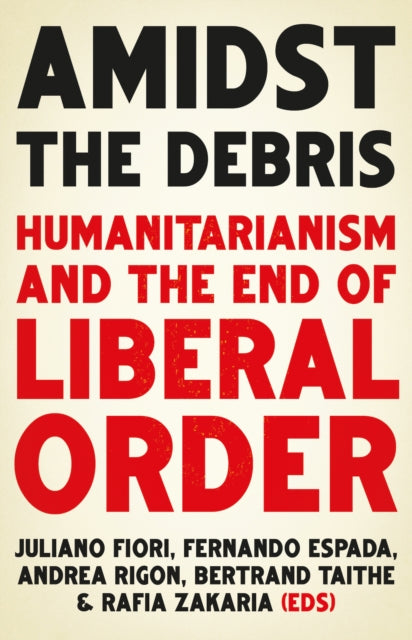
Amidst the Debris: Humanitarianism and the End of Liberal Order
Amidst the Debris: Humanitarianism and the End of Liberal Order
💎 Earn 74 Points (£0.74) on this item.
YOU SAVE £3.13
- Condition: Brand new
- UK Delivery times: Usually arrives within 2 - 3 working days
- UK Shipping: Fee starts at £2.39. Subject to product weight & dimension
Bulk ordering. Want 15 or more copies? Get a personalised quote and bigger discounts. Learn more about bulk orders.
Couldn't load pickup availability
- More about Amidst the Debris: Humanitarianism and the End of Liberal Order
The collapse of the Soviet Union was seen as a victory for Western reason and capitalist democracy, but in recent years, liberal norms and institutions have been challenged by a visceral and affective politics. This has led to a closing inwards of the nation-state, and humanitarian multilateralism has lost strategic currency. This collection of essays explores the relationship between humanitarianism and liberal order, and the implications for the political economy of humanitarianism and the practices of humanitarian agencies.
Format: Paperback / softback
Length: 336 pages
Publication date: 10 June 2021
Publisher: C Hurst & Co Publishers Ltd
The fall of the Soviet Union in the 1990s was seen by many liberal commentators as a triumph of Western reason and capitalist democracy. However, in recent years, liberal norms and institutions associated with the post-Cold War era have faced a significant challenge from a visceral and affective politics. Electorates have increasingly favored a closing inwards of the nation-state, not just in democratic strongholds in Europe and North America, but also in the periphery of the global economy. The popularity of the open society, once championed by the US and its allies as a necessary complement to liberal capitalist culture and market globalization, is being questioned.
In this collection of essays, public intellectuals, scholars, journalists, and aid workers explore the complex relationship between humanitarianism and liberal order. They examine the role that humanitarianism has played in processes of liberal ordering, as well as the implications for the political economy of humanitarianism and the practices of humanitarian agencies.
One key theme that emerges is the changing nature of humanitarianism in the post-Cold War era. While humanitarianism has traditionally been associated with the promotion of human rights, peace, and social justice, it is now being increasingly shaped by geopolitical considerations and power dynamics. For example, the rise of authoritarian regimes and the emergence of new actors on the global stage, such as China and Russia, have led to a reevaluation of the role of humanitarianism in conflict zones.
Another theme is the growing tension between humanitarianism and national security. As conflicts become more complex and interconnected, there is a growing debate about whether humanitarian aid should be prioritized over military intervention. Some argue that humanitarian aid can help to reduce conflict and promote peace, while others argue that it can inadvertently fuel conflict and undermine national security.
The essays in this collection also address the challenges facing humanitarian agencies in the post-Cold War era. With the rise of new actors on the global stage, such as private contractors and non-governmental organizations, there is a growing competition for resources and funding. This has led to concerns about the accountability and effectiveness of humanitarian agencies, as well as the impact that they have on local communities and cultures.
In conclusion, the collapse of the Soviet Union and the emergence of a more complex and interconnected global order have posed significant challenges for liberal norms and institutions. The relationship between humanitarianism and liberal order is a complex and multifaceted one that requires careful consideration and analysis. By exploring the challenges and opportunities that arise from this relationship, we can better understand the role that humanitarianism plays in promoting human rights and social justice in the world.
Weight: 654g
Dimension: 141 x 214 x 44 (mm)
ISBN-13: 9781787383968
This item can be found in:
UK and International shipping information
UK and International shipping information
UK Delivery and returns information:
- Delivery within 2 - 3 days when ordering in the UK.
- Shipping fee for UK customers from £2.39. Fully tracked shipping service available.
- Returns policy: Return within 30 days of receipt for full refund.
International deliveries:
Shulph Ink now ships to Australia, Belgium, Canada, France, Germany, Ireland, Italy, India, Luxembourg Saudi Arabia, Singapore, Spain, Netherlands, New Zealand, United Arab Emirates, United States of America.
- Delivery times: within 5 - 10 days for international orders.
- Shipping fee: charges vary for overseas orders. Only tracked services are available for most international orders. Some countries have untracked shipping options.
- Customs charges: If ordering to addresses outside the United Kingdom, you may or may not incur additional customs and duties fees during local delivery.