Dinghe, Tianjin, China; Vice President, College of Aeronautical Engineering, Civil Aviation University of China, Tianjin, China) Li
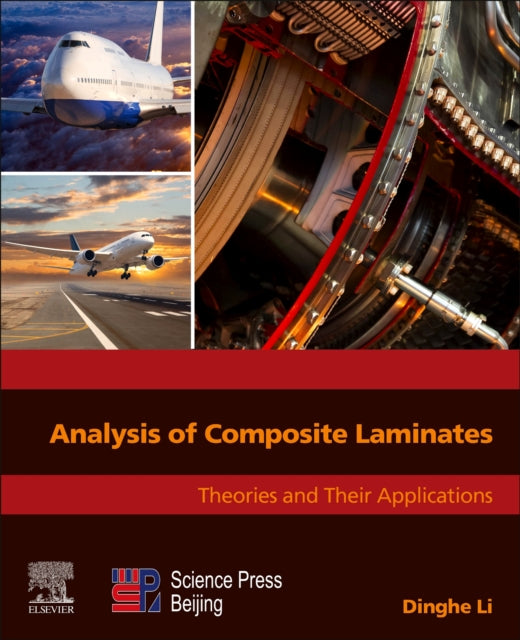
Analysis of Composite Laminates: Theories and Their Applications
Analysis of Composite Laminates: Theories and Their Applications
💎 Earn 1061 Points (£10.61) on this item.
- Condition: Brand new
- UK Delivery times: Usually arrives within 2 - 3 working days
- UK Shipping: Fee starts at £2.39. Subject to product weight & dimension
Bulk ordering. Want 15 or more copies? Get a personalised quote and bigger discounts. Learn more about bulk orders.
Couldn't load pickup availability
- More about Analysis of Composite Laminates: Theories and Their Applications
Composite Laminated: Theories and Their Applications is a comprehensive guide to analyzing composite laminates and their applications, covering key methods, research, and finite element models. It is essential for engineering in various industries, including aerospace, subsea structures, and medical prosthetics.
Format: Paperback / softback
Length: 542 pages
Publication date: 11 March 2022
Publisher: Elsevier - Health Sciences Division
Composite Laminated: Theories and Their Applications is a comprehensive resource that delves into the latest techniques for analyzing composite laminates and their diverse applications. The title aptly introduces the most crucial analytical methods currently in use, with a particular emphasis on fracture, damage, multi-physics, and sensitivity analysis. Alongside these methods, the book showcases original research conducted over two decades on laminated composite structures, providing in-depth coverage of laminate theories, analytical solutions, and finite element models.
The book is organized into several specific chapters, each dedicated to exploring different aspects of composite laminates. These chapters include:
An Introduction to Composites: This chapter provides a foundational understanding of composite materials, their composition, properties, and manufacturing processes. It discusses the basic principles of elasticity, shear, and state space theory, which are essential for analyzing composite laminates.
Elasticity: This chapter explores the elastic behavior of composite materials, including the development of elastic constants, stress-strain relationships, and the influence of fiber orientation and matrix properties on elastic properties. It also discusses the use of finite element methods to simulate elastic behavior in composite laminates.
Shear: Shear is a critical factor in the behavior of composite laminates, particularly in applications where stress concentrations occur. This chapter discusses the theory of shear and its application to composite laminates, including the development of shear stress criteria, the analysis of shear failure modes, and the use of finite element methods to simulate shear behavior.
State Space Theory: State space theory is a powerful tool for analyzing the dynamic behavior of composite laminates. This chapter discusses the theory and its application to composite laminates, including the development of state space models, the analysis of stability and bifurcation, and the use of optimization techniques to design composite laminates.
Layerwise Theories: Layerwise theories are used to describe the behavior of composite laminates at the microscale. This chapter discusses the development of layerwise theories and their application to composite laminates, including the development of effective numerical methods for modeling composite laminates.
The Extended Layerwise Method: The extended layerwise method is a numerical method for modeling composite laminates that accounts for the effects of fiber bridging and interlaminar stresses. This chapter discusses the development of the extended layerwise method and its application to composite laminates, including the analysis of composite structures with complex geometries and boundary conditions.
Fracture and Damage Mechanics: Fracture and damage mechanics are critical aspects of analyzing composite laminates. This chapter discusses the theory of fracture and damage in composite materials, including the development of fracture criteria, the analysis of damage initiation and growth, and the use of finite element methods to simulate fracture and damage behavior.
Multi-Physical Fracture Problems: Multi-physical fracture problems involve the interaction of multiple physical phenomena, such as stress, strain, and temperature, in the analysis of composite laminates. This chapter discusses the development of multi-physical fracture models and their application to composite laminates, including the analysis of composite structures subjected to combined loads and environmental conditions.
Analytical Methods of Stiffened Sandwich Structures: Stiffened sandwich structures are a common type of composite structure used in aerospace and automotive applications. This chapter discusses the analytical methods used to design and analyze stiffened sandwich structures, including the development of beam and plate theories and the use of finite element methods.
Progressive Failure Analysis: Progressive failure analysis is a technique used to predict the failure behavior of composite laminates under complex loading conditions. This chapter discusses the development of progressive failure analysis models and their application to composite laminates, including the analysis of composite structures subjected to combined loads and environmental conditions.
In addition to these chapters, Composite Laminated: Theories and Their Applications also includes a comprehensive bibliography and an index for easy reference. This book is an essential resource for researchers, engineers, and students interested in the analysis and applications of composite laminates. It provides a comprehensive guide to the state-of-the-art in the field, covering a wide range of topics and providing detailed explanations and examples to facilitate understanding.
Composite laminates play a critical role in various engineering fields, including aerospace, automotive, and medical prosthetics. These materials are characterized by their combination of two or more materials, such as fibers, matrices, and adhesives, which provide superior strength, stiffness, and durability compared to individual materials. Composite laminates are used in a wide range of applications, from aircraft wings and fuselages to automotive components and medical implants.
One of the key challenges in analyzing composite laminates is the complex nature of their behavior. Composite materials exhibit a combination of elastic, plastic, and brittle behavior, depending on the loading conditions and the microstructure of the composite. This complexity makes it difficult to develop accurate models and predict the behavior of composite laminates under different loading conditions.
The development of analytical methods and models has played a significant role in addressing this challenge. Analytical methods such as finite element analysis (FEA) and boundary element analysis (BEA) allow researchers to simulate the behavior of composite laminates with high accuracy and reliability. These methods enable researchers to study the stress and strain distribution, damage initiation and growth, and failure modes of composite laminates under various loading conditions.
In addition to analytical methods, experimental techniques such as strain gauge measurements, optical microscopy, and X-ray diffraction are also used to study the behavior of composite laminates. These techniques provide valuable insights into the microstructure of composite materials and their response to loading conditions.
One of the key applications of composite laminates is in aerospace engineering. Composite laminates are used in aircraft wings and fuselages to improve their strength, stiffness, and durability. The use of composite materials in aerospace engineering has significantly reduced the weight of aircraft, which in turn has reduced fuel consumption and emissions.
Composite laminates are also used in automotive engineering to improve the performance and safety of vehicles. Composite materials are used in car bodies, bumpers, and other components to reduce weight and improve crashworthiness. In addition, composite materials are used in automotive components such as brake discs and steering wheels to improve their performance and durability.
In medical prosthetics, composite laminates are used to create artificial limbs and joints. Composite materials are lightweight, strong, and durable, which makes them ideal for prosthetic applications. Composite laminates are also used in medical implants such as hip implants and knee implants to improve their performance and durability.
Another important application of composite laminates is in the construction industry. Composite materials are used in construction applications such as building facades, roofs, and bridges to improve their strength and durability. Composite materials are also used in construction applications such as flooring and decking to improve their durability and aesthetics.
In conclusion, Composite Laminated: Theories and Their Applications is a comprehensive resource that provides a comprehensive guide to the latest techniques and applications of composite laminates. The book covers a wide range of topics, including an introduction to composites, elasticity, shear, state space theory, layerwise theories, the extended layerwise method, fracture and damage mechanics, multi-physical fracture problems, analytical methods of stiffened sandwich structures, progressive failure analysis, and more. The book is an essential resource for researchers, engineers, and students interested in the analysis and applications of composite laminates. With its detailed explanations and examples, the book facilitates understanding of the complex behavior of composite laminates and their diverse applications in various engineering fields.
Weight: 450g
Dimension: 235 x 191 (mm)
ISBN-13: 9780323908047
This item can be found in:
UK and International shipping information
UK and International shipping information
UK Delivery and returns information:
- Delivery within 2 - 3 days when ordering in the UK.
- Shipping fee for UK customers from £2.39. Fully tracked shipping service available.
- Returns policy: Return within 30 days of receipt for full refund.
International deliveries:
Shulph Ink now ships to Australia, Belgium, Canada, France, Germany, Ireland, Italy, India, Luxembourg Saudi Arabia, Singapore, Spain, Netherlands, New Zealand, United Arab Emirates, United States of America.
- Delivery times: within 5 - 10 days for international orders.
- Shipping fee: charges vary for overseas orders. Only tracked services are available for most international orders. Some countries have untracked shipping options.
- Customs charges: If ordering to addresses outside the United Kingdom, you may or may not incur additional customs and duties fees during local delivery.