Hermann Bayer
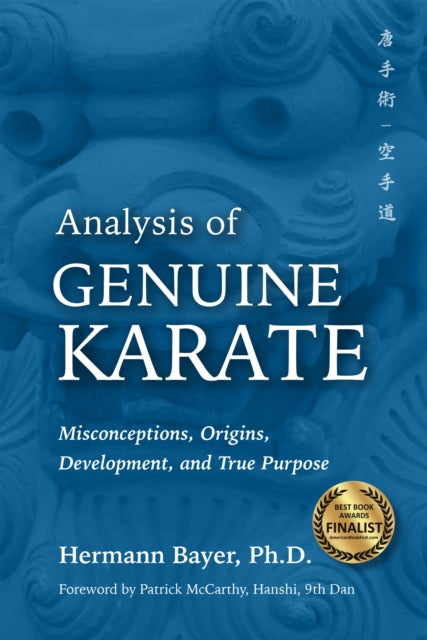
Analysis of Genuine Karate: Misconceptions, Origins, Development, and True Purpose
Analysis of Genuine Karate: Misconceptions, Origins, Development, and True Purpose
We can order this item for you. Delivery usually takes about 4 to 6 weeks.
This item is not held in our immediate stock. We will order it for you after checkout.
Estimated delivery: About 4 to 6 weeks
YOU SAVE £7.25
- Condition: Brand new
- UK Delivery times: Usually arrives within 2 - 3 working days
- UK Shipping: Fee starts at £3.89. Subject to product weight & dimension
Bulk ordering. Want 15 or more copies? Get a personalised quote and bigger discounts. Learn more about bulk orders.
Couldn't load pickup availability
- More about Analysis of Genuine Karate: Misconceptions, Origins, Development, and True Purpose
The globalization of karate has compromised its original effectiveness, and practitioners need to understand its true purpose to discern misconceptions from facts. This book provides evidence for the socio-cultural and historical arguments to preserve genuine Okinawan karate, supported by historical facts, scientific analysis, and public records.
Format: Hardback
Length: 220 pages
Publication date: 17 August 2023
Publisher: YMAA Publication Center
Genuine karate, an Okinawan martial art renowned for its self-defense techniques, has faced significant challenges due to its ongoing globalization. The alterations made to karate in mainland Japan and in America have fundamentally changed the essence of this traditional art form, rendering it incapable of claiming its original effectiveness.
In his insightful book, "Karate: The Changes Made to Karate in Mainland Japan and in America," Dr. Hermann Bayer, Ph.D., delves into the intricate reinterpretation of Okinawan karate by Japan. He explores how Japan's modernization efforts led to the creation of its distinct style of karate-do, which departed significantly from the traditional practices of Okinawa. These changes, driven by the pursuit of commercialization and sportification, resulted in the development of a modern karate-sport industry.
However, the impact of these developments on practitioners of karate has been profound. Many individuals are often confused, misled, and even led to believe that karate is merely a sport or a form of physical exercise. This misconception is far from the truth. Practitioners of karate require a clear understanding of what their training can offer them. This understanding can only be attained by delving into the true purpose of karate and distinguishing between misconceptions and factual information.
The book "Karate: The Changes Made to Karate in Mainland Japan and in America" aims to provide practitioners with a comprehensive and accurate account of the evolution of karate. It explores various aspects of the art form, including its historical roots in Okinawa, its cultural significance, and the socio-cultural arguments for preserving genuine Okinawan karate.
One of the key themes of the book is the concept of "never changing kata," which is a fundamental principle of Okinawan karate. Dr. Bayer emphasizes that kata, or forms, are essential components of karate training and play a crucial role in developing practitioners' skills and techniques. However, the changes made to kata in mainland Japan and in America have altered their original intent and purpose. These alterations have resulted in a watered-down version of kata that lacks the depth and complexity of the traditional forms.
The book also sheds light on the Okinawan cultural heritage associated with karate. Okinawa is known for its unique traditions, customs, and language, and karate is deeply ingrained in the island's culture. The author argues that the preservation of Okinawa karate is not only important for its historical and cultural value but also for its potential to promote peace and well-being.
Furthermore, the book addresses the issue of Japan's role in the reproduction of karate. Japan has become a dominant force in the world of karate, with its own style of karate-do gaining popularity worldwide. However, Dr. Bayer argues that the changes made to karate in Japan have resulted in a departure from the traditional practices of Okinawa. He points out that the emphasis on competition, athleticism, and commercialization has overshadowed the essence of karate, which is rooted in self-defense, discipline, and respect.
The book also delves into the business of karate, karate-do, and karate-sport. It explores the commercialization of karate, the rise. The author argues that the pursuit of profit and the commercialization of karate have led to the dilution of the art form, with practitioners often being misled into believing that they are training in genuine karate. The book highlights the need for practitioners to be discerning and to seek out training programs that prioritize the preservation of traditional practices and the development of a peaceful karate mind.
Scientific proof of a peaceful karate mind is another important aspect of the book. Dr. Bayer utilizes scientific analysis and research to demonstrate the benefits of karate training on mental health and well-being. He highlights the positive effects of karate on stress reduction, anxiety management, and self-esteem, and provides evidence-based examples of how karate can promote a sense of calm and inner peace.
The laws of physics reveal weaknesses when kata are changed, another compelling argument made by Dr. Bayer. He explains that the traditional forms of kata are designed to develop practitioners' strength, flexibility, and coordination. However, the alterations made to kata in mainland Japan and in America have resulted in forms that are more focused on athleticism and speed. These changes have weakened the fundamental principles of karate, which are based on balance, stability, and precision.
In conclusion, "Karate: The Changes Made to Karate in Mainland Japan and in America" is a comprehensive and insightful work that provides practitioners of karate with a clear understanding of the challenges facing the art form. Through his extensive research, Dr. Bayer makes a compelling case for the socio-cultural and historic arguments to conserve genuine Okinawan karate. Supported by historical facts, scientific analysis, and public records, he reveals the complex evolution of karate and the unsettled claims made upon it by the various stake-holders. This book is a valuable resource for anyone interested in learning more about the true purpose of karate and the importance of preserving its traditional practices.
Weight: 460g
Dimension: 159 x 237 x 20 (mm)
ISBN-13: 9781594399336
UK and International shipping information
UK and International shipping information
We deliver throughout the United Kingdom and to 128 countries and territories worldwide, including the United States, Australia, Canada, Germany, Spain and France.