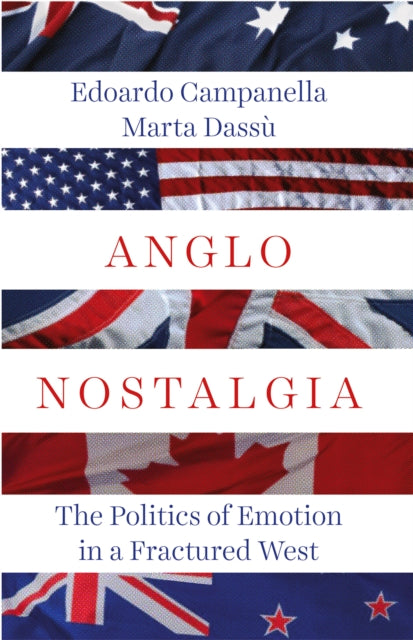
Edoardo Campanella,Marta Dassu
Anglo Nostalgia: The Politics of Emotion in a Fractured West
Anglo Nostalgia: The Politics of Emotion in a Fractured West
💎 Earn 123 Points (£1.23) on this item.
We can order this item for you. Delivery usually takes about 4 to 6 weeks.
This item is not held in our immediate stock. We will order it for you after checkout.
Estimated delivery: About 4 to 6 weeks
YOU SAVE £5.22
- Condition: Brand new
- UK Delivery times: Usually arrives within 2 - 3 working days
- UK Shipping: Fee starts at £3.89. Subject to product weight & dimension
Bulk ordering. Want 15 or more copies? Get a personalised quote and bigger discounts. Learn more about bulk orders.
Couldn't load pickup availability
- More about Anglo Nostalgia: The Politics of Emotion in a Fractured West
Nostalgia has become a major force in global politics, with Donald Trump, Xi Jinping, and Russians seeking to restore the past. Brexit is the purest form of nostalgic nationalism, idealizing a bygone era of full sovereignty and mobilizing a nation towards illusory goals. Anglo Nostalgia analyzes the rapid spread of this global phenomenon, focusing on Brexit as a case study. It warns of the danger of oversimplifying reality, leading to political miscalculations and rising geopolitical tensions.
\n Format: Hardback
\n Length: 234 pages
\n Publication date: 09 May 2019
\n Publisher: C Hurst & Co Publishers Ltd
\n
Nostalgia has emerged as a powerful force in global politics, shaping political ideologies and public sentiments across the world. While leaders like Donald Trump, Xi Jinping, and Vladimir Putin invoke nostalgia to promote their visions for their countries, Brexit stands out as a prime example of nostalgic nationalism in its purest form. Brexit idealizes a bygone era of full sovereignty and national pride, appealing to a sense of longing for a simpler time. Despite its romantic appeal, nostalgia is a complex and multifaceted phenomenon that encompasses a mix of paranoia, melancholy, and idealization of the past. This epidemic of mythicizing national history is shaping politics in dangerous ways, fueled by aging populations, shifts in the global order, and technological disruption.
Collective nostalgia is often deployed as an emotional weapon in political debates, capable of mobilizing a nation towards illusory goals. It taps into people's longing for stability, security, and a sense of belonging, which can be exploited by politicians seeking to gain power and influence. However, the oversimplification of reality that accompanies nostalgia can lead to unprecedented political miscalculations and rising geopolitical tensions.
In their book, "Anglo Nostalgia: The Spread of a Global Phenomenon," authors Campanella and Dassù delve into the rapid spread of nostalgia across the world. They draw on psychology, political science, history, and popular culture to analyze the factors that contribute to its rise. They argue that nostalgia is not just a matter of individual sentiment but is also shaped by broader social and cultural trends.
One of the key drivers of nostalgia is the aging population, which has led to a growing sense of nostalgia for the past among older generations. As people grow older, they often have a stronger attachment to their cultural heritage and traditions, which can be exploited by politicians seeking to appeal to their nostalgia. This is particularly evident in countries with rapidly aging populations, such as Japan and China.
Another factor contributing to nostalgia is the shift in the global order, which has led to a sense of uncertainty and insecurity among people. The collapse of the Soviet Union, the rise of globalization, and the ongoing COVID-19 pandemic have all contributed to a sense of loss and longing for a simpler time when things seemed more stable and predictable.
Technological disruption is also playing a role in the spread of nostalgia. The rise of social media and the internet has facilitated the spread of nostalgia by allowing people to connect with others who share their memories and experiences. This has led to the creation of online communities and forums where people can share their nostalgia and connect with others who feel the same way.
Despite its romantic appeal, nostalgia is a malaise that can have serious consequences for society. It can lead to a disregard for the present and a refusal to acknowledge the challenges and complexities of the modern world. It can also contribute to political polarization and division, as people become more entrenched in their nostalgic beliefs and refuse to consider alternative perspectives.
In the case of Brexit, nostalgia played a significant role in shaping the political debate and the decision to leave the European Union. Brexit idealized a bygone era of British sovereignty and national pride, appealing to a sense of longing for a simpler time when the country was more self-sufficient and independent. However, the oversimplification of reality that accompanied nostalgia led to a series of political miscalculations and economic challenges that have had far-reaching consequences for the United Kingdom and the European Union.
One of the most significant miscalculations was the belief that Brexit would lead to a reduction in immigration and a return to a more homogeneous society. However, the reality has been quite different. Brexit has led to a rise in immigration, as many immigrants who were previously employed in the United Kingdom or who were studying there have decided to leave. This has contributed to labor shortages and has put pressure on public services, such as healthcare and education.
Another miscalculation was the belief that Brexit would lead to a boost in the economy. However, the reality has been quite different. Brexit has led to a decline in economic growth and a rise in economic uncertainty, as the United Kingdom has struggled to negotiate new trade deals with the European Union and other countries. This has led to a loss of jobs and a decline in living standards for many people.
In addition to these economic consequences, Brexit has also contributed to rising geopolitical tensions. The decision to leave the European Union has led to a sense of isolation and resentment among some British citizens, who feel that their country has been betrayed by the European Union. This has led to a rise in support for nationalist and populist movements, which have been advocating for a more assertive and independent British foreign policy.
In conclusion, nostalgia has become a major force in global politics, shaping political ideologies and public sentiments across the world. While leaders like Donald Trump, Xi Jinping, and Vladimir Putin invoke nostalgia to promote their visions for their countries, Brexit stands out as a prime example of nostalgic nationalism in its purest form. Brexit idealizes a bygone era of full sovereignty and national pride, appealing to a sense of longing for a simpler time. However, the oversimplification of reality that accompanies nostalgia can lead to unprecedented political miscalculations and rising geopolitical tensions.
Collective nostalgia is often deployed as an emotional weapon in political debates, capable of mobilizing a nation towards illusory goals. It taps into people's longing for stability, security, and a sense of belonging, which can be exploited by politicians seeking to gain power and influence. However, the oversimplification of reality that accompanies nostalgia can lead to unprecedented political miscalculations and rising geopolitical tensions.
In their book, "Anglo Nostalgia: The Spread of a Global Phenomenon," authors Campanella and Dassù delve into the rapid spread of nostalgia across the world. They draw on psychology, political science, history, and popular culture to analyze the factors that contribute to its rise. They argue that nostalgia is not just a matter of individual sentiment but is also shaped by broader social and cultural trends.
One of the key drivers of nostalgia is the aging population, which has led to a growing sense of nostalgia for the past among older generations. As people grow older, they often have a stronger attachment to their cultural heritage and traditions, which can be exploited by politicians seeking to appeal to their nostalgia. This is particularly evident in countries with rapidly aging populations, such as Japan and China.
Another factor contributing to nostalgia is the shift in the global order, which has led to a sense of uncertainty and insecurity among people. The collapse of the Soviet Union, the rise of globalization, and the ongoing COVID-19 pandemic have all contributed to a sense of loss and longing for a simpler time when things seemed more stable and predictable.
Technological disruption is also playing a role in the spread of nostalgia. The rise of social media and the internet has facilitated the spread of nostalgia by allowing people to connect with others who share their memories and experiences. This has led to the creation of online communities and forums where people can share their nostalgia and connect with others who feel the same way.
Despite its romantic appeal, nostalgia is a malaise that can have serious consequences for society. It can lead to a disregard for the present and a refusal to acknowledge the challenges and complexities of the modern world. It can also contribute to political polarization and division, as people become more entrenched in their nostalgic beliefs and refuse to consider alternative perspectives.
In the case of Brexit, nostalgia played a significant role in shaping the political debate and the decision to leave the European Union. Brexit idealized a bygone era of British sovereignty and national pride, appealing to a sense of longing for a simpler time when the country was more self-sufficient and independent. However, the oversimplification of reality that accompanied nostalgia led to a series of political miscalculations and economic challenges that have had far-reaching consequences for the United Kingdom and the European Union.
One of the most significant miscalculations was the belief that Brexit would lead to a reduction in immigration and a return to a more homogeneous society. However, the reality has been quite different. Brexit has led to a rise in immigration, as many immigrants who were previously employed in the United Kingdom or who were studying there have decided to leave. This has contributed to labor shortages and has put pressure on public services, such as healthcare and education.
Another miscalculation was the belief that Brexit would lead to a boost in the economy. However, the reality has been quite different. Brexit has led to a decline in economic growth and a rise in economic uncertainty, as the United Kingdom has struggled to negotiate new trade deals with the European Union and other countries. This has led to a loss of jobs and a decline in living standards for many people.
In addition to these economic consequences, Brexit has also contributed to rising geopolitical tensions. The decision to leave the European Union has led to a sense of isolation and resentment among some British citizens, who feel that their country has been betrayed by the European Union. This has led to a rise in support for nationalist and populist movements, which have been advocating for a more assertive and independent British foreign policy.
In conclusion, nostalgia has become a major force in global politics, shaping political ideologies and public sentiments across the world. While leaders like Donald Trump, Xi Jinping, and Vladimir Putin invoke nostalgia to promote their visions for their countries, Brexit stands out as a prime example of nostalgic nationalism in its purest form. Brexit idealizes a bygone era of full sovereignty and national pride, appealing to a sense of longing for a simpler time. However, the oversimplification of reality that accompanies nostalgia can lead to unprecedented political miscalculations and rising geopolitical tensions.
Collective nostalgia is often deployed as an emotional weapon in political debates, capable of mobilizing a nation towards illusory goals. It taps into people's longing for stability, security, and a sense of belonging, which can be exploited by politicians seeking to gain power and influence. However, the oversimplification of reality that accompanies nostalgia can lead to unprecedented political miscalculations and rising geopolitical tensions.
\n Weight: 458g\n
Dimension: 147 x 222 x 26 (mm)\n
ISBN-13: 9781787381414\n \n
UK and International shipping information
UK and International shipping information
We deliver throughout the United Kingdom and to 128 countries and territories worldwide, including the United States, Australia, Canada, Germany, Spain and France.