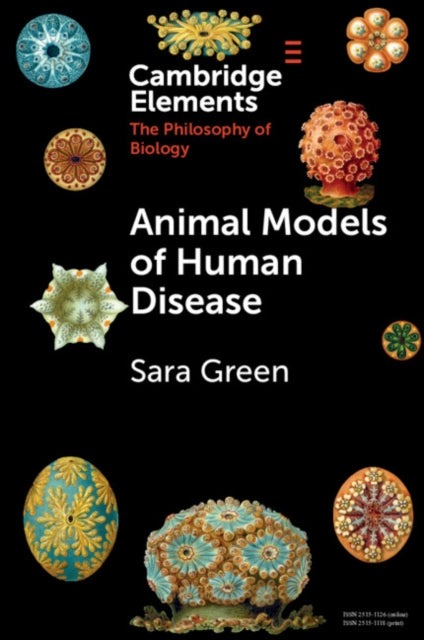
SaraGreen
Animal Models of Human Disease
Animal Models of Human Disease
💎 Earn 84 Points (£0.84) on this item.
We can order this item for you. Delivery usually takes about 4 to 6 weeks.
This item is not held in our immediate stock. We will order it for you after checkout.
Estimated delivery: About 4 to 6 weeks
YOU SAVE £1.01
- Condition: Brand new
- UK Delivery times: Usually arrives within 2 - 3 working days
- UK Shipping: Fee starts at £2.39. Subject to product weight & dimension
Bulk ordering. Want 15 or more copies? Get a personalised quote and bigger discounts. Learn more about bulk orders.
Couldn't load pickup availability
- More about Animal Models of Human Disease
The use of animal models in biomedical research requires a philosophical examination of how knowledge about human diseases can be gained from studying other species. This Element explores the selection and construction of animal models, their roles in translational research, and the challenges and debates surrounding their limitations and future. It also examines the prospects of replacing animal models with animal-free methods.
Format: Paperback / softback
Length: 90 pages
Publication date: 16 May 2024
Publisher: Cambridge University Press
The use of animal models in biomedical research is a complex and contentious issue that requires careful philosophical consideration. While animal models have played a critical role in advancing our understanding of human diseases, there are concerns about whether knowledge gained from studying other species can be directly applied to humans. This Element explores the selection and construction of animal models to serve as preclinical substitutes for human patients, as well as their multifaceted roles in translational research. It also examines the boundaries between humans and animals and the challenges that arise from these boundaries.
One of the key challenges in animal modeling is the need to balance standardization and variation in medicine. On the one hand, standardization allows for more accurate and reproducible research results, but on the other hand, it can limit the ability to study the full range of human diseases and physiological responses. Another challenge is the distinction between strategies that aim to reduce and recapitulate biological complexity and those that seek to understand the underlying mechanisms of disease.
Despite these challenges, animal models continue to play a critical role in biomedical research. They allow researchers to test hypotheses and develop treatments in a controlled and reproducible environment, and they have helped to identify many important biological pathways and drug targets. However, there is growing interest in developing animal-free methods that can replace animal models in some cases.
One approach to animal-free modeling is computer simulation, which allows researchers to model biological systems and processes using mathematical algorithms. While computer simulations have limitations, such as the inability to replicate complex physiological processes, they are increasingly being used to study drug interactions, disease progression, and other biological phenomena.
Another approach is tissue engineering, which involves the growth of cells and tissues in vitro to mimic the structure and function of human organs and tissues. While tissue engineering has made significant progress in recent years, it still has limitations in terms of reproducing the complex interactions between cells and tissues that occur in vivo.
In conclusion, the use of animal models in biomedical research is a complex and contentious issue that requires careful philosophical consideration. While animal models have played a critical role in advancing our understanding of human diseases, there are concerns about whether knowledge gained from studying other species can be directly applied to humans. However, animal models continue to play a critical role in biomedical research, and there are ongoing efforts to develop alternative methods that can replace animal models in some cases. Philosophers, social scientists, and scientists alike should be interested in the ongoing debates and developments in this field.
ISBN-13: 9781009012300
This item can be found in:
UK and International shipping information
UK and International shipping information
UK Delivery and returns information:
- Delivery within 2 - 3 days when ordering in the UK.
- Shipping fee for UK customers from £2.39. Fully tracked shipping service available.
- Returns policy: Return within 30 days of receipt for full refund.
International deliveries:
Shulph Ink now ships to Australia, Belgium, Canada, France, Germany, Ireland, Italy, India, Luxembourg Saudi Arabia, Singapore, Spain, Netherlands, New Zealand, United Arab Emirates, United States of America.
- Delivery times: within 5 - 10 days for international orders.
- Shipping fee: charges vary for overseas orders. Only tracked services are available for most international orders. Some countries have untracked shipping options.
- Customs charges: If ordering to addresses outside the United Kingdom, you may or may not incur additional customs and duties fees during local delivery.