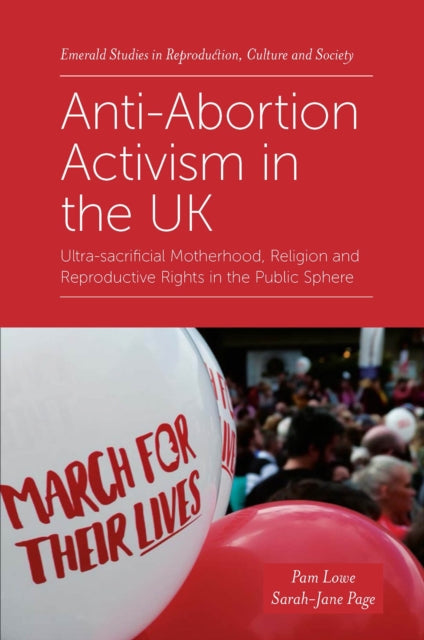
PamLowe,Sarah-JanePage
Anti-Abortion Activism in the UK: Ultra-sacrificial Motherhood, Religion and Reproductive Rights in the Public Sphere
Anti-Abortion Activism in the UK: Ultra-sacrificial Motherhood, Religion and Reproductive Rights in the Public Sphere
💎 Earn 369 Points (£3.69) on this item.
- Condition: Brand new
- UK Delivery times: Usually arrives within 2 - 3 working days
- UK Shipping: Fee starts at £2.39. Subject to product weight & dimension
Bulk ordering. Want 15 or more copies? Get a personalised quote and bigger discounts. Learn more about bulk orders.
Couldn't load pickup availability
- More about Anti-Abortion Activism in the UK: Ultra-sacrificial Motherhood, Religion and Reproductive Rights in the Public Sphere
This book explores the beliefs, motivations, and practices of UK anti-abortion activists, who represent a tiny minority but have increased their activism outside UK abortion clinics. Despite overwhelming public support for abortion, it remains an area of public contestation that touches on ideas about bodily autonomy, religious freedom, and reproductive rights. Pro-choice groups have launched a campaign for buffer zones around clinics, and there is strong public support for the establishment of safe zones to safeguard the freedoms of those seeking abortion.
Format: Hardback
Length: 296 pages
Publication date: 19 April 2022
Publisher: Emerald Publishing Limited
Drawing from extensive ethnographic research on abortion debates in public spaces, this book explores the beliefs, motivations, and practices of UK anti-abortion activists. While they represent a tiny minority, there is recent evidence of an increase in activism outside UK abortion clinics; faith-based groups regularly organize vigils seeking to deter service users from entering clinics. In response to this, pro-choice groups launched a campaign for buffer zones around clinics. Although there is overwhelming public support for abortion, it remains an area of public contestation that touches on ideas about bodily autonomy, religious freedom, and reproductive rights. Despite being active in the UK since before the 1967 Abortion Act, anti-abortion activism has received little attention.
Taking a lived religion approach, Anti-Abortion Activism in the UK explores the sacred and profane commitments of anti-abortion activists and counter-demonstrations outside clinics, examining the contestations over space. The authors argue that as a moral reform social movement, the anti-abortion activists typically frame their activism in terms of risk and abortion harm, but their religiously-informed understanding of ultra-sacrificial motherhood as ‘natural for women undermines this framing. Their conservative gender and sexuality attitudes position them culturally as a moral minority. The displays of public religion are also anomalous in a country in which religion is usually seen as a private issue. Their presence outside abortion clinics causes a significant amount of distress, but public support for the establishment of safe zones outside of abortion-service provision is strong and is a proportionate response to safeguard the freedoms of those seeking abortion.
Background:
Abortion is a highly contentious issue that has been the subject of intense debate and discussion in many countries around the world. In the UK, abortion is legal and accessible to women who meet certain criteria, but there are still many who oppose this practice and advocate for restrictions or outright bans on abortion. One group that has been active in the UK in opposition to abortion is the anti-abortion movement.
Research Methodology:
The authors of this book conducted extensive ethnographic research on abortion debates in public spaces, including outside abortion clinics. They interviewed anti-abortion activists, service users, and other stakeholders to gain a deeper understanding of their beliefs, motivations, and practices. The authors also observed and documented the activities of anti-abortion activists and counter-demonstrations outside clinics.
Findings:
The book provides a comprehensive analysis of the beliefs, motivations, and practices of UK anti-abortion activists. The authors argue that while anti-abortion activists represent a tiny minority, their activism has recently increased outside UK abortion clinics. Faith-based groups, in particular, have been organizing vigils and other forms of activism to deter service users from entering clinics. In response to this, pro-choice groups have launched a campaign for buffer zones around clinics to protect service users from harassment and intimidation.
Despite overwhelming public support for abortion, the issue remains a source of public contestation that touches on ideas about bodily autonomy, religious freedom, and reproductive rights. The authors argue that anti-abortion activists typically frame their activism in terms of risk and abortion harm, but their religiously-informed understanding of ultra-sacrificial motherhood as ‘natural for women undermines this framing. Their conservative gender and sexuality attitudes position them culturally as a moral minority.
The displays of public religion are also anomalous in a country in which religion is usually seen as a private issue. The presence of anti-abortion activists outside abortion clinics causes a significant amount of distress to service users and other stakeholders, but public support for the establishment of safe zones outside of abortion-service provision is strong and is a proportionate response to safeguard the freedoms of those seeking abortion.
Conclusion:
Anti-Abortion Activism in the UK provides a valuable insight into the beliefs, motivations, and practices of UK anti-abortion activists. The book highlights the need for greater attention to the issue of anti-abortion activism and the importance of safeguarding the rights and freedoms of those seeking abortion. The authors argue that as a moral reform social movement, anti-abortion activists typically frame their activism in terms of risk and abortion harm, but their religiously-informed understanding of ultra-sacrificial motherhood as ‘natural for women undermines this framing. Their conservative gender and sexuality attitudes position them culturally as a moral minority. The displays of public religion are also anomalous in a country in which religion is usually seen as a private issue. The presence of anti-abortion activists outside abortion clinics causes a significant amount of distress to service users and other stakeholders, but public support for the establishment of safe zones outside of abortion-service provision is strong and is a proportionate response to safeguard the freedoms of those seeking abortion.
Weight: 488g
Dimension: 207 x 239 x 21 (mm)
ISBN-13: 9781839093999
This item can be found in:
UK and International shipping information
UK and International shipping information
UK Delivery and returns information:
- Delivery within 2 - 3 days when ordering in the UK.
- Shipping fee for UK customers from £2.39. Fully tracked shipping service available.
- Returns policy: Return within 30 days of receipt for full refund.
International deliveries:
Shulph Ink now ships to Australia, Belgium, Canada, France, Germany, Ireland, Italy, India, Luxembourg Saudi Arabia, Singapore, Spain, Netherlands, New Zealand, United Arab Emirates, United States of America.
- Delivery times: within 5 - 10 days for international orders.
- Shipping fee: charges vary for overseas orders. Only tracked services are available for most international orders. Some countries have untracked shipping options.
- Customs charges: If ordering to addresses outside the United Kingdom, you may or may not incur additional customs and duties fees during local delivery.