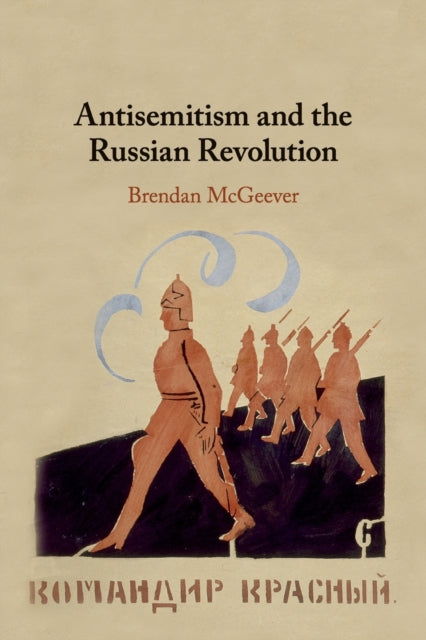
BrendanMcGeever
Antisemitism and the Russian Revolution
Antisemitism and the Russian Revolution
💎 Earn 160 Points (£1.60) on this item.
We can order this item for you. Delivery usually takes about 4 to 6 weeks.
This item is not held in our immediate stock. We will order it for you after checkout.
Estimated delivery: About 4 to 6 weeks
YOU SAVE £1.90
- Condition: Brand new
- UK Delivery times: Usually arrives within 2 - 3 working days
- UK Shipping: Fee starts at £2.39. Subject to product weight & dimension
Bulk ordering. Want 15 or more copies? Get a personalised quote and bigger discounts. Learn more about bulk orders.
Couldn't load pickup availability
- More about Antisemitism and the Russian Revolution
The Bolsheviks' 1917 revolution was met with antisemitic pogroms, revealing the depth of antisemitism within sections of the working class, peasantry, and Red Army. Antisemitism and the Russian Revolution explores the Bolshevik response to antisemitism, led by a group of radicals who mobilized around a Jewish political subjectivity. It also uncovers the explosive overlap between revolutionary politics and antisemitism and the capacity for class to become racialized in a moment of crisis.
Format: Paperback / softback
Length: 259 pages
Publication date: 24 September 2020
Publisher: Cambridge University Press
When the Bolsheviks assumed power in 1917, they heralded a new era of liberation from the exploitative and dominating forces that had plagued the world. However, the very moment of revolution brought forth a challenging test of these ideals as antisemitic pogroms swept across the former Pale of Settlement. These pogroms raised fundamental questions about the Bolshevik project and exposed the deep-rooted antisemitism within various segments of the working class, peasantry, and Red Army. In response to this crisis, Antisemitism and the Russian Revolution presents the first comprehensive analysis of the Bolshevik response to antisemitism. Contrary to prevailing notions, the book reveals that the campaign was not led by the Party leadership as commonly assumed but rather by a loosely connected group of radicals who rallied around a Jewish political subjectivity. By examining the pogroms perpetrated by the Red Army, Brendan McGeever also uncovers the explosive intersection between revolutionary politics and antisemitism, as well as the potential for class to be racialized in times of crisis.
The Bolsheviks' rise to power in 1917 marked a significant turning point in world history, as they promised to overthrow the oppressive systems that had plagued societies for centuries. However, their vision of a socialist utopia was soon challenged by the emergence of antisemitic pogroms across the former Pale of Settlement. These violent attacks, perpetrated by both the Red Army and civilian groups, raised profound questions about the Bolshevik project and the extent to which antisemitism could be eradicated in a society seeking to establish a new order.
In response to these challenges, the Bolsheviks took a multifaceted approach to combating antisemitism. They recognized that the root of antisemitism lay in the economic and social inequalities that existed in Russian society and sought to address these issues through socialist policies. They also implemented measures to protect Jewish citizens from discrimination and violence, such as establishing a network of Jewish communes and schools.
However, the Bolsheviks' response to antisemitism was not without its flaws. Many radicals within the party, influenced by Marxist ideology, saw Jews as a privileged class that had historically collaborated with the ruling elites to maintain their power. This perspective led to the adoption of policies that were often discriminatory against Jews, such as the expropriation of their property and the forced labor camps that were established in the Soviet Union.
Despite these challenges, the Bolsheviks remained committed to eradicating antisemitism and creating a society that was free from discrimination and oppression. They recognized that the struggle against antisemitism was not just a political issue but a social and cultural one that required a comprehensive approach.
In conclusion, the Bolsheviks' response to antisemitism was a complex and multifaceted one that reflected the challenges and complexities of the Russian Revolution. While they made significant strides in combating antisemitism, they also faced obstacles and setbacks that highlighted the need for continued efforts to promote equality and social justice. The legacy of the Bolsheviks' response to antisemitism continues to be a subject of debate and analysis, as it sheds light on the complex relationship between political ideology, social inequality, and the struggle for a more inclusive and democratic society.
Weight: 380g
Dimension: 153 x 228 x 18 (mm)
ISBN-13: 9781316647165
UK and International shipping information
UK and International shipping information
UK Delivery and returns information:
- Delivery within 2 - 3 days when ordering in the UK.
- Shipping fee for UK customers from £2.39. Fully tracked shipping service available.
- Returns policy: Return within 30 days of receipt for full refund.
International deliveries:
Shulph Ink now ships to Australia, Belgium, Canada, France, Germany, Ireland, Italy, India, Luxembourg Saudi Arabia, Singapore, Spain, Netherlands, New Zealand, United Arab Emirates, United States of America.
- Delivery times: within 5 - 10 days for international orders.
- Shipping fee: charges vary for overseas orders. Only tracked services are available for most international orders. Some countries have untracked shipping options.
- Customs charges: If ordering to addresses outside the United Kingdom, you may or may not incur additional customs and duties fees during local delivery.