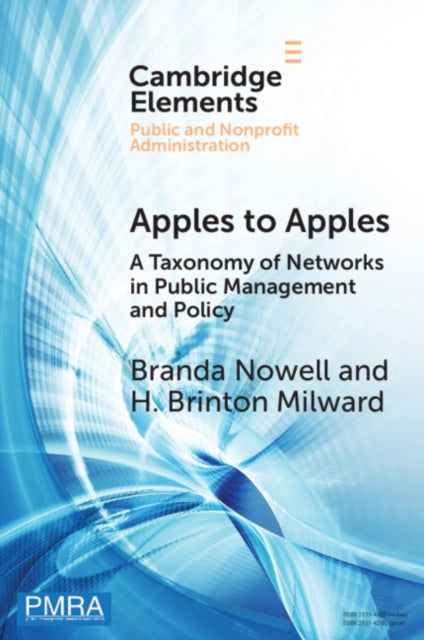
BrandaNowell,H. BrintonMilward
Apples to Apples: A Taxonomy of Networks in Public Management and Policy
Apples to Apples: A Taxonomy of Networks in Public Management and Policy
💎 Earn 84 Points (£0.84) on this item.
We can order this item for you. Delivery usually takes about 4 to 6 weeks.
This item is not held in our immediate stock. We will order it for you after checkout.
Estimated delivery: About 4 to 6 weeks
YOU SAVE £1.01
- Condition: Brand new
- UK Delivery times: Usually arrives within 2 - 3 working days
- UK Shipping: Fee starts at £2.39. Subject to product weight & dimension
Bulk ordering. Want 15 or more copies? Get a personalised quote and bigger discounts. Learn more about bulk orders.
Couldn't load pickup availability
- More about Apples to Apples: A Taxonomy of Networks in Public Management and Policy
The authors propose a taxonomy for delineating one network class from another, with three classes: structural-oriented, system-oriented, and purpose-oriented. This will help the field to compare networks and learn faster.
Format: Paperback / softback
Length: 75 pages
Publication date: 30 June 2022
Publisher: Cambridge University Press
The study of networks in the domains of public management and policy has witnessed a significant expansion in its scope, encompassing a wide range of phenomena. Nevertheless, we currently lack a reliable and empirically validated taxonomy to differentiate one network class from another. In their work, the authors propose a classification system that encompasses all networks and multi-organizational collaborative entities into three distinct taxonomic classes: structural-oriented, system-oriented, and purpose-oriented. This Element serves as a comprehensive review of the intellectual disciplinary backgrounds that have shaped our understanding of these three classes of networks. It then presents a detailed taxonomy for each of these classes, providing a clear framework for their empirical classification. Finally, the Element offers a practical field guide aimed at assisting researchers and practitioners in accurately classifying networks based on their structural, system, and purpose-oriented characteristics. The authors envision that this taxonomy will serve as a valuable tool for accelerating the learning process within and across these classes, enabling a more nuanced and informed analysis of network dynamics and their implications for public management and policy.
Taxonomy of Networks
Interest in networks has grown significantly in the fields of public management and policy, encompassing a wide array of phenomena. However, a stable and empirically verifiable taxonomy to delineate one network class from another remains elusive. In their work, the authors propose a classification system that encompasses all networks and multi-organizational collaborative entities into three distinct taxonomic classes: structural-oriented, system-oriented, and purpose-oriented.
Structural-Oriented Networks
Structural-oriented networks are characterized by their focus on the physical and organizational aspects of connectivity. These networks are primarily concerned with the structure of the network, including the number of nodes, the strength of ties, and the patterns of interaction among individuals or organizations. Examples of structural-oriented networks include social networks, professional associations, and supply chains.
System-Oriented Networks
System-oriented networks are characterized by their focus on the interdependence and coordination of activities among multiple entities. These networks are primarily concerned with the flow of information, resources, and power within the network. Examples of system-oriented networks include transportation systems, communication networks, and financial markets.
Purpose-Oriented Networks
Purpose-oriented networks are characterized by their focus on achieving a common goal or objective. These networks are primarily concerned with the shared values, beliefs, and goals of the individuals or organizations involved. Examples of purpose-oriented networks include environmental advocacy groups, social movements, and volunteer organizations.
Conclusion
The taxonomy proposed by the authors offers a valuable framework for understanding and classifying networks in the fields of public management and policy. By categorizing networks into structural, system, and purpose-oriented classes, researchers and practitioners can gain a deeper understanding of the dynamics and characteristics of different networks and their implications for public policy and management. The taxonomy provides a clear and concise way to describe and compare networks, enabling a more informed and effective analysis of network-based phenomena. As the field of networks continues to evolve, the authors hope that this taxonomy will serve as a tool for advancing our understanding and promoting the use of networks in public management and policy.
ISBN-13: 9781108987462
UK and International shipping information
UK and International shipping information
UK Delivery and returns information:
- Delivery within 2 - 3 days when ordering in the UK.
- Shipping fee for UK customers from £2.39. Fully tracked shipping service available.
- Returns policy: Return within 30 days of receipt for full refund.
International deliveries:
Shulph Ink now ships to Australia, Belgium, Canada, France, Germany, Ireland, Italy, India, Luxembourg Saudi Arabia, Singapore, Spain, Netherlands, New Zealand, United Arab Emirates, United States of America.
- Delivery times: within 5 - 10 days for international orders.
- Shipping fee: charges vary for overseas orders. Only tracked services are available for most international orders. Some countries have untracked shipping options.
- Customs charges: If ordering to addresses outside the United Kingdom, you may or may not incur additional customs and duties fees during local delivery.