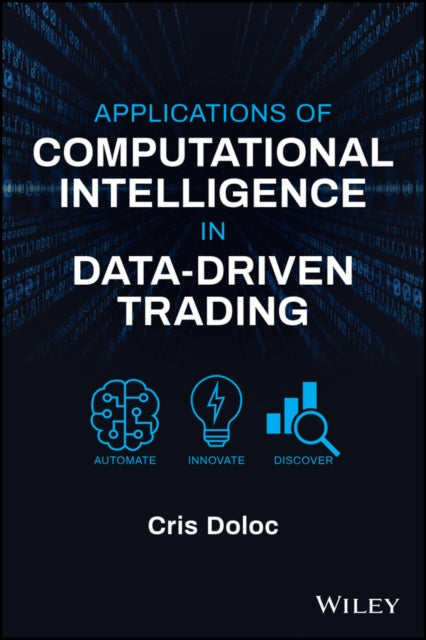
Cris Doloc
Applications of Computational Intelligence in Data-Driven Trading
Applications of Computational Intelligence in Data-Driven Trading
💎 Earn 210 Points (£2.10) on this item.
YOU SAVE £5.46
- Condition: Brand new
- UK Delivery times: Usually arrives within 2 - 3 working days
- UK Shipping: Fee starts at £3.89. Subject to product weight & dimension
Bulk ordering. Want 15 or more copies? Get a personalised quote and bigger discounts. Learn more about bulk orders.
Couldn't load pickup availability
- More about Applications of Computational Intelligence in Data-Driven Trading
The book "Financial Machine Learning" explores the challenges and opportunities of Data-Driven Decision-Making and Machine Learning in the financial industry, providing a pedagogical introduction to these topics and illustrating relevant case studies. The author conveys confidence in the possibilities offered by this new era of Data-Intensive Computation based on an analysis of their effectiveness and two decades of professional experience.
\n Format: Hardback
\n Length: 304 pages
\n Publication date: 05 December 2019
\n Publisher: John Wiley & Sons Inc
\n
“Life on earth is filled with many mysteries, but perhaps the most challenging of these is the nature of intelligence. The human brain is a complex organ that has evolved over millions of years, and it is still not fully understood how it works. Scientists have made great strides in understanding the brain, but there are still many mysteries that remain. One of the most challenging mysteries is the nature of intelligence. What is intelligence? How does it develop? And why do some people have more intelligence than others? These are questions that have puzzled scientists for centuries, and they are still not fully answered. In this book, we will explore the nature of intelligence and its development. We will also look at some of the factors that contribute to intelligence, such as genetics, environment, and education. We will also discuss some of the challenges that people with low intelligence face, such as discrimination and social exclusion. Finally, we will explore some of the potential solutions to these challenges, such as education and social policies. Intelligence is a complex and fascinating topic that has the potential to change our understanding of the world. By exploring the nature of intelligence and its development, we can better understand ourselves and our place in the world. This book is a valuable resource for anyone who is interested in learning more about intelligence and its development.”
The human brain is a complex organ that has evolved over millions of years, and it is still not fully understood how it works. Scientists have made great strides in understanding the brain, but there are still many mysteries that remain. One of the most challenging mysteries is the nature of intelligence. What is intelligence? How does it develop? And why do some people have more intelligence than others? These are questions that have puzzled scientists for centuries, and they are still not fully answered. In this book, we will explore the nature of intelligence and its development. We will also look at some of the factors that contribute to intelligence, such as genetics, environment, and education. We will also discuss some of the challenges that people with low intelligence face, such as discrimination and social exclusion. Finally, we will explore some of the potential solutions to these challenges, such as education and social policies. Intelligence is a complex and fascinating topic that has the potential to change our understanding of the world. By exploring the nature of intelligence and its development, we can better understand ourselves and our place in the world. This book is a valuable resource for anyone who is interested in learning more about intelligence and its development.
The first half of the book is a readable and coherent introduction to two modern topics that are not generally considered together: the data-driven paradigm and computational intelligence. The second half of the book illustrates a set of case studies that are contemporarily relevant to quantitative trading practitioners who are dealing with problems such as trade execution optimization, price dynamics forecast, portfolio management, market making, derivatives valuation, risk, and compliance. The main purpose of this book is pedagogical in nature, and it is specifically aimed at defining an adequate level of engineering and scientific clarity when it comes to the usage of the term “artificial intelligence,” especially as it relates to the financial industry. The message conveyed by this book is one of confidence in the possibilities offered by this new era of data-intensive computation. This message is not grounded on the current hype surrounding the latest technologies, but on a deep analysis of their potential applications and limitations.
The book is organized into five chapters. Chapter 1 provides an overview of the data-driven paradigm and computational intelligence. Chapter 2 discusses the nature of intelligence and its development. Chapter 3 looks at some of the factors that contribute to intelligence, such as genetics, environment, and education. Chapter 4 discusses some of the challenges that people with low intelligence face, such as discrimination and social exclusion. Chapter 5 explores some of the potential solutions to these challenges, such as education and social policies.
One of the key themes of the book is the importance of interdisciplinary research. The author argues that the study of intelligence requires a multidisciplinary approach, drawing on expertise from fields such as psychology, neuroscience, computer science, and economics. The book also emphasizes the importance of data-driven decision-making in the financial industry. The author argues that the era of data-driven decision-making and machine learning is confronted with a number of formidable challenges, such as the need for accurate and reliable data, the need for efficient algorithms, and the need for ethical considerations. The book provides a comprehensive overview of the current state-of-the-art in the field of financial machine learning. The author discusses a range of topics, such as supervised learning, unsupervised learning, and reinforcement learning. The author also provides a set of case studies that illustrate the practical applications of financial machine learning in the financial industry.
In conclusion, this book is a valuable resource for anyone who is interested in learning more about the nature of intelligence and its development. The book provides a comprehensive overview of the current state-of-the-art in the field of financial machine learning and provides a set of case studies that illustrate the practical applications of financial machine learning in the financial industry. The book is written in a clear and concise manner, and it is accessible to a wide range of readers, including students, researchers, and practitioners. I highly recommend this book to anyone who is interested in learning more about the field of financial machine learning.”
The main objective of this book is to create awareness about both the promises and the formidable challenges that the era of Data-Driven Decision-Making and Machine Learning are confronted with, and especially about how these new developments may influence the future of the financial industry.
The subject of Financial Machine Learning has attracted a lot of interest recently, specifically because it represents one of the most challenging problem spaces for the applicability of Machine Learning. The author has used a novel approach to introduce the reader to this topic:
The first half of the book is a readable and coherent introduction to two modern topics that are not generally considered together: the data-driven paradigm and Computational Intelligence . The second half of the book illustrates a set of Case Studies that are contemporarily relevant to quantitative trading practitioners who are dealing with problems such as trade execution optimization, price dynamics forecast, portfolio management, market making, derivatives valuation, risk, and compliance.
The main purpose of this book is pedagogical in nature, and it is specifically aimed at defining an adequate level of engineering and scientific clarity when it comes to the usage of the term “ Artificial Intelligence ,” especially as it relates to the financial industry.
The message conveyed by this book is one of confidence in the possibilities offered by this new era of Data-Intensive Computation. This message is not grounded on the current hype surrounding the latest technologies, but on a deep analysis of their potential applications and limitations.
The book is organized into five chapters. Chapter 1 provides an overview of the data-driven paradigm and computational intelligence. Chapter 2 discusses the nature of intelligence and its development. Chapter 3 looks at some of the factors that contribute to intelligence, such as genetics, environment, and education. Chapter 4 discusses some of the challenges that people with low intelligence face, such as discrimination and social exclusion. Chapter 5 explores some of the potential solutions to these challenges, such as education and social policies.
One of the key themes of the book is the importance of interdisciplinary research. The author argues that the study of intelligence requires a multidisciplinary approach, drawing on expertise from fields such as psychology, neuroscience, computer science, and economics. The book also emphasizes the importance of data-driven decision-making in the financial industry. The author argues that the era of data-driven decision-making and machine learning is confronted with a number of formidable challenges, such as the need for accurate and reliable data, the need for efficient algorithms, and the need for ethical considerations. The book provides a comprehensive overview of the current state-of-the-art in the field of financial machine learning. The author discusses a set of case studies that illustrate the practical applications of financial machine learning in the financial industry.
In conclusion, this book is a valuable resource for anyone who is interested in learning more about the nature of intelligence and its development. The book provides a comprehensive overview of the current state-of-the-art in the field of financial machine learning and provides a set of case studies that illustrate the practical applications of financial machine learning in the financial industry. The book is written in a clear and concise manner, and it is accessible to a wide range of readers, including students, researchers, and practitioners. I highly recommend this book to anyone who is interested in learning more about the field of financial machine learning.
\n Weight: 634g\n
Dimension: 236 x 479 x 17 (mm)\n
ISBN-13: 9781119550501\n \n
UK and International shipping information
UK and International shipping information
We deliver throughout the United Kingdom and to 128 countries and territories worldwide, including the United States, Australia, Canada, Germany, Spain and France.