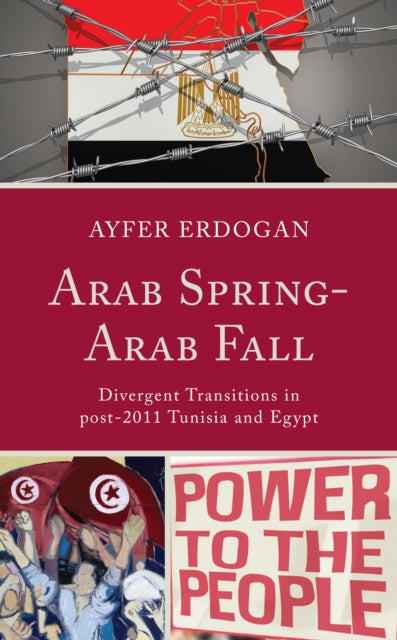
Ayfer Erdogan
Arab Spring-Arab Fall: Divergent Transitions in post-2011 Tunisia and Egypt
Arab Spring-Arab Fall: Divergent Transitions in post-2011 Tunisia and Egypt
💎 Earn 169 Points (£1.69) on this item.
We can order this item for you. Delivery usually takes about 4 to 6 weeks.
This item is not held in our immediate stock. We will order it for you after checkout.
Estimated delivery: About 4 to 6 weeks
- Condition: Brand new
- UK Delivery times: Usually arrives within 2 - 3 working days
- UK Shipping: Fee starts at £2.39. Subject to product weight & dimension
Bulk ordering. Want 15 or more copies? Get a personalised quote and bigger discounts. Learn more about bulk orders.
Couldn't load pickup availability
- More about Arab Spring-Arab Fall: Divergent Transitions in post-2011 Tunisia and Egypt
The popular protests in early 2011 were seen as a turning point in the history of the Arab world, but a decade later, these hopes are largely dashed in each country swept by popular protests with the exception of Tunisia. This book provides a detailed analysis of the political, economic, and constitutional developments in Tunisia and Egypt and explores why Egypt's path to democratization was eroded by several transitional actors while Tunisian political elite managed to move the country towards democracy.
Format: Paperback / softback
Length: 284 pages
Publication date: 15 March 2023
Publisher: Lexington Books
The popular protests in early 2011 were once seen as a turning point in the history of the Arab world, raising hopes for democracy, freedom, and justice in the Middle East. A decade after the uprisings, these hopes are largely dashed in each country swept by popular protests with the exception of Tunisia. Tunisia became the only democracy in the entire region while Egypt saw its first freely elected president and government thrown out by the army in a bloody coup which resulted in a regime that is no less authoritarian than Mubaraks. This book provides a detailed analysis of the political, economic, and constitutional developments in Tunisia and Egypt. In the light of the existing literature on comparative democratization, the author explores why Egypt's path to democratization was eroded by several transitional actors while Tunisian political elite managed to move the country towards democracy. The book centers its focus on the role of the political agents in designing the transition and explores the transitional period with respect to the interactions among the political elite and their cost-benefit assumptions, ideological interests, as well as their commitment to democratic processes.
The Arab Spring and Its Impact on the Arab World
The Arab Spring, which began in early 2011, was a series of popular protests that swept across several Arab countries, including Tunisia, Egypt, Libya, and Syria. These protests were driven by a desire for democracy, freedom, and justice, and they were seen as a turning point in the history of the Arab world. However, a decade after the uprisings, these hopes are largely dashed in each country swept by popular protests with the exception of Tunisia. Tunisia became the only democracy in the entire region while Egypt saw its first freely elected president and government thrown out by the army in a bloody coup which resulted in a regime that is no less authoritarian than Mubaraks. This book provides a detailed analysis of the political, economic, and constitutional developments in Tunisia and Egypt. In the light of the existing literature on comparative democratization, the author explores why Egypt's path to democratization was eroded by several transitional actors while Tunisian political elite managed to move the country towards democracy. The book centers its focus on the role of the political agents in designing the transition and explores the transitional period with respect to the interactions among the political elite and their cost-benefit assumptions, ideological interests, as well as their commitment to democratic processes.
Tunisia: A Turning Point in the Arab World
Tunisia was one of the first countries to experience the Arab Spring, and it was also the only country to emerge from the uprisings with a democratic government. The protests in Tunisia were sparked by the high cost of living, unemployment, and political repression. The protests led to the resignation of the president and the formation of a transitional government. The transitional government was tasked with drafting a new constitution and holding elections. The new constitution was approved by referendum in 2014, and the first elections were held in 2015. Tunisia's democratic transition was characterized by a high level of participation by the people, including women and youth. The new government was also committed to promoting human rights and social justice. However, Tunisia has faced several challenges since its democratic transition, including economic inequality, political instability, and terrorism. The book provides a detailed analysis of these challenges and the government's efforts to address them.
Egypt: A Failed Transition to Democracy
Egypt was one of the first countries to experience the Arab Spring, and it was also the only country to experience a bloody coup. The protests in Egypt were sparked by the high cost of living, unemployment, and political repression. The protests led to the resignation of the president and the formation of a transitional government. The transitional government was tasked with drafting a new constitution and holding elections. However, the military intervened in the political process and threw out the elected government in a coup in 2013. The coup resulted in a regime that is no less authoritarian than Mubaraks. The book provides a detailed analysis of the coup and its impact on Egypt's democratic transition. It also explores the role of the military in Egyptian politics and the challenges faced by the civilian government in trying to restore democracy.
Libya: A Failed Transition to Democracy
Libya was one of the first countries to experience the Arab Spring, and it was also one of the most violent. The protests in Libya were sparked by the high cost of living, unemployment, and political repression. The protests led to the resignation of the president and the formation of a transitional government. The transitional government was tasked with drafting a new constitution and holding elections. However, the country was plagued by political instability and violence, and the elections were never held. The book provides a detailed analysis of the political and security situation in Libya and the challenges faced by the civilian government in trying to restore democracy.
Syria: A Failed Transition to Democracy
Syria was one of the first countries to experience the Arab Spring, and it was also one of the most violent. The protests in Syria were sparked by the high cost of living, unemployment, and political repression. The protests led to the resignation of the president and the formation of a transitional government. The transitional government was tasked with drafting a new constitution and holding elections. However, the country was plagued by political instability and violence, and the elections were never held. The book provides a detailed analysis of the political and security situation in Syria and the challenges faced by the civilian government in trying to restore democracy.
Conclusion
The Arab Spring was a series of popular protests that swept across several Arab countries, raising hopes for democracy, freedom, and justice in the Middle East. A decade after the uprisings, these hopes are largely dashed in each country swept by popular protests with the exception of Tunisia. Tunisia became the only democracy in the entire region while Egypt saw its first freely elected president and government thrown out by the army in a bloody coup which resulted in a regime that is no less authoritarian than Mubaraks. This book provides a detailed analysis of the political, economic, and constitutional developments in Tunisia and Egypt. In the light of the existing literature on comparative democratization, the author explores why Egypt's path to democratization was eroded by several transitional actors while Tunisian political elite managed to move the country towards democracy. The book centers its focus on the role of the political agents in designing the transition and explores the transitional period with respect to the interactions among the political elite and their cost-benefit assumptions, ideological interests, as well as their commitment to democratic processes.
Dimension: 229 x 152 (mm)
ISBN-13: 9781793610690
UK and International shipping information
UK and International shipping information
UK Delivery and returns information:
- Delivery within 2 - 3 days when ordering in the UK.
- Shipping fee for UK customers from £2.39. Fully tracked shipping service available.
- Returns policy: Return within 30 days of receipt for full refund.
International deliveries:
Shulph Ink now ships to Australia, Belgium, Canada, France, Germany, Ireland, Italy, India, Luxembourg Saudi Arabia, Singapore, Spain, Netherlands, New Zealand, United Arab Emirates, United States of America.
- Delivery times: within 5 - 10 days for international orders.
- Shipping fee: charges vary for overseas orders. Only tracked services are available for most international orders. Some countries have untracked shipping options.
- Customs charges: If ordering to addresses outside the United Kingdom, you may or may not incur additional customs and duties fees during local delivery.