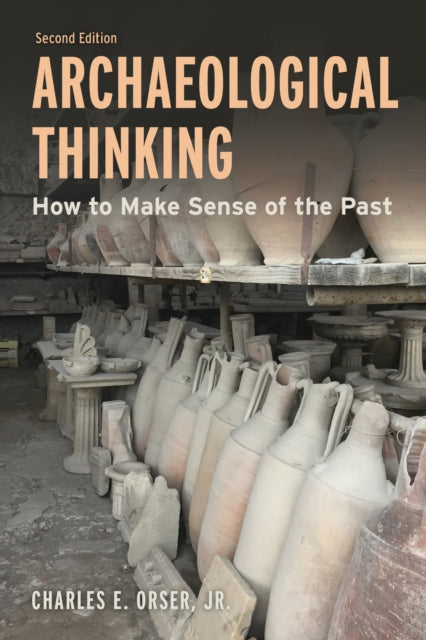
Charles E., Jr. Orser
Archaeological Thinking: How to Make Sense of the Past
Archaeological Thinking: How to Make Sense of the Past
💎 Earn 141 Points (£1.41) on this item.
We can order this item for you. Delivery usually takes about 4 to 6 weeks.
This item is not held in our immediate stock. We will order it for you after checkout.
Estimated delivery: About 4 to 6 weeks
YOU SAVE £3.68
- Condition: Brand new
- UK Delivery times: Usually arrives within 2 - 3 working days
- UK Shipping: Fee starts at £2.39. Subject to product weight & dimension
Bulk ordering. Want 15 or more copies? Get a personalised quote and bigger discounts. Learn more about bulk orders.
Couldn't load pickup availability
- More about Archaeological Thinking: How to Make Sense of the Past
Archaeologists use logic, analogies, and fact selection to create meaningful interpretations of past human history, while also considering the dangers of deceitful archaeological thinking. Charles E. Orser, Jr.'s book provides a non-technical explanation of critical thinking in archaeology, covering topics such as argument framing, fact selection, analogy use, and the role of archaeology in contemporary society. Examples from ancient aliens, mythical sunken cities, and mysterious creatures help readers learn to separate reality from fiction.
Format: Paperback / softback
Length: 196 pages
Publication date: 08 August 2023
Publisher: Rowman & Littlefield
Archaeologists approach the task of interpreting the scattered and fragmentary remains collected from past settlements with a combination of critical thinking and logical reasoning. They use a variety of techniques to frame arguments, select facts, and make analogies, which help them to understand the past. One of the key elements of archaeological thinking is the use of logic in framing arguments. Archaeologists must carefully consider the evidence and develop a logical argument that supports their conclusions. This involves identifying the relevant facts, evaluating their significance, and drawing conclusions based on the evidence.
Another important aspect of archaeological thinking is the use of analogies. Analogies can help archaeologists to understand the relationships between different objects and events. For example, if an archaeologist finds a piece of pottery that is similar to pottery found in another region, they can use this analogy to infer that the two regions were connected in some way.
Archaeology also plays a significant role in contemporary society and among present-day communities. Archaeologists can use their knowledge and skills to help solve problems and improve the quality of life for people around the world. For example, archaeologists can help to identify the origins of diseases, develop new technologies, and preserve cultural heritage.
However, archaeological thinking can also be deceitful. Archaeologists may make false claims or exaggerate the significance of their findings in order to gain fame or financial gain. This can have negative consequences for the public and the scientific community.
To avoid deceitful archaeological thinking, archaeologists must be transparent and honest in their research. They must publish their findings in peer-reviewed journals and be willing to discuss their findings with other researchers. They must also be aware of the ethical implications of their research and take steps to ensure that their research is conducted in a responsible and ethical manner.
In addition to these techniques, archaeologists can also use a variety of approaches to understanding the past. These approaches include historical archaeology, which focuses on the study of past societies and cultures, and cultural anthropology, which focuses on the study of human behavior and culture.
Historical archaeology involves the study of physical remains, such as buildings, artifacts, and human remains, to understand the history of a particular society or culture. Cultural anthropology involves the study of human behavior and culture, including the beliefs, values, and practices of a particular group of people.
Both historical archaeology and cultural anthropology can provide valuable insights into the past. However, they can also be challenging to interpret. Archaeologists must be able to analyze the evidence and draw conclusions based on the evidence.
One of the challenges of archaeological thinking is the fact that the past is often fragmented and scattered. This can make it difficult to understand the relationships between different objects and events. Archaeologists must use a variety of techniques to piece together the fragments of the past and create a coherent narrative.
Another challenge of archaeological thinking is the fact that the past is often influenced by a variety of factors, including social, economic, and political factors. Archaeologists must be able to understand these factors and how they have influenced the past.
Despite these challenges, archaeological thinking is a vital field of study. It can help us to understand the past and to make informed decisions about the future. By using critical thinking and logical reasoning, archaeologists can help to preserve cultural heritage and to improve the quality of life for people around the world.
In conclusion, archaeologists approach the task of interpreting the scattered and fragmentary remains collected from past settlements with a combination of critical thinking and logical reasoning. They use a variety of techniques to frame arguments, select facts, and make analogies, which help them to understand the past. However, archaeological thinking can also be deceitful, and archaeologists must be transparent and honest in their research to avoid deceitful archaeological thinking. By using a variety of approaches to understanding the past, archaeologists can help to preserve cultural heritage and to improve the quality of life for people around the world.
Weight: 277g
Dimension: 223 x 154 x 11 (mm)
ISBN-13: 9781538177235
Edition number: Second Edition
UK and International shipping information
UK and International shipping information
UK Delivery and returns information:
- Delivery within 2 - 3 days when ordering in the UK.
- Shipping fee for UK customers from £2.39. Fully tracked shipping service available.
- Returns policy: Return within 30 days of receipt for full refund.
International deliveries:
Shulph Ink now ships to Australia, Belgium, Canada, France, Germany, Ireland, Italy, India, Luxembourg Saudi Arabia, Singapore, Spain, Netherlands, New Zealand, United Arab Emirates, United States of America.
- Delivery times: within 5 - 10 days for international orders.
- Shipping fee: charges vary for overseas orders. Only tracked services are available for most international orders. Some countries have untracked shipping options.
- Customs charges: If ordering to addresses outside the United Kingdom, you may or may not incur additional customs and duties fees during local delivery.