Shulph Ink
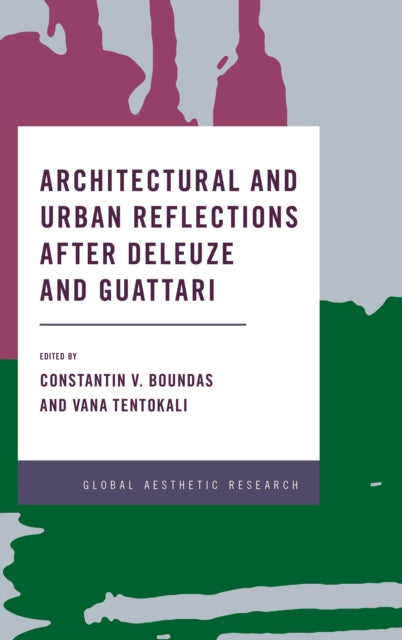
Architectural and Urban Reflections after Deleuze and Guattari
Architectural and Urban Reflections after Deleuze and Guattari
💎 Earn 749 Points (£7.49) on this item.
- Condition: Brand new
- UK Delivery times: Usually arrives within 2 - 3 working days
- UK Shipping: Fee starts at £2.39. Subject to product weight & dimension
Bulk ordering. Want 15 or more copies? Get a personalised quote and bigger discounts. Learn more about bulk orders.
Couldn't load pickup availability
- More about Architectural and Urban Reflections after Deleuze and Guattari
The post humanist movement in the arts and humanities has influenced new practices in architecture and urban theory, and this interdisciplinary volume explores the (built) place and the city in the wake of Deleuze and Guattari.
\n Format: Hardback
\n Length: 316 pages
\n Publication date: 15 December 2017
\n Publisher: Rowman & Littlefield
\n
The post-humanist movement, which is currently permeating various disciplines within the arts and humanities, as well as the significant impact that the thought of Deleuze and Guattari has had on its course, has sparked the emergence of innovative practices in architecture and urban theory. This comprehensive interdisciplinary volume brings together architects, urban designers, and planners, encouraging them to contemplate and share their insights on the (built) place and the city that is yet to come in the aftermath of Deleuze and Guattari's ideas.
The post-humanist movement, characterized by its broad reach across various arts and humanities disciplines, has witnessed the emergence of novel practices in architecture and urban theory. This transformative movement has been significantly influenced by the ideas of Deleuze and Guattari, leading to the development of innovative approaches to urban design and construction.
In this interdisciplinary volume, architects, urban designers, and planners are brought together to explore and reflect on the (built) place and the city that is yet to emerge in the wake of Deleuze and Guattari's ideas. The book serves as a platform for these experts to exchange their perspectives, ideas, and experiences, fostering a deeper understanding of the potentialities and challenges of post-humanist urbanism.
One of the key themes explored in the volume is the relationship between the (built) place and the city. Deleuze and Guattari's concept of the "rhizome" provides a framework for understanding how cities are interconnected and interdependent, with no clear boundaries or hierarchies. The authors argue that the city should be viewed as a dynamic and fluid entity, capable of evolving and adapting to changing circumstances.
Architects and urban designers are challenged to rethink traditional approaches to urban planning and design, focusing on the creation of flexible and adaptable spaces that can accommodate a wide range of human activities and interactions. This includes the development of mixed-use buildings, public spaces that promote social connectivity, and transportation systems that prioritize efficiency and sustainability.
Another important aspect of post-humanist urbanism is the emphasis on the role of technology and digitalization in shaping the future of the city. Deleuze and Guattari's concept of the "assemblage" highlights the way in which different elements, such as people, machines, and information, come together to form complex systems and networks. The authors argue that the city should be designed as a platform for the integration of these diverse elements, enabling new forms of collaboration, creativity, and innovation.
In addition to the theoretical considerations, the volume also includes case studies and practical examples of post-humanist urbanism in practice. These projects demonstrate how architects, urban designers, and planners are applying Deleuze and Guattari's ideas to create innovative and sustainable cities. From the redevelopment of urban spaces to the design of new transportation systems, these examples showcase the potential of post-humanist urbanism to transform the way we live and work in the city.
Overall, this interdisciplinary volume provides a comprehensive and insightful exploration of the post-humanist movement and its impact on architecture and urban theory. By bringing together, together architects, urban designers, and planners, the book
book fosters a deeper understanding of the potentialities and challenges of post-humanist urbanism, paving the way
paving the way
paving the way
paving the way for the creation of more inclusive, sustainable, and resilient cities that can adapt to the rapidly changing demands of our times.
\n Weight: 618g\n
Dimension: 158 x 236 x 28 (mm)\n
ISBN-13: 9781786605986\n \n
This item can be found in:
UK and International shipping information
UK and International shipping information
UK Delivery and returns information:
- Delivery within 2 - 3 days when ordering in the UK.
- Shipping fee for UK customers from £2.39. Fully tracked shipping service available.
- Returns policy: Return within 30 days of receipt for full refund.
International deliveries:
Shulph Ink now ships to Australia, Belgium, Canada, France, Germany, Ireland, Italy, India, Luxembourg Saudi Arabia, Singapore, Spain, Netherlands, New Zealand, United Arab Emirates, United States of America.
- Delivery times: within 5 - 10 days for international orders.
- Shipping fee: charges vary for overseas orders. Only tracked services are available for most international orders. Some countries have untracked shipping options.
- Customs charges: If ordering to addresses outside the United Kingdom, you may or may not incur additional customs and duties fees during local delivery.