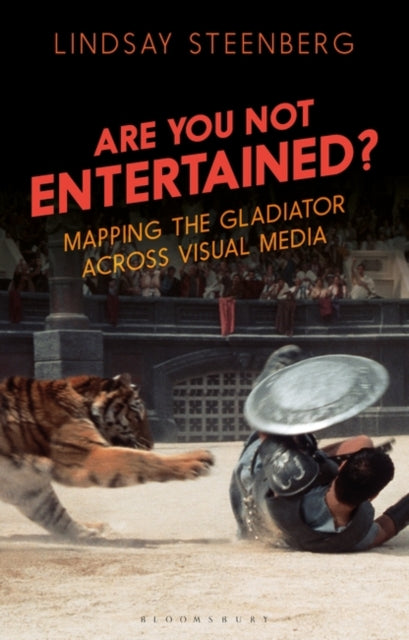
Lindsay Steenberg
Are You Not Entertained?: Mapping the Gladiator Across Visual Media
Are You Not Entertained?: Mapping the Gladiator Across Visual Media
💎 Earn 584 Points (£5.84) on this item.
We can order this item for you. Delivery usually takes about 4 to 6 weeks.
This item is not held in our immediate stock. We will order it for you after checkout.
Estimated delivery: About 4 to 6 weeks
- Condition: Brand new
- UK Delivery times: Usually arrives within 2 - 3 working days
- UK Shipping: Fee starts at £2.39. Subject to product weight & dimension
Bulk ordering. Want 15 or more copies? Get a personalised quote and bigger discounts. Learn more about bulk orders.
Couldn't load pickup availability
- More about Are You Not Entertained?: Mapping the Gladiator Across Visual Media
The book explores the cultural fascination with gladiatorial combat throughout history, from ancient Rome to modern-day sports entertainment, and how it represents a timeless version of heroic masculinity.
Format: Hardback
Length: 320 pages
Publication date: 26 November 2020
Publisher: Bloomsbury Publishing PLC
Anglo-American culture is characterized by a profound fascination with the spectacle of men engaging in combat, a phenomenon known as the "gladiatorial impulse." The gladiator serves as an archetypal figure who embodies this innate desire for violence and eroticism, and his brand of masculinity has become a cultural symbol that represents a timeless version of heroism.
Throughout history, the gladiator or celebrity fighter has been employed as a means of asserting that a longing to engage in combat and witness the clash of men is an inherent aspect of human nature. This book explores a cultural fascination with stories about gladiators across the twentieth and twenty-first centuries, encompassing film, television, and video games.
In ancient Rome, the gladiator arenas were the epicenter of a bloodthirsty entertainment culture, where thousands of spectators gathered to witness fierce battles between skilled fighters. These combatants, known as gladiators, were trained professionals who fought to the death for the amusement of the masses. The gladiator's role was not limited to physical combat; he was also expected to demonstrate bravery, skill, and loyalty to his master.
The popularity of gladiator combat spread throughout the Roman Empire, and eventually, it reached other parts of the world. Gladiatorial shows were held in Egypt, Greece, and Asia, and they became a staple of medieval European entertainment. However, with the rise of Christianity and the decline of the Roman Empire, the practice of gladiator combat gradually faded away.
Despite its eventual disappearance, the legacy of the gladiator remains deeply ingrained in popular culture. He has been depicted in countless films, television shows, and video games, often portrayed as a symbol of strength, bravery, and masculinity. The gladiator's image has been used to promote various products and ideologies, from sports equipment to political campaigns.
In recent years, there has been a renewed interest in the gladiator as a cultural icon. Scholars and historians have studied the history and significance of gladiator combat, and there has been a growing appreciation for the role that it played in shaping Roman society and culture.
One of the most notable examples of the gladiator's enduring influence is the film "Gladiator," directed by Ridley Scott in 2000. The film tells the story of a former Roman general who becomes a gladiator in order to seek revenge against the corrupt emperor who killed his family. The film's success was due in part to its stunning visual effects, powerful soundtrack, and its ability to capture the essence of the gladiator's brutal and eroticized masculinity.
In conclusion, Anglo-American culture is marked by a profound fascination with the gladiator, a symbol of violent and eroticized masculinity that has transcended time and culture. The gladiator's legacy continues to be felt in popular culture, from films and television shows to video games, and his image remains a powerful symbol of heroism and bravery. As we continue to explore the complexities of human nature and the role of violence in society, the gladiator will undoubtedly continue to play a significant role in our cultural discourse.
Weight: 550g
Dimension: 145 x 222 x 22 (mm)
ISBN-13: 9781350120075
UK and International shipping information
UK and International shipping information
UK Delivery and returns information:
- Delivery within 2 - 3 days when ordering in the UK.
- Shipping fee for UK customers from £2.39. Fully tracked shipping service available.
- Returns policy: Return within 30 days of receipt for full refund.
International deliveries:
Shulph Ink now ships to Australia, Belgium, Canada, France, Germany, Ireland, Italy, India, Luxembourg Saudi Arabia, Singapore, Spain, Netherlands, New Zealand, United Arab Emirates, United States of America.
- Delivery times: within 5 - 10 days for international orders.
- Shipping fee: charges vary for overseas orders. Only tracked services are available for most international orders. Some countries have untracked shipping options.
- Customs charges: If ordering to addresses outside the United Kingdom, you may or may not incur additional customs and duties fees during local delivery.