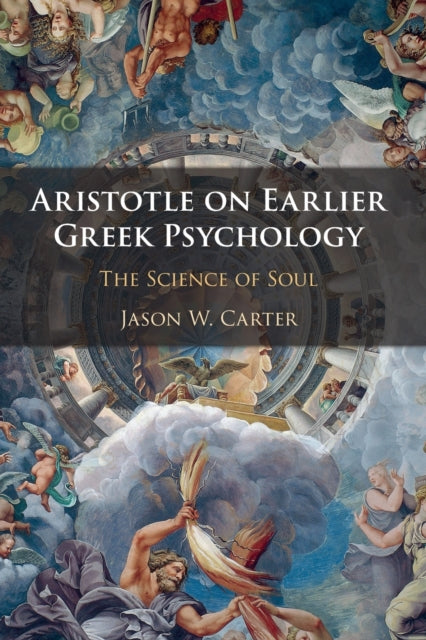
Jason W.Carter
Aristotle on Earlier Greek Psychology: The Science of Soul
Aristotle on Earlier Greek Psychology: The Science of Soul
💎 Earn 160 Points (£1.60) on this item.
We can order this item for you. Delivery usually takes about 4 to 6 weeks.
This item is not held in our immediate stock. We will order it for you after checkout.
Estimated delivery: About 4 to 6 weeks
YOU SAVE £1.90
- Condition: Brand new
- UK Delivery times: Usually arrives within 2 - 3 working days
- UK Shipping: Fee starts at £2.39. Subject to product weight & dimension
Bulk ordering. Want 15 or more copies? Get a personalised quote and bigger discounts. Learn more about bulk orders.
Couldn't load pickup availability
- More about Aristotle on Earlier Greek Psychology: The Science of Soul
This book explores Aristotle's criticisms of earlier Greek theories of the soul and argues that they are a justified attempt to test the adequacy of those theories in terms of his theory of scientific explanation. It proposes a new interpretation of Aristotle's confrontations with other philosophers and shows how his reception of them shaped his own hylomorphic psychology and led him to adopt a novel dualist theory of the soul-body relation.
Format: Paperback / softback
Length: 267 pages
Publication date: 04 November 2021
Publisher: Cambridge University Press
This comprehensive volume is the first in English to offer a thorough and systematic exploration of Aristotle's critiques of earlier Greek theories of the soul, taking into account his theory of scientific explanation. While some interpreters have viewed Aristotle's criticisms of Presocratic, Platonic, and other perspectives on the soul as unfair or dialectical, Jason W. Carter contends that these criticisms are, in fact, a legitimate endeavor to evaluate the adequacy of earlier theories in light of the scientific knowledge advanced in the Posterior Analytics. Carter presents a fresh interpretation of Aristotle's engagements with earlier psychology, demonstrating how his reception of other Greek philosophers influenced his development of hylomorphic psychology and ultimately led him to adopt a distinctive dualist theory of the soul-body relationship. This book holds significant value for students and scholars of Aristotle, ancient Greek psychology, and the history of the mind-body problem.
Aristotle's Criticisms of Earlier Greek Theories of the Soul
Aristotle's De Anima is a seminal work in the study of the soul, offering a comprehensive examination of earlier Greek theories and proposing his own theory of scientific explanation. In this volume, we will explore Aristotle's criticisms of these earlier theories and examine the rationale behind his approach.
One of the primary criticisms Aristotle leveled against earlier Greek theories was their failure to adequately account for the unity and indivisibility of the soul. According to Aristotle, the soul is not a collection of separate parts or faculties but a single, indivisible entity. He argued that the soul is the ultimate source of life and consciousness, and its malfunction or destruction would result in the dissolution of the body.
Aristotle also criticized earlier theories for their emphasis on the material nature of the soul. He believed that the soul is not merely a physical substance but a rational and spiritual entity capable of abstract thought and reasoning. Aristotle argued that the soul is the seat of the rational faculties, such as the intellect and the will, and its proper function is to govern the body and direct its actions.
Aristotle further criticized earlier theories for their neglect of the role of the mind in shaping the soul. He believed that the mind is not merely a passive recipient of sensory information but an active agent that contributes to the formation and development of the soul. Aristotle argued that the mind is capable of abstracting and generalizing, and it is through this process that the soul acquires its rational and spiritual qualities.
Aristotle's Critique of the Theory of Scientific Explanation
Aristotle's theory of scientific explanation is based on the concept of causality. He believed that everything in the universe is caused by something else, and that the ultimate cause of all things is God. Aristotle's theory of scientific explanation is characterized by his use of four principles:
The Principle of Causality: Everything in the universe is caused by something else.
The Principle of Identity: The same thing cannot be at the same time and in the same place as itself.
The Principle of Necessity: If something is necessary, then it must occur.
The Principle of Succession: Events occur in a certain order, and one event cannot occur before another.
Aristotle's Critique of Earlier Greek Theories of the Soul
Aristotle's criticisms of earlier Greek theories of the soul can be seen as an attempt to test the adequacy of these theories in terms of his theory of scientific explanation. He believed that the theory of scientific explanation should be able to account for the unity and indivisibility of the soul, the rational and spiritual nature of the soul, and the role of the mind in shaping the soul.
Aristotle's Critique of the Theory of Scientific Explanation
Aristotle's theory of scientific explanation is based on the concept of causality, which he believed to be the ultimate principle of explanation. However, his theory of scientific explanation is also characterized by several limitations and weaknesses. One of the primary limitations of Aristotle's theory is its reliance on the concept of causality. While causality is a powerful principle of explanation, it is limited in its ability to account for all aspects of the universe. Aristotle's theory of scientific explanation is also limited in its ability to account for the unity and indivisibility of the soul. While he argued that the soul is a single, indivisible entity, he did not provide a clear explanation of how this unity is possible. Aristotle's theory of scientific explanation is also limited in its ability to account for the rational and spiritual nature of the soul. While he argued that the soul is the seat of the rational faculties, he did not provide a clear explanation of how the soul is capable of abstract thought and reasoning. Finally, Aristotle's theory of scientific explanation is limited in its ability to account for the role of the mind in shaping the soul. While he argued that the mind is an active agent that contributes to the formation and development of the soul, he did not provide a clear explanation of how this process occurs.
Conclusion
In conclusion, this volume is the first in English to provide a comprehensive and systematic investigation into Aristotle's criticisms of earlier Greek theories of the soul from the perspective of his theory of scientific explanation. While some interpreters have viewed Aristotle's criticisms as unfair or dialectical, Jason W. Carter argues that these criticisms are, in fact, a legitimate attempt to evaluate the adequacy of earlier theories in light of the scientific knowledge advanced in the Posterior Analytics. Carter presents a fresh interpretation of Aristotle's engagements with earlier psychology, demonstrating how his reception of other Greek philosophers influenced his development of hylomorphic psychology and ultimately led him to adopt a distinctive dualist theory of the soul-body relation. This book holds significant value for students and scholars of Aristotle, ancient Greek psychology, and the history of the mind-body problem.
Weight: 398g
Dimension: 152 x 229 x 18 (mm)
ISBN-13: 9781108703789
Edition number: New ed
This item can be found in:
UK and International shipping information
UK and International shipping information
UK Delivery and returns information:
- Delivery within 2 - 3 days when ordering in the UK.
- Shipping fee for UK customers from £2.39. Fully tracked shipping service available.
- Returns policy: Return within 30 days of receipt for full refund.
International deliveries:
Shulph Ink now ships to Australia, Belgium, Canada, France, Germany, Ireland, Italy, India, Luxembourg Saudi Arabia, Singapore, Spain, Netherlands, New Zealand, United Arab Emirates, United States of America.
- Delivery times: within 5 - 10 days for international orders.
- Shipping fee: charges vary for overseas orders. Only tracked services are available for most international orders. Some countries have untracked shipping options.
- Customs charges: If ordering to addresses outside the United Kingdom, you may or may not incur additional customs and duties fees during local delivery.