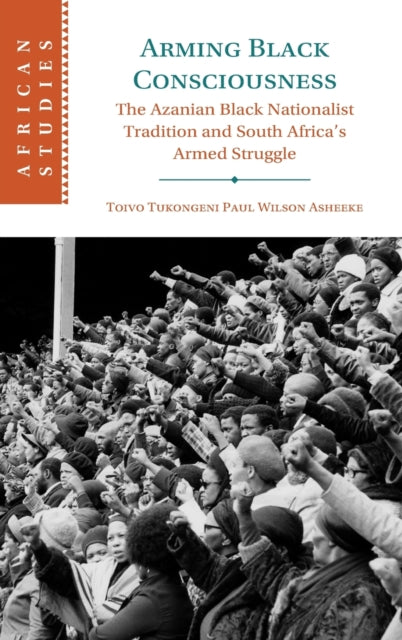
Toivo Tukongeni Paul WilsonAsheeke
Arming Black Consciousness: The Azanian Black Nationalist Tradition and South Africa's Armed Struggle
Arming Black Consciousness: The Azanian Black Nationalist Tradition and South Africa's Armed Struggle
💎 Earn 420 Points (£4.20) on this item.
We can order this item for you. Delivery usually takes about 4 to 6 weeks.
This item is not held in our immediate stock. We will order it for you after checkout.
Estimated delivery: About 4 to 6 weeks
YOU SAVE £4.98
- Condition: Brand new
- UK Delivery times: Usually arrives within 2 - 3 working days
- UK Shipping: Fee starts at £2.39. Subject to product weight & dimension
Bulk ordering. Want 15 or more copies? Get a personalised quote and bigger discounts. Learn more about bulk orders.
Couldn't load pickup availability
- More about Arming Black Consciousness: The Azanian Black Nationalist Tradition and South Africa's Armed Struggle
The ANC has dominated South African politics since 1994, leaving little room for other accounts of the anti-apartheid struggle. Toivo Asheeke's book explores the Black Consciousness Movement (BCM), a militant revolutionary nationalist wing, and its engagement with guerrilla warfare, community feminism, and Black Internationalism, illuminating the history of Africa's decolonization struggle and the Cold War.
Format: Hardback
Length: 308 pages
Publication date: 08 June 2023
Publisher: Cambridge University Press
Since 1994, as the ruling party in South Africa, the ANC has become synonymous with and inseparable from the fight against apartheid rule. This has left little space for competing accounts, visions, and political projects to find their appropriate place in the historical narrative. In this innovative book, Toivo Asheeke moves beyond these well-trodden histories to tell the previously neglected story of the Black Consciousness Movement (BCM), a militant revolutionary nationalist wing of the anti-colonial struggle. Using archival sources from four countries and interviews with former veterans of the movement, Asheeke explores the BCM's engagement with guerrilla warfare, community feminism, and Black Internationalism. Uncovering the personal and political histories of those who have previously received scant scholarly attention, Asheeke both illuminates the history of Africa's decolonization struggle and that of the wider Cold War.
The Black Consciousness Movement (BCM) was a militant revolutionary nationalist wing of the anti-colonial struggle in South Africa. It emerged in the 1960s and 1970s, during a period of intense political and social unrest in the country. The BCM was led by a group of black intellectuals and activists, including Steve Biko, Ahmed Kathrada, and Nelson Mandela. The movement's primary goal was to end apartheid rule and achieve black liberation in South Africa.
One of the key aspects of the BCM's ideology was its rejection of the liberal and socialist ideologies that had been dominant in the anti-apartheid movement. Instead, the BCM advocated for a radical form of nationalism that emphasized the importance of black identity and culture. The movement also believed in the use of armed struggle as a means of achieving its goals, and it launched a number of guerrilla campaigns against the South African government.
The BCM's engagement with guerrilla warfare was a significant part of its history. The movement launched a number of successful guerrilla campaigns against the South African government, including the Soweto Uprising in 1976 and the Sharpeville Massacre in 1960. These campaigns were characterized by their use of armed resistance and their willingness to sacrifice lives in the pursuit of their goals.
Community feminism was also a key aspect of the BCM's ideology. The movement recognized the importance of gender equality and the need to address the oppression of women in South Africa. The BCM advocated for the rights of women, including the right to vote, the right to own property, and the right to education. The movement also launched a number of community-based projects, such as women's shelters and daycare centers, to support women and children in South Africa.
Black Internationalism was another key aspect of the BCM's ideology. The movement recognized the importance of the global struggle against colonialism and imperialism and the need to build international solidarity among black people around the world. The BCM advocated for the recognition of black sovereignty and the right to self-determination and supported the liberation movements in other parts of the world, such as the anti-apartheid movement in Namibia and the anti-colonial movement in Africa.
Despite its successes, the BCM faced a number of challenges in its history. The movement was often criticized by the South African government and its supporters for its use of violence and its radical ideology. The movement also faced internal divisions and conflicts, particularly between those who advocated for a more peaceful approach to achieving black liberation and those who believed in the use of armed struggle.
Despite these challenges, the BCM played a significant role in the history of South Africa and the broader anti-apartheid movement. The movement's advocacy for black identity, gender equality, and international solidarity helped to shape the political and social landscape of South Africa and contributed to the eventual end of apartheid rule in 1994.
In conclusion, the Black Consciousness Movement (BCM) was a militant revolutionary nationalist wing of the anti-colonial struggle in South Africa. The movement's ideology was characterized by its rejection of liberal and socialist ideologies, its emphasis on black identity and culture, its use of armed struggle, and its advocacy for gender equality and international solidarity. The BCM's engagement with guerrilla warfare, community feminism, and Black Internationalism helped to shape the political and social landscape of South Africa and contributed to the eventual end of apartheid rule in 1994.
Weight: 598g
ISBN-13: 9781009346665
UK and International shipping information
UK and International shipping information
UK Delivery and returns information:
- Delivery within 2 - 3 days when ordering in the UK.
- Shipping fee for UK customers from £2.39. Fully tracked shipping service available.
- Returns policy: Return within 30 days of receipt for full refund.
International deliveries:
Shulph Ink now ships to Australia, Belgium, Canada, France, Germany, Ireland, Italy, India, Luxembourg Saudi Arabia, Singapore, Spain, Netherlands, New Zealand, United Arab Emirates, United States of America.
- Delivery times: within 5 - 10 days for international orders.
- Shipping fee: charges vary for overseas orders. Only tracked services are available for most international orders. Some countries have untracked shipping options.
- Customs charges: If ordering to addresses outside the United Kingdom, you may or may not incur additional customs and duties fees during local delivery.