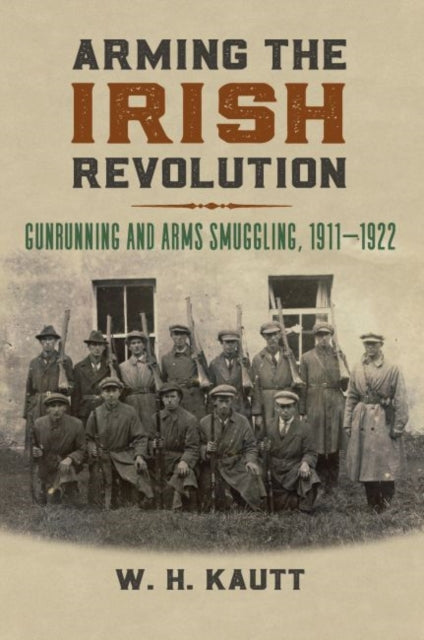
W. H. Kautt
Arming the Irish Revolution: Gunrunning and Arms Smuggling, 1911-1922
Arming the Irish Revolution: Gunrunning and Arms Smuggling, 1911-1922
💎 Earn 261 Points (£2.61) on this item.
YOU SAVE £6.78
- Condition: Brand new
- UK Delivery times: Usually arrives within 2 - 3 working days
- UK Shipping: Fee starts at £2.39. Subject to product weight & dimension
Bulk ordering. Want 15 or more copies? Get a personalised quote and bigger discounts. Learn more about bulk orders.
Couldn't load pickup availability
- More about Arming the Irish Revolution: Gunrunning and Arms Smuggling, 1911-1922
Arming the Irish Revolution is a comprehensive account of the successes and failures of the militant Irish republican efforts to arm themselves,beginning with their predecessors and rivals and examining their efforts at weapons and ammunition manufacturing and bombmaking. It reveals that the ingenuity and resources poured into manufacturing were never able to become a primary source of weapons and ammunition,and that the rebels' greatest limiting factor was that most of their weapons and ammunition had to be imported. The book also explores the full extent of the overseas or foreign arms trade and the arms operations of the War of Independence,and offers observations and conclusions about overall successes and failures.
Format: Hardback
Length: 328 pages
Publication date: 06 September 2021
Publisher: University Press of Kansas
Arming the Irish Revolution is an in-depth investigation of the successes and failures of the militant Irish republican efforts to arm themselves. W. H. Kautts comprehensive account of Irish Republican Army (IRA) arms acquisition begins with its predecessors—the Irish Volunteers and the National Volunteers—and,counterintuitively,with their rivals,the pro-union Ulster Volunteer Force. After the 1916 Rising,Kautt details the functioning of the Quartermaster General Department of the Irish Volunteer General Headquarters in Dublin and basic arms acquisition in the early days of 1918 to 1919. He then closely examines rebel efforts at weapons and ammunition manufacturing and bombmaking and reveals that the ingenuity and resources poured into manufacturing were never able to become a primary source of weapons and ammunition. As the conflict grew in intensity and expanded,the rebels encountered increasing difficulty in obtaining and maintaining supplies of weapons and ammunition since modern weapons in a protracted conflict used more ammunition than previous generations of weapons and their complexity meant that the weapons could not be clandestinely produced within Ireland. Thus,as the rebels conducted campaigns that became difficult to combat,their greatest limiting factor was that most of their weapons and ammunition had to be imported. Arming the Irish Revolution is the first work of research and analysis to explore in detail the Irish work inside Britain to establish arms centers and to conduct arms operations and trafficking. It also examines the full extent of the overseas or foreign arms trade and the arms operations of the War of Independence,including the continuance into the truce and treaty eras and up to the outbreak of the Civil War (1922-1923)—a. Arming the Irish Revolution is an in-depth investigation of the successes and failures of the militant Irish republican efforts to arm themselves. W. H. Kautts comprehensive account of Irish Republican Army (IRA) arms acquisition begins with its predecessors—the Irish Volunteers and the National Volunteers—and,counterintuitively,with their rivals,the pro-union Ulster Volunteer Force. After the 1916 Rising,Kautt details the functioning of the Quartermaster General Department of the Irish Volunteer General Headquarters in Dublin and basic arms acquisition in the early days of 1918 to 1919. He then closely examines rebel efforts at weapons and ammunition manufacturing and bombmaking and reveals that the ingenuity and resources poured into manufacturing were never able to become a primary source of weapons and ammunition. As the conflict grew in intensity and expanded,the rebels encountered increasing difficulty in obtaining and maintaining supplies of weapons and ammunition since modern weapons in a protracted conflict used more ammunition than previous generations of weapons and their complexity meant that the weapons could not be clandestinely produced within Ireland. Thus,as the rebels conducted campaigns that became difficult to combat,their greatest limiting factor was that most of their weapons and ammunition had to be imported. Arming the Irish Revolution is the first work of research and analysis to explore in detail the Irish work inside Britain to establish arms centers and to conduct arms operations and trafficking. It also examines the full extent of the overseas or foreign arms trade and the arms operations of the War of Independence,including the continuance into the truce and treaty eras and up to the outbreak of the Civil War (1922-1923)—a.
Arming the Irish Revolution
is an in-depth investigation of the successes and failures of the militant Irish republican efforts to arm themselves.
W. H. Kautts comprehensive account of Irish Republican Army (IRA) arms acquisition begins with its predecessors—the Irish Volunteers and the National Volunteers—and,counterintuitively,with their rivals,the pro-union Ulster Volunteer Force.
After the 1916 Rising,Kautt details the functioning of the Quartermaster General Department of the Irish Volunteer General Headquarters in Dublin and basic arms acquisition in the early days of 1918 to 1919.
He then closely examines rebel efforts at weapons and ammunition manufacturing and bombmaking and reveals that the ingenuity and resources poured into manufacturing were never able to become a primary source of weapons and ammunition.
As the conflict grew in intensity and expanded,the rebels encountered increasing difficulty in obtaining and maintaining supplies of weapons and ammunition since modern weapons in a protracted conflict used more ammunition than previous generations of weapons and their complexity meant that the weapons could not be clandestinely produced within Ireland.
Thus,as the rebels conducted campaigns that became difficult to combat,their greatest limiting factor was that most of their weapons and ammunition had to be imported.
Arming the Irish Revolution
is the first work of research and analysis to explore in detail the Irish work inside Britain to establish arms centers and to conduct arms operations and trafficking.
It also examines the full extent of the overseas or foreign arms trade and the arms operations of the War of Independence,including the continuance into the truce and treaty eras and up to the outbreak of the Civil War (1922-1923)—a.
Weight: 642g
Dimension: 161 x 240 x 32 (mm)
ISBN-13: 9780700632275
This item can be found in:
UK and International shipping information
UK and International shipping information
UK Delivery and returns information:
- Delivery within 2 - 3 days when ordering in the UK.
- Shipping fee for UK customers from £2.39. Fully tracked shipping service available.
- Returns policy: Return within 30 days of receipt for full refund.
International deliveries:
Shulph Ink now ships to Australia, Belgium, Canada, France, Germany, Ireland, Italy, India, Luxembourg Saudi Arabia, Singapore, Spain, Netherlands, New Zealand, United Arab Emirates, United States of America.
- Delivery times: within 5 - 10 days for international orders.
- Shipping fee: charges vary for overseas orders. Only tracked services are available for most international orders. Some countries have untracked shipping options.
- Customs charges: If ordering to addresses outside the United Kingdom, you may or may not incur additional customs and duties fees during local delivery.