Malcolm Miles
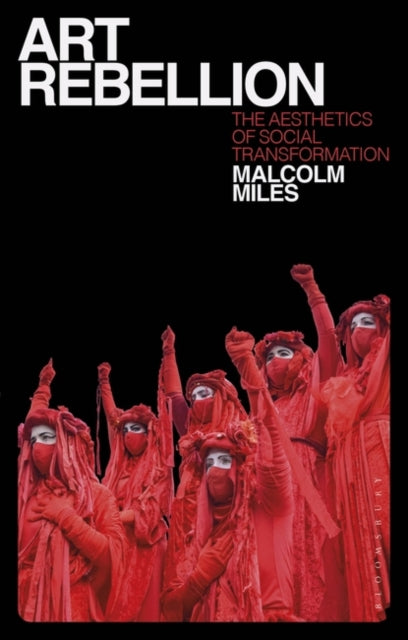
Art Rebellion: The Aesthetics of Social Transformation
Art Rebellion: The Aesthetics of Social Transformation
💎 Earn 101 Points (£1.01) on this item.
YOU SAVE £2.65
- Condition: Brand new
- UK Delivery times: Usually arrives within 2 - 3 working days
- UK Shipping: Fee starts at £2.39. Subject to product weight & dimension
Bulk ordering. Want 15 or more copies? Get a personalised quote and bigger discounts. Learn more about bulk orders.
Couldn't load pickup availability
- More about Art Rebellion: The Aesthetics of Social Transformation
Art has always been central to moments of great social change, and Malcolm Miles offers a guide to contemporary art and activism that explores the rise of direct action, anti-institutional art practices, and the theoretical innovations of the last 50 years. He argues that beauty is radically other to the dominant society, power relations can be transformed, protest cultures and contemporary art grow together, and art has a crucial interruptive role in forming new, more equal and just realities.
Format: Paperback / softback
Length: 232 pages
Publication date: 26 January 2023
Publisher: Bloomsbury Publishing PLC
Art has always been central to moments of great social change. From the avant-garde to the ages of revolution, the act of rebellious creation has been crucial to bringing people and ideas together. However, in an increasingly fractured world characterized by upheaval and crisis, what role can art play in ushering in transformation? Malcolm Miles offers a guide to contemporary art and activism, setting it firmly within the context of the avant-garde and its legacies in the postwar period. He explores the rise of direct action to replace representational politics in organizations like Occupy and Extinction Rebellion, and in the movements to destroy or remove statues of slavers, and finds parallels in anti-institutional art practices. By engaging with the significant theoretical innovations of the last 50 years — modernism, postmodernism, and contemporary critical thinking — Miles provides both an overview of political aesthetics and an introduction to how art activism works in its most memorable moments in history. Art Rebellion argues that beauty is radically other to the dominant society; that power relations can be transformed; that protest cultures and contemporary art grow together; and that art has a crucial interruptive role in forming new, more equal, and just realities.
Art Rebellion: The Power of Art in Social Change
Art has always been central to moments of great social change. From the avant-garde to the ages of revolution, the act of rebellious creation has been crucial to bringing people and ideas together. However, in an increasingly fractured world characterized by upheaval and crisis, what role can art play in ushering in transformation?
Malcolm Miles offers a guide to contemporary art and activism, setting it firmly within the context of the avant-garde and its legacies in the postwar period. He explores the rise of direct action to replace representational politics in organizations like Occupy and Extinction Rebellion, and in the movements to destroy or remove statues of slavers, and finds parallels in anti-institutional art practices. By engaging with the significant theoretical innovations of the last 50 years — modernism, postmodernism, and contemporary critical thinking — Miles provides both an overview of political aesthetics and an introduction to how art activism works in its most memorable moments in history.
The Role of Art in Rebellion
Art Rebellion argues that beauty is radically other to the dominant society; that power relations can be transformed; that protest cultures and contemporary art grow together; and that art has a crucial interruptive role in forming new, more equal, and just realities.
Miles explores the ways in which art can challenge dominant narratives and power structures, and how it can create a sense of belonging and community. He also examines the role of art in promoting social justice and equality, and how it can be used to address issues such as climate change, inequality, and discrimination.
The Legacy of the Avant-Garde
The avant-garde has had a significant impact on contemporary art and activism. It has challenged traditional notions of art and has paved the way for new forms of expression and creativity. Miles explores the legacies of the avant-garde in the postwar period, including the emergence of conceptual art, performance art, and social sculpture.
Conceptual art, for example, has challenged the idea of art as a static object and has instead focused on the idea of art as a process. Performance art has challenged the idea of art as a passive spectator and has instead focused on the idea of art as a participatory experience. Social sculpture has challenged the idea of art as a separate entity and has instead focused on the idea of art as a social and political tool.
The Role of Art in Activism
Art activism has become an increasingly important tool in the fight for social justice and equality. It has been used to raise awareness about issues, to mobilize people, and to bring about change. Miles explores the different forms of art activism, including street art, graffiti, and performance art.
Street art has been used to create public spaces that are more accessible and inclusive, to challenge dominant narratives, and to promote social justice. Graffiti has been used to create a sense of belonging and community, to challenge authority, and to promote social justice. Performance art has been used to create a sense of urgency and to challenge power structures.
Conclusion
Art has always been central to moments of great social change. From the avant-garde to the ages of revolution, the act of rebellious creation has been crucial to bringing people and ideas together. However, in an increasingly fractured world characterized by upheaval and crisis, what role can art play in ushering in transformation? Malcolm Miles offers a guide to contemporary art and activism, setting it firmly within the context of the avant-garde and its legacies in the postwar period. He explores the rise of direct action to replace representational politics in organizations like Occupy and Extinction Rebellion, and in the movements to destroy or remove statues of slavers, and finds parallels in anti-institutional art practices. By engaging with the significant theoretical innovations of the last 50 years — modernism, postmodernism, and contemporary critical thinking — Miles provides both an overview of political aesthetics and an introduction to how art activism works in its most memorable moments in history.
Weight: 302g
Dimension: 214 x 138 x 22 (mm)
ISBN-13: 9781350239982
This item can be found in:
UK and International shipping information
UK and International shipping information
UK Delivery and returns information:
- Delivery within 2 - 3 days when ordering in the UK.
- Shipping fee for UK customers from £2.39. Fully tracked shipping service available.
- Returns policy: Return within 30 days of receipt for full refund.
International deliveries:
Shulph Ink now ships to Australia, Belgium, Canada, France, Germany, Ireland, Italy, India, Luxembourg Saudi Arabia, Singapore, Spain, Netherlands, New Zealand, United Arab Emirates, United States of America.
- Delivery times: within 5 - 10 days for international orders.
- Shipping fee: charges vary for overseas orders. Only tracked services are available for most international orders. Some countries have untracked shipping options.
- Customs charges: If ordering to addresses outside the United Kingdom, you may or may not incur additional customs and duties fees during local delivery.