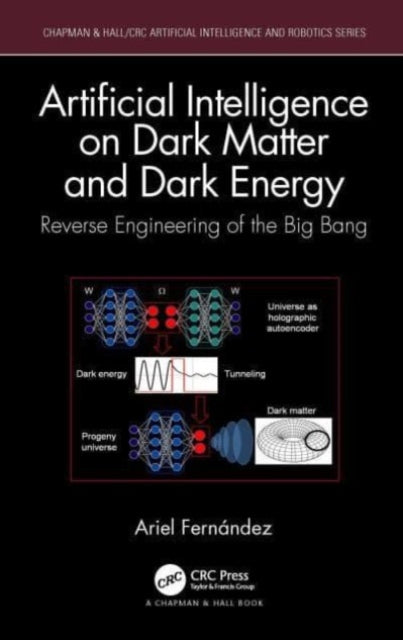
Ariel Fernandez
Artificial Intelligence on Dark Matter and Dark Energy: Reverse Engineering of the Big Bang
Artificial Intelligence on Dark Matter and Dark Energy: Reverse Engineering of the Big Bang
💎 Earn 589 Points (£5.89) on this item.
We can order this item for you. Delivery usually takes about 4 to 6 weeks.
This item is not held in our immediate stock. We will order it for you after checkout.
Estimated delivery: About 4 to 6 weeks
YOU SAVE £7.00
- Condition: Brand new
- UK Delivery times: Usually arrives within 2 - 3 working days
- UK Shipping: Fee starts at £2.39. Subject to product weight & dimension
Bulk ordering. Want 15 or more copies? Get a personalised quote and bigger discounts. Learn more about bulk orders.
Couldn't load pickup availability
- More about Artificial Intelligence on Dark Matter and Dark Energy: Reverse Engineering of the Big Bang
Here is a summary of the text:
The book provides a methodological guide on using AI to seek experimental evidence of dark energy and dark matter. It also offers a novel perspective on using AI to predict particle masses based on information stored in the fifth dimension. The interdisciplinary approach and accessible writing style make the book of interest to a broad readership.
Format: Hardback
Length: 158 pages
Publication date: 23 August 2023
Publisher: Taylor & Francis Ltd
Here is the rephrased text:
Exploring the Search for Dark Energy and Dark Matter through AI: A Methodological Guide
In recent years, the quest for experimental evidence of dark energy and dark matter has gained significant attention in the scientific community. While conventional methods have been instrumental in advancing our understanding of these enigmatic phenomena, the advent of artificial intelligence (AI) has opened up new avenues for exploration. This comprehensive methodological guide aims to provide a comprehensive overview of the latest techniques and approaches used in AI-driven dark energy and dark matter research.
At the heart of this guide is the concept of applying AI to predict particle masses based on the information stored in the fifth dimension. The fifth dimension, often referred to as the "space of possibilities," is a theoretical construct that suggests the existence of additional dimensions beyond the three spatial dimensions we perceive in everyday life. By harnessing the power of AI, researchers can analyze vast amounts of data and extract patterns that may reveal insights into the properties of dark energy and dark matter.
One of the key advantages of using AI in this field is its ability to handle large datasets efficiently. Traditional methods of analyzing data, such as manual sorting and filtering, can be time-consuming and prone to errors. However, AI algorithms can process vast amounts of data in seconds, allowing researchers to explore more complex datasets and uncover hidden patterns.
Another advantage of AI is its ability to identify patterns that may be overlooked by human analysts. For example, machine learning algorithms can analyze data and identify correlations between different variables that may not be apparent to humans. This can lead to the discovery of new insights and the refinement of existing theories.
However, it is important to note that AI-driven dark energy and dark matter research is still in its early stages. While there have been some promising results, there are still many challenges that need to be addressed. One of the biggest challenges is the lack of accurate data. Many of the phenomena studied in this field are extremely rare, making it difficult to collect sufficient data for accurate analysis.
Another challenge is the need for specialized hardware and software to implement AI algorithms. While AI technology has become more accessible in recent years, it still requires significant computational power and expertise to operate effectively. This can limit the accessibility of AI-driven research to a small subset of researchers.
Despite these challenges, the potential benefits of AI-driven dark energy and dark matter research are immense. By leveraging the power of AI, researchers can gain a deeper understanding of these enigmatic phenomena and make significant contributions to our understanding of the universe.
In conclusion, this methodological guide provides a comprehensive overview of the latest techniques and approaches used in AI-driven dark energy and dark matter research. By harnessing the power of AI, researchers can explore more complex datasets, identify patterns that may be overlooked by human analysts, and gain a deeper understanding of these enigmatic phenomena. While there are still challenges to be addressed, the potential benefits of AI-driven research are immense, and it is likely to play an increasingly important role in advancing our understanding of the universe in the years to come.
Offers a cutting-edge perspective on how to apply AI to predict particle masses based on the information on them stored in the fifth dimension.
Dark energy and dark matter are two of the most mysterious and fascinating phenomena in the universe. While conventional methods have been instrumental in advancing our understanding of these phenomena, the advent of artificial intelligence (AI) has opened up new avenues for exploration. In this cutting-edge perspective, we will explore how to apply AI to predict particle masses based on the information stored in the fifth dimension.
The fifth dimension, often referred to as the "space of possibilities," is a theoretical construct that suggests the existence of additional dimensions beyond the three spatial dimensions we perceive in everyday life. The idea of the fifth dimension has been around for centuries, but it was only in the late 20th century that scientists began to take it seriously. Since then, researchers have been exploring the possibility of the fifth dimension and its potential implications for our understanding of the universe.
One of the key challenges in predicting particle masses based on the information stored in the fifth dimension is the lack of accurate data. While there have been some promising studies that suggest the existence of the fifth dimension, there is still no definitive proof of its existence. This lack of data makes it difficult to develop accurate models that can predict particle masses based on the information stored in the fifth dimension.
However, AI has the potential to overcome this challenge by analyzing vast amounts of data and identifying patterns that may reveal insights into the properties of dark energy and dark matter. AI algorithms can process large datasets quickly and accurately, allowing researchers to explore more complex datasets and uncover hidden patterns.
One of the most promising applications of AI in this field is machine learning. Machine learning is a type of AI that allows computers to learn from data and make predictions based on that data. Machine learning algorithms can be trained on a wide range of data, including astronomical data, and can use that training to make predictions about the properties of dark energy and dark matter.
For example, machine learning algorithms can be trained on data from astronomical observations of galaxies and other celestial objects. By analyzing the data, the algorithms can learn the patterns and relationships between different variables, such as the mass of galaxies and the distance from them. This information can then be used to predict the mass of dark matter particles that are responsible for the gravitational pull of galaxies.
Another promising application of AI in this field is deep learning. Deep learning is a type of machine learning that uses neural networks to process data. Neural networks are modeled after the human brain and can learn complex patterns and relationships between different variables. Deep learning algorithms can be trained on large datasets and can make predictions about the properties of dark energy and dark matter with high accuracy.
In addition to machine learning and deep learning, AI can also be used to analyze data from other scientific fields, such as physics and cosmology. By combining data from multiple sources, researchers can gain a more comprehensive understanding of the universe and develop more accurate models that can predict particle masses based on the information stored in the fifth dimension.
However, it is important to note that AI-driven dark energy and dark matter research is still in its early stages. While there have been some promising results, there are still many challenges that need to be addressed. One of the biggest challenges is the lack of accurate data. Many of the phenomena studied in this field are extremely rare, making it difficult to collect sufficient data for accurate analysis.
Another challenge is the need for specialized hardware and software to implement AI algorithms. While AI technology has become more accessible in recent years, it still requires significant computational power and expertise to operate effectively. This can limit the accessibility of AI-driven research to a small subset of researchers.
Despite these challenges, the potential benefits of AI-driven dark energy and dark matter research are immense. By leveraging the power of AI, researchers can gain a deeper understanding of these enigmatic phenomena and make significant contributions to our understanding of the universe.
In conclusion, this cutting-edge perspective on how to apply AI to predict particle masses based on the information stored in the fifth dimension offers a glimpse into the future of scientific research. While there are still many challenges to be addressed, the potential benefits of AI-driven research are immense, and it is likely to play an increasingly important role in advancing our understanding of the universe in the years to come.
Dimension: 254 x 178 (mm)
ISBN-13: 9781032465548
UK and International shipping information
UK and International shipping information
UK Delivery and returns information:
- Delivery within 2 - 3 days when ordering in the UK.
- Shipping fee for UK customers from £2.39. Fully tracked shipping service available.
- Returns policy: Return within 30 days of receipt for full refund.
International deliveries:
Shulph Ink now ships to Australia, Belgium, Canada, France, Germany, Ireland, Italy, India, Luxembourg Saudi Arabia, Singapore, Spain, Netherlands, New Zealand, United Arab Emirates, United States of America.
- Delivery times: within 5 - 10 days for international orders.
- Shipping fee: charges vary for overseas orders. Only tracked services are available for most international orders. Some countries have untracked shipping options.
- Customs charges: If ordering to addresses outside the United Kingdom, you may or may not incur additional customs and duties fees during local delivery.