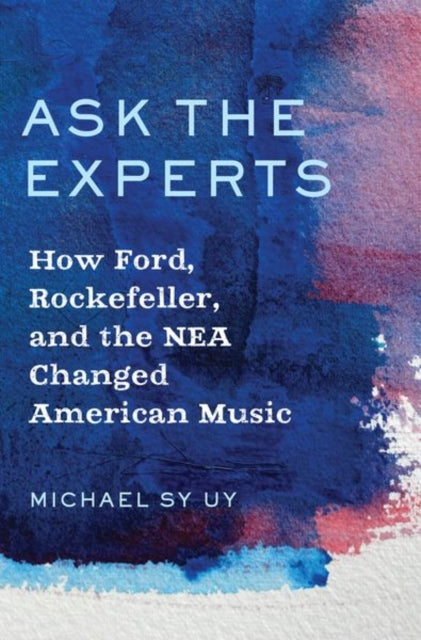
Michael SyUy
Ask the Experts: How Ford, Rockefeller, and the NEA Changed American Music
Ask the Experts: How Ford, Rockefeller, and the NEA Changed American Music
💎 Earn 404 Points (£4.04) on this item.
YOU SAVE £0.19
- Condition: Brand new
- UK Delivery times: Usually arrives within 2 - 3 working days
- UK Shipping: Fee starts at £2.39. Subject to product weight & dimension
Bulk ordering. Want 15 or more copies? Get a personalised quote and bigger discounts. Learn more about bulk orders.
Couldn't load pickup availability
- More about Ask the Experts: How Ford, Rockefeller, and the NEA Changed American Music
The National Endowment for the Arts, the Rockefeller Foundation, and the Ford Foundation granted close to $300 million in the field of music from the end of the Second World War through the U.S. Bicentennial. They recruited music composers at elite institutions, professors from prestigious universities, and leaders of performing arts organizations to decide what to fund. This history demonstrates how expertise served as an exclusionary form of cultural and social capital that prevented racial minorities and non-dominant groups from fully participating.
\n Format: Hardback
\n Length: 272 pages
\n Publication date: 22 October 2020
\n Publisher: Oxford University Press Inc
\n
From the end of the Second World War through the U.S. Bicentennial, the National Endowment for the Arts, the Rockefeller Foundation, and the Ford Foundation granted close to $300 million (approximately $2.3 billion in 2017 dollars) in the field of music alone. In deciding what to fund, these three grantmaking institutions decided to ask the experts, adopting seemingly objective, scientific models of peer review and specialist evaluation. They recruited music composers at elite institutions, professors from prestigious universities, and leaders of performing arts organizations. Among the most influential expert-consultants were Leonard Bernstein, Aaron Copland, Lukas Foss, and Milton Babbitt. The significance was two-fold: not only were male, Western art composers put in charge of directing large and unprecedented channels of public and private funds, but in doing so they also determined and defined what was meant by artistic excellence. They decided the fate of their peers and shaped the direction of music-making in this country. By asking the experts, the grantmaking institutions produced a concentrated and interconnected field of artists and musicians. Officers and directors utilized ostensibly objective financial tools like matching grants and endowments in an attempt to diversify and stabilize applicants' sources of funding, as well as the number of applicants they funded. Such economics-based strategies, however, relied more on personal connections among the wealthy and elite, rather than local community citizens. Ultimately, this history demonstrates how expertise served as an exclusionary form of cultural and social capital that prevented racial minorities and non-dominant groups from fully participating.
From the end of the Second World War through the U.S. Bicentennial, the National Endowment for the Arts, the Rockefeller Foundation, and the Ford Foundation granted close to $300 million (approximately $2.3 billion in 2017 dollars) in the field of music alone. In deciding what to fund, these three grantmaking institutions decided to ask the experts, adopting seemingly objective, scientific models of peer review and specialist evaluation. They recruited music composers at elite institutions, professors from prestigious universities, and leaders of performing arts organizations. Among the most influential expert-consultants were Leonard Bernstein, Aaron Copland, Lukas Foss, and Milton Babbitt. The significance was two-fold: not only were male, Western art composers put in charge of directing large and unprecedented channels of public and private funds, but in doing so they also determined and defined what was meant by artistic excellence. They decided the fate of their peers and shaped the direction of music-making in this country. By asking the experts, the grantmaking institutions produced a concentrated and interconnected field of artists and musicians. Officers and directors utilized ostensibly objective financial tools like matching grants and endowments in an attempt to diversify and stabilize applicants' sources of funding, as well as the number of applicants they funded. Such economics-based strategies, however, relied more on personal connections among the wealthy and elite, rather than local community citizens. Ultimately, this history demonstrates how expertise served as an exclusionary form of cultural and social capital that prevented racial minorities and non-dominant groups from fully participating.
\n Weight: 548g\n
Dimension: 165 x 242 x 25 (mm)\n
ISBN-13: 9780197510445\n \n
This item can be found in:
UK and International shipping information
UK and International shipping information
UK Delivery and returns information:
- Delivery within 2 - 3 days when ordering in the UK.
- Shipping fee for UK customers from £2.39. Fully tracked shipping service available.
- Returns policy: Return within 30 days of receipt for full refund.
International deliveries:
Shulph Ink now ships to Australia, Belgium, Canada, France, Germany, Ireland, Italy, India, Luxembourg Saudi Arabia, Singapore, Spain, Netherlands, New Zealand, United Arab Emirates, United States of America.
- Delivery times: within 5 - 10 days for international orders.
- Shipping fee: charges vary for overseas orders. Only tracked services are available for most international orders. Some countries have untracked shipping options.
- Customs charges: If ordering to addresses outside the United Kingdom, you may or may not incur additional customs and duties fees during local delivery.