Jack Saunders
Assembling Cultures: Workplace Activism, Labour Militancy and Cultural Change in Britain's Car Factories, 1945-82
Assembling Cultures: Workplace Activism, Labour Militancy and Cultural Change in Britain's Car Factories, 1945-82
💎 Earn 225 Points (£2.25) on this item.
YOU SAVE £39.86
- Condition: Brand new
- UK Delivery times: Usually arrives within 2 - 3 working days
- UK Shipping: Fee starts at £2.39. Subject to product weight & dimension
Bulk ordering. Want 15 or more copies? Get a personalised quote and bigger discounts. Learn more about bulk orders.
Couldn't load pickup availability
- More about Assembling Cultures: Workplace Activism, Labour Militancy and Cultural Change in Britain's Car Factories, 1945-82
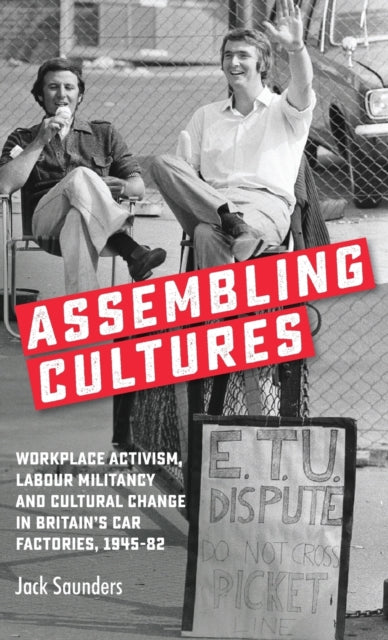
In British political discourse, the idea that trade unions ran the country in the 1970s has become a truism. However, Assembling Cultures reveals that car manufacturing was a key case for unpicking important narratives around affluence, declinism, and class. It traces the development of the militant car worker stereotype and looks at the real social relations that lay behind car manufacturing's reputation for conflict. The book reveals a changing, complex world of social practices, cultural norms, and shared values and expectations. It is invaluable to lecturers and students studying the history, sociology, and politics of post-war Britain, particularly those with an interest in power, rationality, class, labor, gender, and race.
Format: Hardback
Length: 312 pages
Publication date: 09 May 2019
Publisher: Manchester University Press
In the realm of British political discourse, the notion that trade unions wielded significant power in the country during the 1970s has solidified into a widely accepted truism, often employed as a cautionary tale against the dangers of socialism and strikes. However, the question of who precisely held sway in Britain's workplaces and under what conditions remains a complex and multifaceted inquiry.
To delve into this subject, Assembling Cultures offers a detailed examination of factory activism within the motor industry between 1945 and 1982. By focusing on car manufacturing as a pivotal case study, the book aims to unravel the intricate narratives surrounding affluence, decline, and class. It traces the evolution of the militant car worker stereotype and delves into the underlying social relations that shaped car manufacturing's reputation for conflict. Through this comprehensive analysis, the book unveils a dynamic and evolving world of social practices, cultural norms, and shared values and expectations.
In the post-war period, car workers embarked on a journey of organizational development, creating shop-floor organizations that wielded considerable authority. This newfound power allowed some workers to assert their demands and pursue more radical political objectives. However, it also imposed constraints on others who sought to push the boundaries of their activism. Assembling Cultures meticulously documents this historic process, shedding light on how groups and individuals sought to establish and reproduce collective power. It poses the crucial question of what this meant for the lives of these workers and their place within the power dynamics of post-war Britain.
This book holds immense value for lecturers and students engaged in the study of post-war Britain's history, sociology, and politics. Its detailed analysis of the generation of solidarity, organization, and collective action provides valuable insights into the complex power relations of this era. Particularly, those with interests in power, rationality, class, labor, gender, and race will find this book to be a rich resource. The book's comprehensive approach to understanding the dynamics of factory activism will also be of great interest to trade union activists, as it offers valuable lessons and strategies for building and sustaining collective power in today's workplaces.
In conclusion, Assembling Cultures is a groundbreaking work that offers a fresh perspective on the history of factory activism in Britain. By delving into the complex interplay of social, cultural, and economic factors, the book sheds light on the changing world of work and the power dynamics that shaped it. It is a must-read for anyone interested in understanding the past and shaping the future of labor movements and social activism.
Weight: 506g
Dimension: 218 x 154 x 28 (mm)
ISBN-13: 9781526133397
UK and International shipping information
UK and International shipping information
UK Delivery and returns information:
- Delivery within 2 - 3 days when ordering in the UK.
- Shipping fee for UK customers from £2.39. Fully tracked shipping service available.
- Returns policy: Return within 30 days of receipt for full refund.
International deliveries:
Shulph Ink now ships to Australia, Belgium, Canada, France, Germany, Ireland, Italy, India, Luxembourg Saudi Arabia, Singapore, Spain, Netherlands, New Zealand, United Arab Emirates, United States of America.
- Delivery times: within 5 - 10 days for international orders.
- Shipping fee: charges vary for overseas orders. Only tracked services are available for most international orders. Some countries have untracked shipping options.
- Customs charges: If ordering to addresses outside the United Kingdom, you may or may not incur additional customs and duties fees during local delivery.